Computer Networks · Module 8 — Network Security & Wireless Basics
Wi-Fi basics
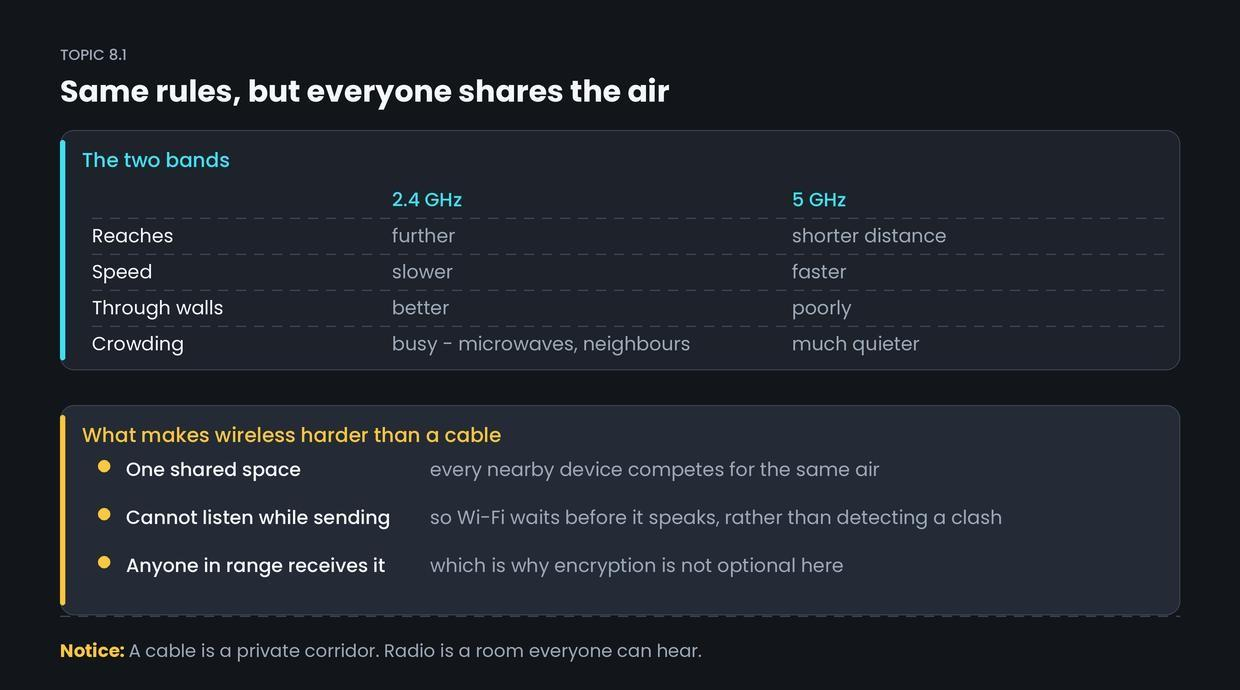
A cable is a private corridor. Radio is a room where everybody can hear everybody.
Sign in to track your score
Aisha's Wi-Fi is fine at her desk and useless in the corridor. Nothing about the network changed. Only the distance did.
Why & what
Why wireless is a different problem. A cable is a private corridor. Radio is a room where everybody can hear everybody.
That one difference causes the rest.
- Every nearby device competes for the same air.
- Any device in range receives your signal, meant for them or not.
- Walls and distance weaken it, so speed drops as you walk away.
What the words mean.
- SSID — the network's name, announced constantly by the access point. HostelNet-3F is one.
- Band — which slice of radio spectrum is used: 2.4 GHz or 5 GHz.
- Channel — a narrower slot inside a band. Two nearby APs on the same channel interfere.
- CSMA/CA — Carrier Sense Multiple Access with Collision Avoidance, the rule for taking turns.
The two bands.
| 2.4 GHz | 5 GHz | |
|---|---|---|
| Reaches | further | shorter distance |
| Speed | slower | faster |
| Through walls | better | poorly |
| Crowding | busy | much quieter |
Why CA and not CD. Wired Ethernet used CSMA/CD — Collision Detection. A device could listen while transmitting and notice a clash.
A radio cannot. Its own transmission drowns out everything else. So Wi-Fi avoids collisions instead: listen first, and if the air is busy, wait a random moment and retry.
How it works
- The access point broadcasts its SSID so devices know it is there.
- Aisha's laptop associates and authenticates with the password.
- Both sides agree encryption keys — WPA2 or WPA3 on any modern network.
- Before sending, her laptop listens. If the air is busy, it waits a random moment.
- When clear, it sends. Everything after this is identical to a cable: same frames, same IP packets.
Common confusion
Students think 5 GHz is simply better than 2.4 GHz. Actually, 5 GHz is faster but travels less far and is stopped more easily by walls.
At her desk, 5 GHz wins easily. Two walls away in the corridor, 2.4 GHz may be the only band still working. In radio, faster and further are a trade-off, not a ranking.
Interview angle
Asked as: "Why does Wi-Fi use CSMA/CA instead of CSMA/CD?" This is the wireless question that actually gets asked.
Model answer:
Wired Ethernet could detect collisions because a device can listen on the wire while transmitting. A radio cannot — its own transmission is far stronger than anything it would hear, so collisions are undetectable at the sender. So Wi-Fi avoids them instead: sense whether the channel is idle, wait a random backoff if busy, then transmit. The other differences follow from radio being shared everyone in range competes for the air and everyone in range receives the signal, which is why WPA2 or WPA3 is standard rather than optional.
- 1.
What does SSID mean?
- 2.
Why does Wi-Fi use collision avoidance rather than detection?
- 3.
Compared with 2.4 GHz, the 5 GHz band is
- 4.
Two access points near each other on the same channel will