Computer Networks · Module 2 — Network Types, Topologies & Devices
Topologies: bus, star, ring, mesh, hybrid
The devices are the same in every case. What changes is the wiring pattern, and that pattern decides three practical things.
Sign in to track your score
Ten laptops in a lab, and one loose cable. Whether that kills one laptop or the entire lab depends only on how the cables were arranged.
Why & what
Why shape matters. The devices are the same in every case. What changes is the wiring pattern, and that pattern decides three practical things.
- How much cable you have to buy.
- What stops working when one cable or one device fails.
- How easy it is to plug in a new device later.
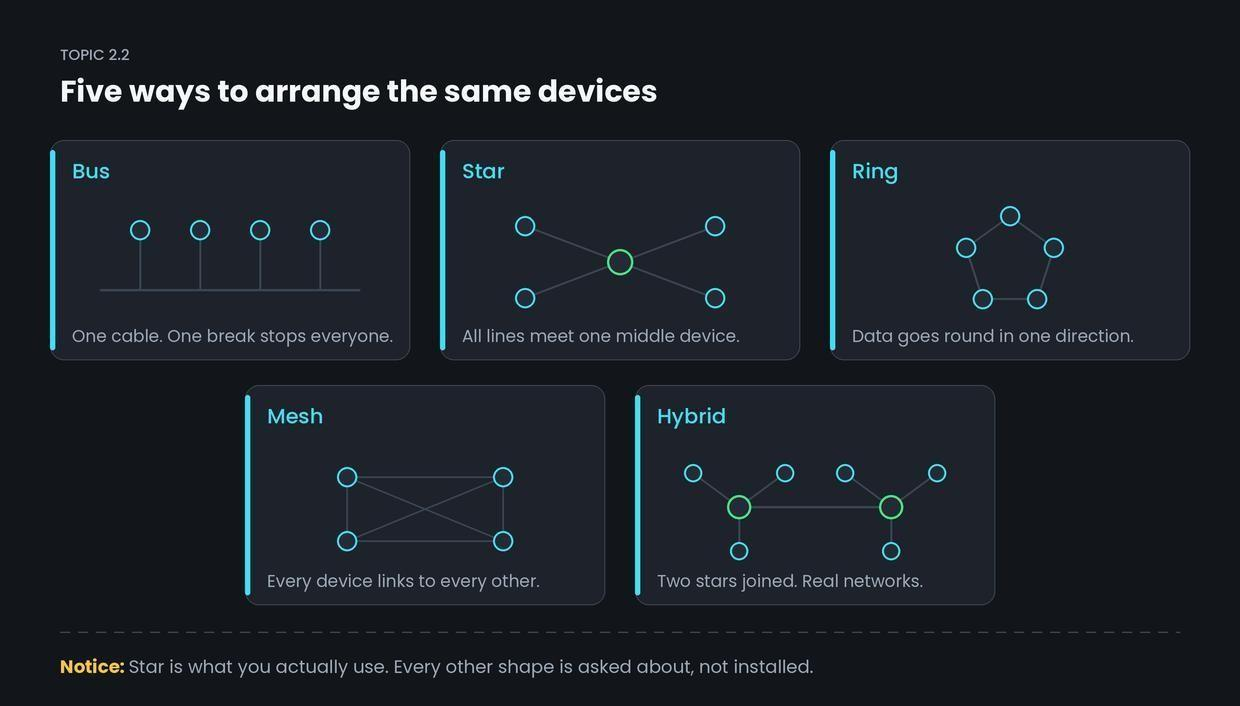
What a topology is. A topology is the layout — the shape in which devices are connected. The five you must know:
- Bus — everyone taps into one shared cable. Cheapest. One break kills the whole line.
- Star — every device has its own cable to one middle device. One broken cable kills only that device.
- Ring — each device connects to the next, forming a loop. Data travels round in one direction.
- Mesh — every device links directly to every other. Extremely reliable, extremely expensive.
- Hybrid — a mix. Real networks are almost always this.
For mesh, the cable count is n(n−1)/2. For 10 devices that is 45 links. That is why nobody wires a lab this way.
How it works
To judge any topology, run these four checks.
- Cable cost — how many links for n devices? Bus needs 1 shared line, star needs n, mesh needs n(n−1)/2.
- Single point of failure — what one break takes everything down? Bus: the main cable. Star: the middle device.
- Adding a device — star and mesh let you add without touching anyone else. Bus and ring need the line opened.
- Traffic — on a bus, only one device can talk at a time. On a star with a switch, many pairs talk at once.
Common confusion
Students think star topology has no single point of failure, because only bus has that problem. Actually, the middle device in a star is a single point of failure too.
The real difference is what a cable break does.
- Bus: one cable break stops everyone.
- Star: one cable break stops one device.
But if the middle switch dies in a star, the whole star is down. Star wins because that middle box is one cheap thing you can swap, not because the weakness disappeared.
Interview angle
Asked as: "Which topology would you choose and why?" or "How many cables does a mesh with n nodes need?"
Model answer:
Star, in almost every real case. Each device gets its own cable to a central switch, so one bad cable affects only one device, and adding a new device does not disturb the rest. Its weakness is that the central device is a single point of failure, so in critical setups you add a second switch. Bus is cheapest but one cable break stops everyone, and only one device can transmit at a time. Mesh is the most reliable but needs n(n−1)/2 links, so it is used only for small critical backbones. Most real networks are hybrid — stars joined together.
- 1.
How many direct links does a full mesh of 6 devices need?
- 2.
In a star topology, one device's cable is cut. What happens?
- 3.
Which topology has the whole network fail if the main shared cable breaks?
- 4.
Why is star used in real buildings despite having a single point of failure?