Computer Networks · Module 1 — Foundations: Why Networks Exist
How data actually travels: packets, bandwidth, latency, throughput
Imagine sending the whole results page as one solid block. Two problems appear at once.
Sign in to track your score
Your video call is smooth, but the 2 GB download crawls. Same Wi-Fi, same room, same moment. Two different things are being measured, and people mix them up constantly.
Why & what
Why packets exist. Imagine sending the whole results page as one solid block. Two problems appear at once.
- While your block is on the line, nobody else can send anything. One big download would freeze the hostel.
- If one bit is damaged halfway, the entire block is ruined and must be sent again.
So we cut data into small pieces. Small pieces take turns, so everyone gets a share. And if one piece breaks, you resend that one piece, not the whole file.
What a packet is. A packet is a small chunk of data with a label attached.
The label is called the header. It carries:
- who sent it (source address)
- who it is for (destination address)
- which piece number this is
The actual chunk of your file is the payload. Header plus payload is the packet.
The three speed words. Picture a water pipe.
- Bandwidth — how wide the pipe is. The maximum it could ever carry. Measured in Mbps (megabits per second).
- Latency — how long one drop takes to travel from one end to the other. Measured in ms (milliseconds). Often called ping.
- Throughput — how much water actually comes out, right now, with everyone else also using the pipe.
Bandwidth is the ceiling. Throughput is reality. Latency is the wait.
Why throughput is always lower than bandwidth. Three things eat into it, every time.
- Sharing. Forty students are on HostelNet-3F. The pipe is split between all of them.
- Overhead. Every packet carries a header. Those header bytes use the pipe but are not your file.
- Resends. Anything lost has to be sent a second time, using the pipe twice for the same data.
So a 50 Mbps plan delivering 22 Mbps is not a fault. It is normal.
How it works
- The server cuts the 60 KB page into pieces — say four packets.
- Each packet gets a header: source, destination, and its number.
- The packets travel out. They may take different routes and arrive out of order.
- Aisha's laptop checks what arrived. If packet 3 is missing, it asks for packet 3 again only that one.
- The laptop sorts them by number and joins them back into the original page.
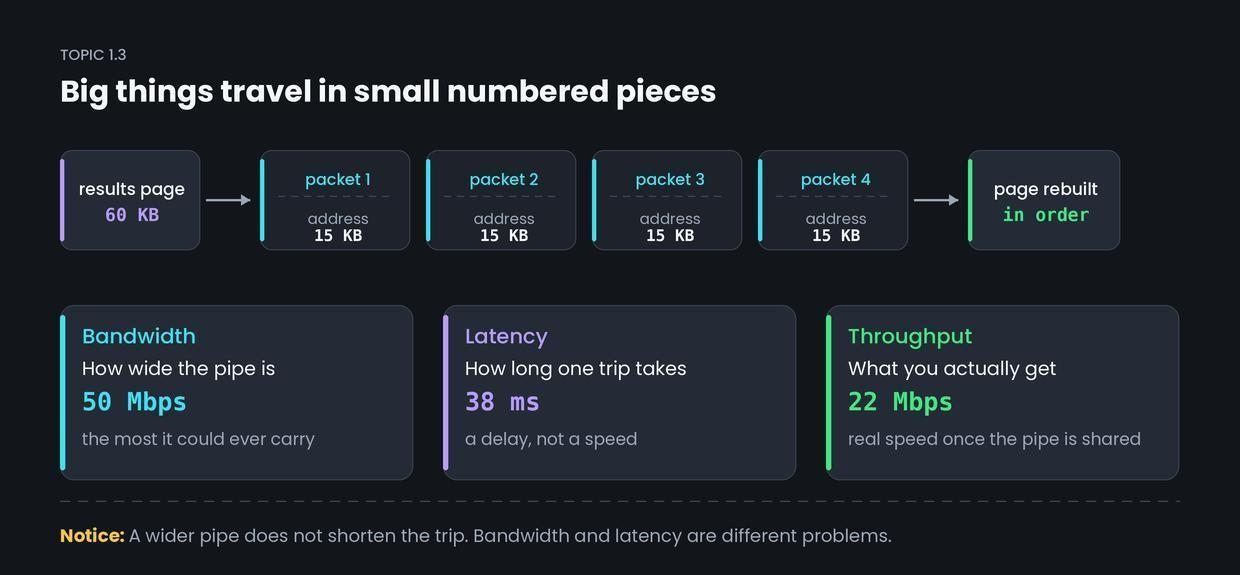
The top row is the whole life of your page: cut up, sent, rebuilt. The bottom row is the part interviewers poke at. Read the three values across: 50 Mbps possible, 38 ms per trip, 22 Mbps actually delivered.
Common confusion
Students think more bandwidth means lower ping. Actually, bandwidth and latency are unrelated. Widening a pipe does not shorten it.
A 1 Gbps connection to a server in the US still has ~250 ms latency, because the data physically has to cross an ocean and pass through many devices on the way. That is why a video call (which needs low latency) can stutter on the same link where a download (which needs high bandwidth) runs fine.
Rough rule: downloads want bandwidth, live calls and games want low latency.
Interview angle
Asked as: "Why is data sent in packets?" and "Difference between bandwidth, throughput and latency?" Both are extremely common in first-round screening.
Answer:
Data is broken into packets so the link can be shared. Small pieces take turns, so one large transfer does not block everyone else. It also makes errors cheap — if one packet is damaged, only that packet is resent, not the whole file. Each packet carries a header with source, destination and a sequence number, so the receiver can reorder them and spot what is missing. Bandwidth is the maximum capacity of the link. Latency is the delay for one trip, measured in milliseconds. Throughput is the actual data rate you get in practice, which is always at or below bandwidth because of congestion, errors and overhead. Adding bandwidth does not reduce latency — distance and the number of hops decide that.
- 1.
A packet is made of
- 2.
Packet 3 of 4 is lost on the way. What gets resent?
- 3.
Your plan says 100 Mbps but you measure 40 Mbps. The 40 is your
- 4.
Downloads are fast, but your online game keeps lagging. The likely problem is