Computer Networks · Module 6 — Transport Layer
Ports and sockets
An IP address identifies a machine. That is all it does.
Sign in to track your score
Aisha has a browser, a music app and a chat window open at once. All three are downloading data. All three arrive at the same IP address. Nothing gets mixed up.
Why & what
Why ports exist. An IP address identifies a machine. That is all it does.
But a machine runs many programs at once. When a packet lands on 192.168.1.42, the operating system has to decide: is this for the browser, the music app, or the chat window?
The IP address cannot answer that. So a second number is added — one that identifies the program, not the machine.
What a port is. A port is a 16-bit number that identifies one program on a machine. Range: 0 to 65535.
They come in three groups.
- 0 – 1023, well-known ports. Fixed by agreement. Every web server in the world listens on 443, so your browser never has to ask.
- 1024 – 4G151, registered ports. Assigned to particular software.
- 4G152 – 65535, ephemeral ports. Your own machine picks one at random for each outgoing connection. Aisha's browser picked 51520 back in Module 5.
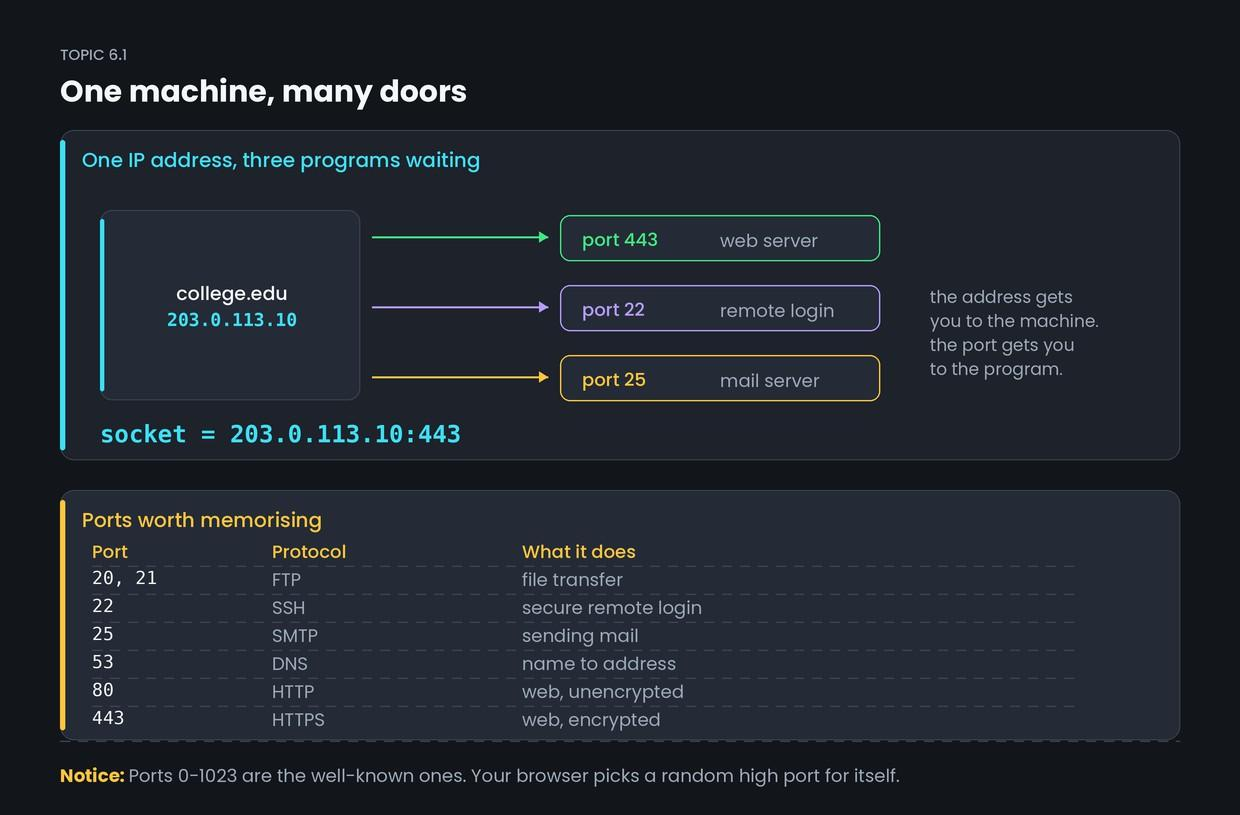
What a socket is. A socket is an IP address and port together: 203.0.113.10:443.
One socket alone does not identify a conversation. A conversation is identified by four things the source IP, source port, destination IP and destination port. This is called the 4-tuple.
That is why Aisha can open five tabs to the same website. Same destination socket every time, but a different source port for each tab, so all five stay separate.
Ports worth memorising: 20/21 FTP, 22 SSH, 25 SMTP, 53 DNS, 80 HTTP, 443 HTTPS.
How it works
- college.edu starts its web server, which binds to port 443 and waits.
- Aisha's browser picks a free ephemeral port, 51520, for this connection.
- It sends a segment to 203.0.113.10:443 with 192.168.1.42:51520 as the source.
- The server's operating system sees port 443 in the header and hands the data to the web server, not the mail server.
- The reply is addressed back to port 51520, so Aisha's OS hands it to the browser and not the music app.
Common confusion
Students think a port is something physical, like the socket you plug a cable into. Actually, a port is just a number in the segment header. Nothing physical exists.
The confusion is made worse by the word "socket", which in networking means an IP-and-port pair, not a hole in a wall. Nothing is opened or plugged in. The operating system simply keeps a list saying "port 443 belongs to this program", and reads the number off each arriving segment.
Interview angle
Asked as: "What is a port?" and "What is a socket?" Often followed by "which port does HTTPS use?"
Model answer:
A port is a 16-bit number in the transport header that identifies which program on a machine the data is for. The IP address gets the packet to the machine; the port gets it to the right process. Ports 0 to 1023 are well-known and fixed by convention, like 80 for HTTP, 443 for HTTPS, 22 for SSH and 53 for DNS. Clients use random high-numbered ephemeral ports for their side of a connection. A socket is an IP address and port together. A connection is actually identified by four values source IP, source port, destination IP and destination port which is how one machine can hold many simultaneous connections to the same server.
- 1.
How many bits is a port number?
- 2.
Which port does HTTPS use?
- 3.
A socket is
- 4.
Aisha opens three tabs to the same website. What keeps the three connections apart?