Computer Networks · Module 3 — Layered Models
The TCP/IP model, and OSI vs TCP/IP
OSI was designed by a committee as an ideal. TCP/IP was built by engineers who needed something to run, and it shipped first.
Sign in to track your score
The internet was built and working before OSI was finished. It never used OSI's seven layers. It uses four.
Why & what
Why there are two models. OSI was designed by a committee as an ideal. TCP/IP was built by engineers who needed something to run, and it shipped first.
So we ended up with one model that is better for explaining, and one that is better for describing what your laptop is actually doing. You need both, because interviewers use both.
What the four TCP/IP layers are.
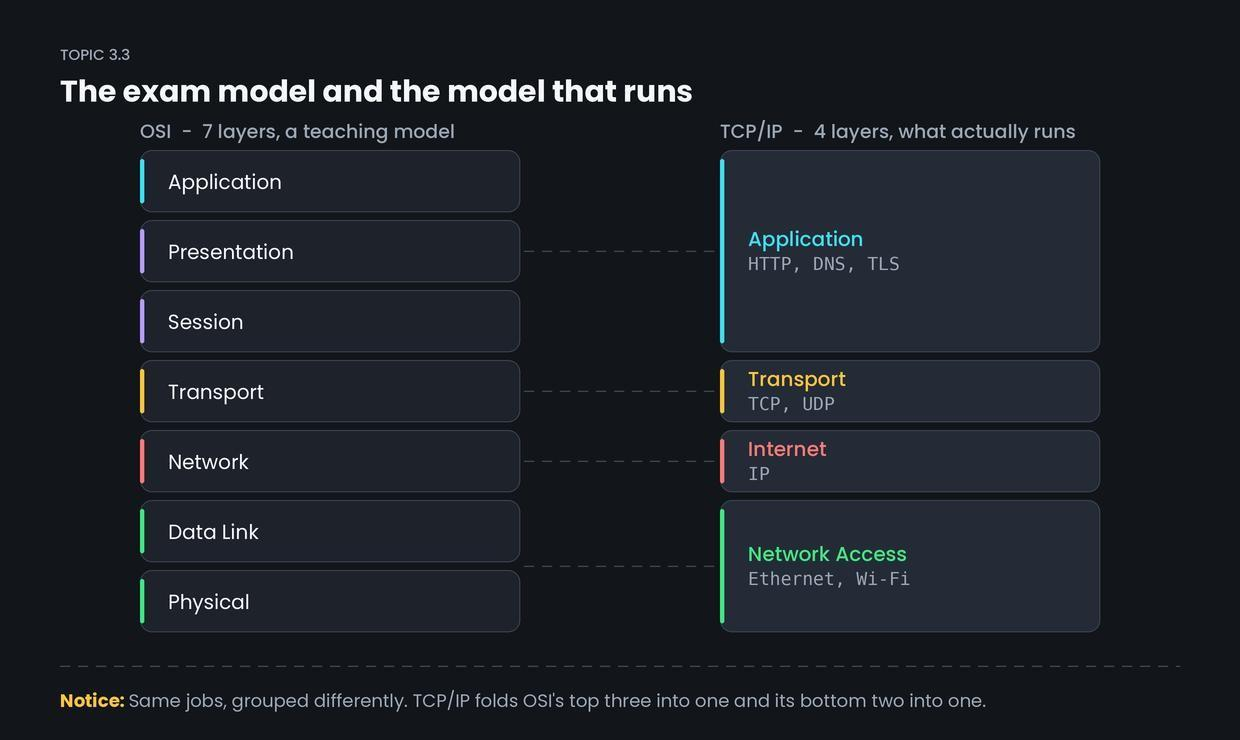
- Application : everything the app deals with. Covers OSI layers 7, 6 and 5 in one. HTTP, DNS, TLS.
- Transport : end-to-end delivery and ports. Same as OSI layer 4. TCP and UDP.
- Internet : addressing and routing. Same as OSI layer 3. IP.
- Network Access : getting data across one physical link. Covers OSI layers 2 and 1. Ethernet, Wi-Fi.
Note the name: TCP/IP's third layer is called Internet, not Network. Exams like that detail.
The differences that get asked:
- OSI has 7 layers; TCP/IP has 4.
- OSI separates Session and Presentation; TCP/IP folds them into Application.
- OSI separates Data Link and Physical; TCP/IP folds them into Network Access.
- OSI was defined first and protocols came later; in TCP/IP the protocols came first and the model described them.
How it works
To map any layer between the two models:
- Is it about what the app says, its format, or its session? → TCP/IP Application.
- Is it about ports, or making sure the whole thing arrived? → Transport.
- Is it about IP addresses or picking a route? → Internet.
- Is it about MAC addresses, cables, or radio? → Network Access.
Common confusion
Students think TCP/IP dropped the session and presentation layers, so those jobs do not happen. Actually, those jobs still happen. They just happen inside the application.
When Aisha loads an HTTPS page, encryption absolutely takes place — that is OSI's presentation layer job. In TCP/IP it is simply counted as part of the Application layer, because the browser and its TLS library do it, not the operating system. The work did not disappear. Only the label did.
Interview angle
Asked as: "Difference between the OSI and TCP/IP models?" Near-guaranteed in college placement rounds.
Model answer:
OSI has seven layers, TCP/IP has four. TCP/IP combines OSI's Application, Presentation and Session into a single Application layer, and combines Data Link and Physical into Network Access. Transport maps directly, and OSI's Network layer is called Internet in TCP/IP. The bigger difference is origin. OSI was specified first as a reference model and protocols were meant to follow. TCP/IP's protocols existed first and the model was written to describe them, which is why it is what actually runs on the internet. OSI is better for teaching and troubleshooting layer by layer; TCP/IP is what real systems implement.
- 1.
How many layers does the TCP/IP model have?
- 2.
OSI's Session and Presentation layers map to which TCP/IP layer?
- 3.
What is TCP/IP's third layer called?
- 4.
Which statement is true?