Computer Networks · Module 1 — Foundations: Why Networks Exist
Client, server, and the request–response idea
Data has to live somewhere. Your results are not on your laptop — if they were, you could edit them. They sit on one machine the college controls, and thousands of students read from it.
Sign in to track your score
You type college.edu/results and hit Enter. For half a second nothing happens — then the whole page appears. Something out there heard you.
Why & what
Why this exists. Data has to live somewhere. Your results are not on your laptop — if they were, you could edit them. They sit on one machine the college controls, and thousands of students read from it.
So we need a clear split: one side that asks, and one side that keeps the data and answers.
What it is.
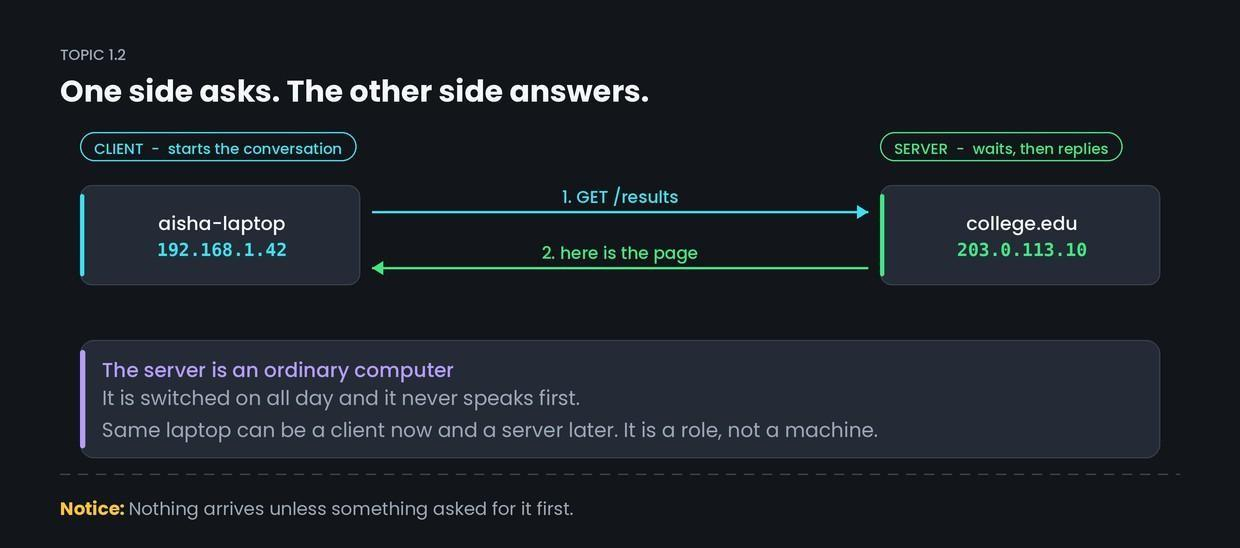
- A client is the side that starts the conversation and asks for something. Your browser is a client.
- A server is the side that sits waiting and answers when asked. The machine holding the results page is the server.
- A request is the message that goes out. A response is what comes back.
This whole arrangement is called the client–server model.
The key rule: the server never speaks first. It waits. Always.
How it works
- Aisha types the address. Her browser becomes the client.
- Her laptop opens a connection to the server at 203.0.113.10.
- It sends a request: what it wants (/results) and where to send the reply (192.168.1.42).
- The server reads the request, fetches the page, and builds a response.
- The response travels back to 192.168.1.42, and the browser draws it on screen.
Common confusion
Students think a server is a special, expensive, giant machine. Actually, "server" is a role, not a type of machine.
Any computer running software that waits and answers is a server. Your own laptop becomes a server the moment you start a local project on port 3000. The same laptop is a client in the browser tab next to it.
One more arrangement is worth naming: peer-to-peer (P2P), where every device is both client and server — torrents, or sharing files directly over Wi-Fi. No fixed middle machine.
Interview angle
Asked as: "Explain the client–server model" or "Difference between client–server and peer-to-peer."
Answer:
In the client–server model one side requests and the other responds. The client starts every conversation; the server waits and answers. The server holds the data, so it stays consistent for everyone. Server is a role, not hardware — one machine can be a client for one task and a server for another. In peer-to-peer there is no fixed server; every node is both. Client–server is easier to secure and control, peer-to-peer has no single point of failure.
- 1.
Which side always starts the conversation?
- 2.
"Server" is best described as
- 3.
Which statement is true of peer-to-peer?
- 4.
In our case study, which address belongs to the server?