Computer Networks · Module 9 — Interview Capstone
Rapid fire and the confusion table
Interviewers use quick questions to calibrate. They are not looking for depth — they are checking whether the basics are automatic or whether you are reconstructing them each time.
Sign in to track your score
The first two minutes of a networking round are usually short questions with short answers.
Hesitating on "which port is HTTPS" costs more than getting a hard question slightly wrong.
Why & what
Why rapid fire exists. Interviewers use quick questions to calibrate. They are not looking for depth — they are checking whether the basics are automatic or whether you are reconstructing them each time.
Answers should take two seconds. Not because speed is impressive, but because hesitation on a definition suggests you learned it last night.
The facts that must be instant.
| Question | Answer |
|---|---|
| Port for HTTP / HTTPS | 80 / 443 |
| Port for DNS / SSH / SMTP | 53 / 22 / 25 |
| Port for DHCP | 67 server, 68 client |
| Bits in IPv4 / IPv6 | 32 / 128 |
| Bits in a MAC address | 48 |
| Ethernet — MTU | 1500 bytes |
| TCP / UDP header size | 20 / 8 bytes |
| Usable hosts in a /26 | 62 |
| Router / switch / hub layer | 3 / 2 / 1 |
| PDU at network / data link layer | packet / frame |
| Layers in OSI / TCP-IP | 7 / 4 |
| Default route | 0.0.0.0/0 |
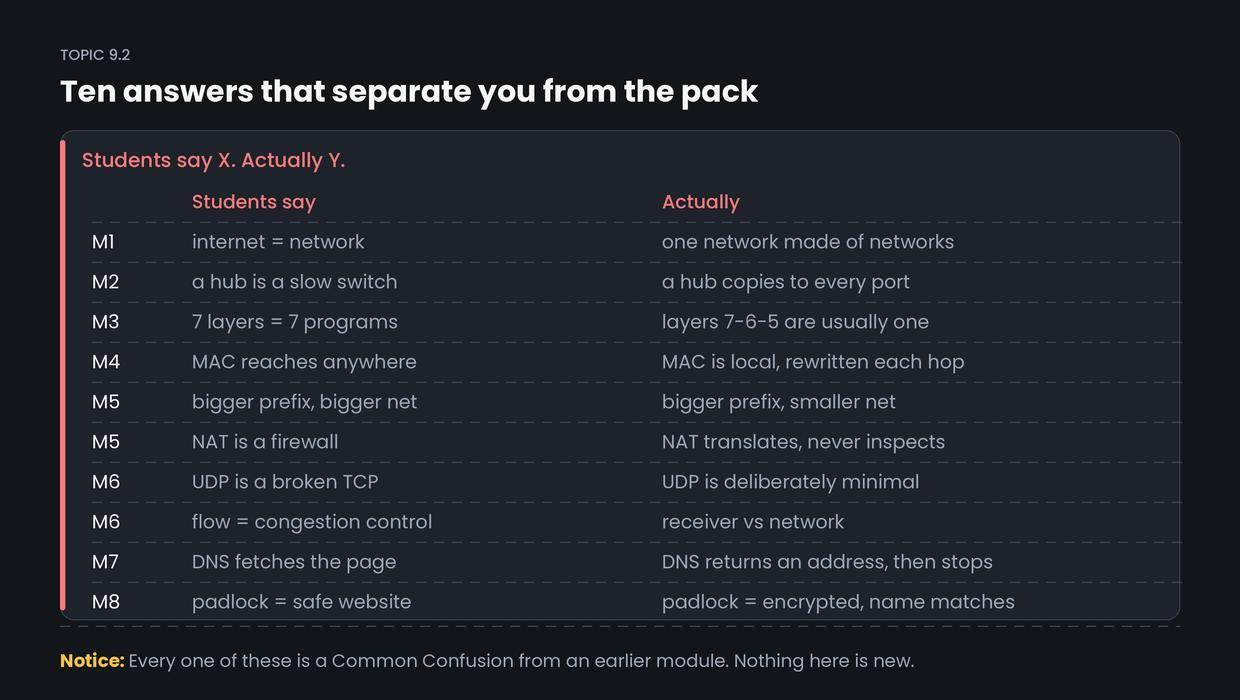
The confusion table. These ten are the Common Confusions from every module, in one place. Each one is a point where a weak answer and a strong answer diverge.
| From | Students say | Actually |
|---|---|---|
| M1 | internet = network | one network made of networks |
| M2 | a hub is a slow switch | a hub copies to every port |
| M3 | 7 layers means 7 programs | layers 7, 6 and 5 are usually one |
| M4 | MAC addresses reach anywhere | MAC is local, rewritten every hop |
| M5 | bigger prefix, bigger network | bigger prefix, smaller network |
| M5 | NAT is a firewall | NAT translates, never inspects |
| M6 | UDP is a broken TCP | UDP is deliberately minimal |
| M6 | flow control = congestion control | receiver vs network |
| M7 | DNS fetches the page | DNS returns an address, then stops |
| M8 | the padlock means the site is safe it | means encrypted, and the name matches |
How it works
How to use this topic as practice.
- Cover the answer column of the fact table. Say each answer out loud. Anything that takes more than two seconds goes on a list.
- Do the same with the confusion table, but say the correction, not the mistake.
- For any correction you cannot explain in one sentence, reread that module's Common Confusion section.
- Repeat until both tables are automatic.
- Then stop revising facts. Once these are instant, extra revision on them adds nothing put the time into 9.1 and 9.3 instead.
Common confusion
Students think rapid-fire answers should be padded out to sound thorough. Actually, a short question wants a short answer, and padding reads as uncertainty.
Asked "which port does SSH use?", the answer is "22". Not "I think it is 22, though it can be configured differently, and some people move it to 2222 for security." All of that is true and none of it was asked. Answer the question, stop, and let them ask the follow-up. Volunteering caveats to a one-word question makes a confident fact sound like a guess.
Interview angle
Asked as: a burst of six to ten short questions with no pauses. The scoring is on hesitation as much as accuracy.
Model answer: the fact table above, said without thinking.
- 1.
Which ports does DHCP use?
- 2.
What is the PDU at the data link layer?
- 3.
How many usable hosts does a /26 provide?
- 4.
Asked "which port is HTTPS?", the best answer is