Computer Networks · Module 8 — Network Security & Wireless Basics
Firewall, VPN and proxy
Each solves a different problem. Home routers bundle all three, which is exactly why they get confused.
Sign in to track your score
Three boxes that sit between you and the internet. Students name all three when asked about any one of them.
Why & what
Why they exist. Each solves a different problem. Home routers bundle all three, which is exactly why they get confused.
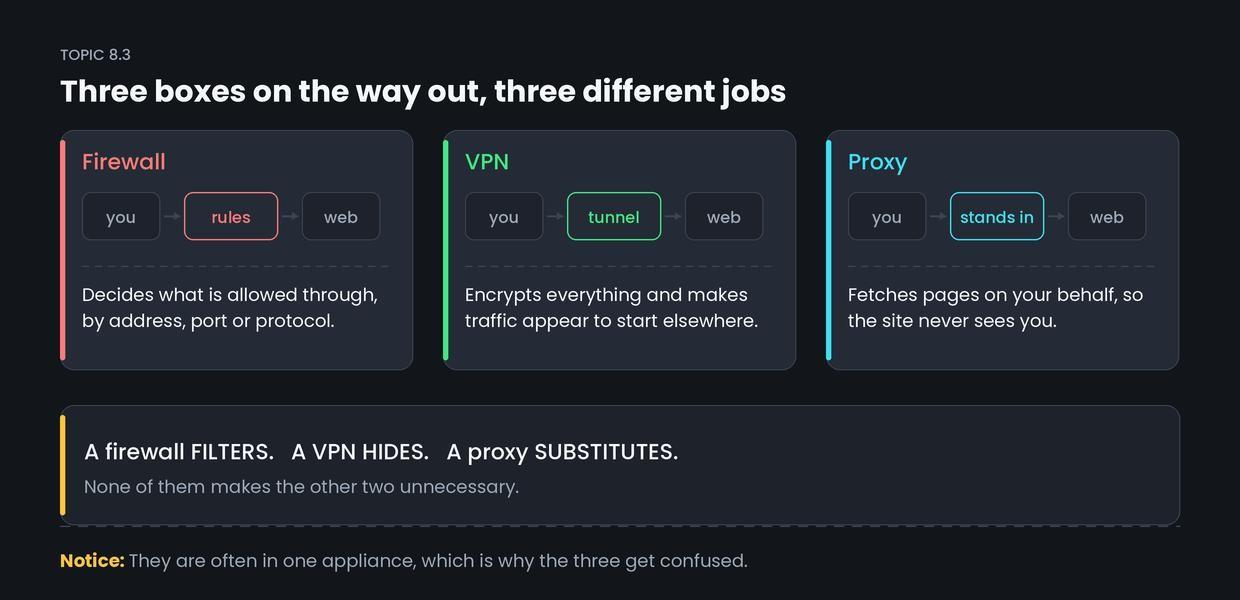
Firewall — decides what is allowed. A firewall inspects traffic and permits or blocks it by rules: address, port, protocol or direction. Blocking all inbound traffic on port 22 is a firewall rule.
Modern firewalls are stateful — they remember that Aisha started a conversation, allow the reply, and block anything unsolicited.
VPN — hides and relocates. A VPN (Virtual Private Network) builds an encrypted tunnel from your device to a VPN server, and all traffic goes through it. The hostel network and AirLink see only encrypted traffic to one address. Websites see the VPN server's address, not 103.21.58.7. Proxy — speaks on your behalf. A proxy fetches things for you. Aisha asks the proxy, the proxy asks the website, the answer returns the same way, and the website sees the proxy. Unlike a VPN, a proxy usually covers one application and often encrypts nothing.
How it works
- Aisha's request leaves her laptop.
- A firewall in the way decides by its rules whether the packet passes at all.
- With a VPN on, the packet is encrypted and wrapped for the tunnel first, so the hostel network cannot see the destination.
- With a proxy configured, her browser asks the proxy, and the proxy makes its own request to college.edu.
- The reply returns through whichever were used, in reverse.
Common confusion
Students think a VPN makes you anonymous. Actually, a VPN moves who can see you. It does not remove them.
The hostel network and AirLink can no longer see where Aisha goes. The VPN provider now can every request passes through them, decrypted at their end. The website still knows it is being visited, still sets cookies, and still recognises her if she logs in.
A VPN shifts trust from your network operator to your VPN operator. Real benefit on untrusted Wi-Fi. Not invisibility.
Interview angle
Asked as: "Difference between a firewall, a VPN and a proxy?" Give the one-line version for each first, then a detail.
Model answer:
A firewall filters — it checks traffic against rules on address, port and protocol and allows or blocks it. Stateful ones track existing connections, so replies are allowed while unsolicited inbound traffic is not. A VPN encrypts — an encrypted tunnel to a VPN server, so the local network cannot see the destination and websites see the VPN's address. It covers all traffic from the device. A proxy substitutes — it requests on your behalf, so the destination sees the proxy.
Usually per-application, and often unencrypted. They are complementary, not alternatives.
- 1.
A stateful firewall differs from a simple one because it
- 2.
With a VPN in use, what does the hostel network see?
- 3.
The main difference between a proxy and a VPN is
- 4.
Which statement about VPNs is accurate?