Computer Networks · Module 9 — Interview Capstone
Mock drill and self-check
Everything so far has been read. But interviews are spoken, and speaking exposes things reading hides — you lose your place, you use a word you cannot define, you realise mid-sentence that you do not actually know why ARP is needed.
Sign in to track your score
Reading a model answer and saying one are different skills. The gap between them only closes by talking out loud, badly, several times.
Why & what
Why speaking is the missing practice. Everything so far has been read. But interviews are spoken, and speaking exposes things reading hides — you lose your place, you use a word you cannot define, you realise mid-sentence that you do not actually know why ARP is needed.
Those failures are the point. Better to find them now.
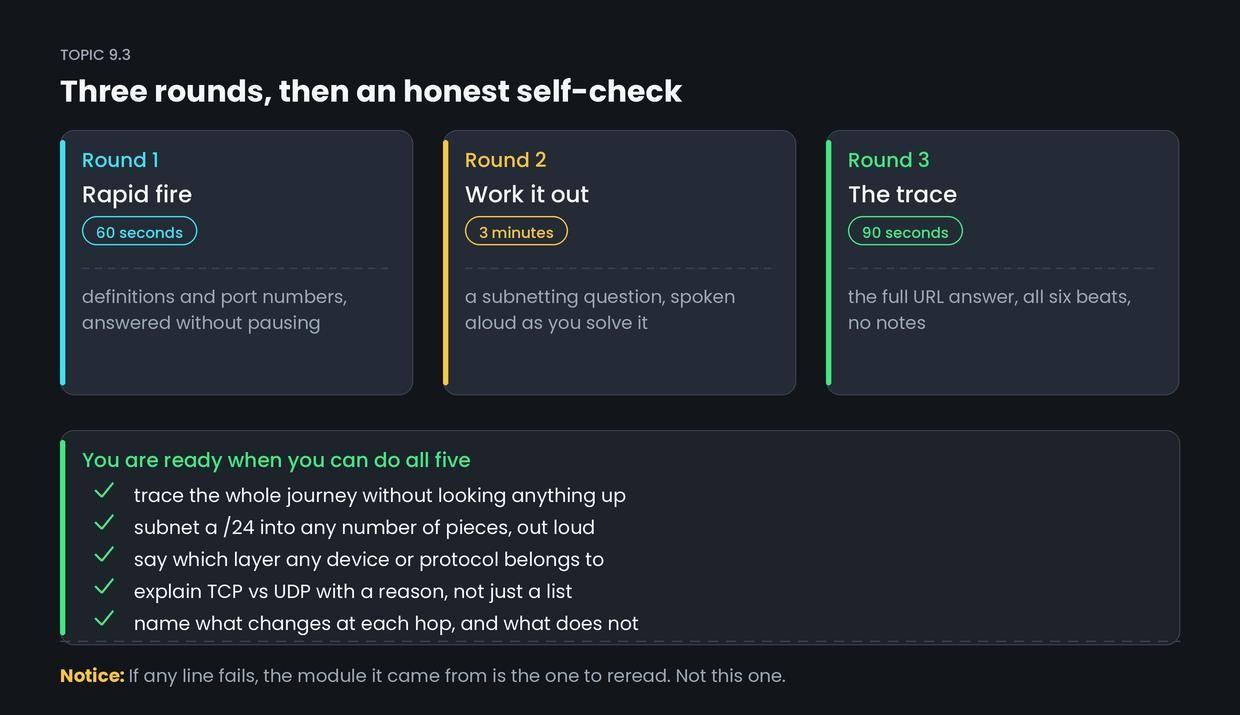
What the drill is. Three rounds, about five minutes total. Do it with a friend, or into your phone's voice recorder.
- Round 1 — rapid fire, 60 seconds. Definitions and port numbers from 9.2, answered without pausing.
- Round 2 — work it out, 3 minutes. A subnetting question, solved out loud while you work. Split 192.168.1.0/24 into 8, or find which subnet 192.168.1.200/27 belongs to.
- Round 3 — the trace, G0 seconds. The full six-beat answer from 9.1, no notes.
Round 2 matters more than it looks. Interviewers who give you a subnetting problem are watching your method, not waiting for the number. Silence while you calculate tells them nothing. Narrating tells them everything.
How it works
- Record yourself doing all three rounds without stopping, even when you stumble. Stopping to restart hides the problem.
- Play it back. Mark every place you paused for more than two seconds, and every term you used but could not have defined.
- Each mark points at one module. Go back to that module, not to this one.
- Redo the drill the next day, not the same hour. Sleep is what turns a reread into recall.
- Stop when the recording is boring — steady, unhurried, no repair sentences.
The self-check. You are ready when you can do all five:
- trace the whole journey without looking anything up
- subnet a /24 into any number of pieces, out loud
- say which layer any device or protocol belongs to
- explain TCP vs UDP with a reason, not just a list
- name what changes at each hop, and what does not
Common confusion
Students think more rereading is what fixes a shaky answer. Actually, rereading builds recognition, and interviews test recall.
Rereading Module 5 makes subnetting feel familiar, which feels like progress. But familiarity is not the same as being able to produce the answer from nothing, and the difference only shows up when someone is watching.
One spoken attempt teaches you more about your gaps than three rereads. Do the drill badly first, then reread the specific thing that broke.
Interview angle
Asked as: this topic is the practice, not a question. But the habit it builds — narrating your reasoning while you work — is scored in every technical round you will ever sit.
If you go blank in a real interview, say what you do know and work outward. "I know the destination is not local, so it has to go to the gateway — and to build the frame I need the gateway's MAC, which means ARP." Reasoning out loud from something certain is far better than silence, and interviewers frequently give partial credit for method alone.
- 1.
Why does Round 2 ask you to solve subnetting out loud?
- 2.
You pause for five seconds on "what is the MTU?" during the drill. What should you do?
- 3.
Why is rereading a weaker preparation than speaking?
- 4.
You go blank mid-answer in a real interview. Best move