Computer Networks · Module 2 — Network Types, Topologies & Devices
LAN, MAN, WAN, PAN
Networks are grouped by how far they reach. Distance is not a detail. It changes everything about the network.
Sign in to track your score
Your earbuds connect to your phone with no Wi-Fi and no internet. That is a network too. Just a very small one.
Why & what
Why these names exist. Networks are grouped by how far they reach. Distance is not a detail. It changes everything about the network.
- A short network can use your own cheap cable.
- A long network needs cable across public land, which you cannot own.
So we split networks by reach, and each name tells you roughly who owns the wires.
What each one is.
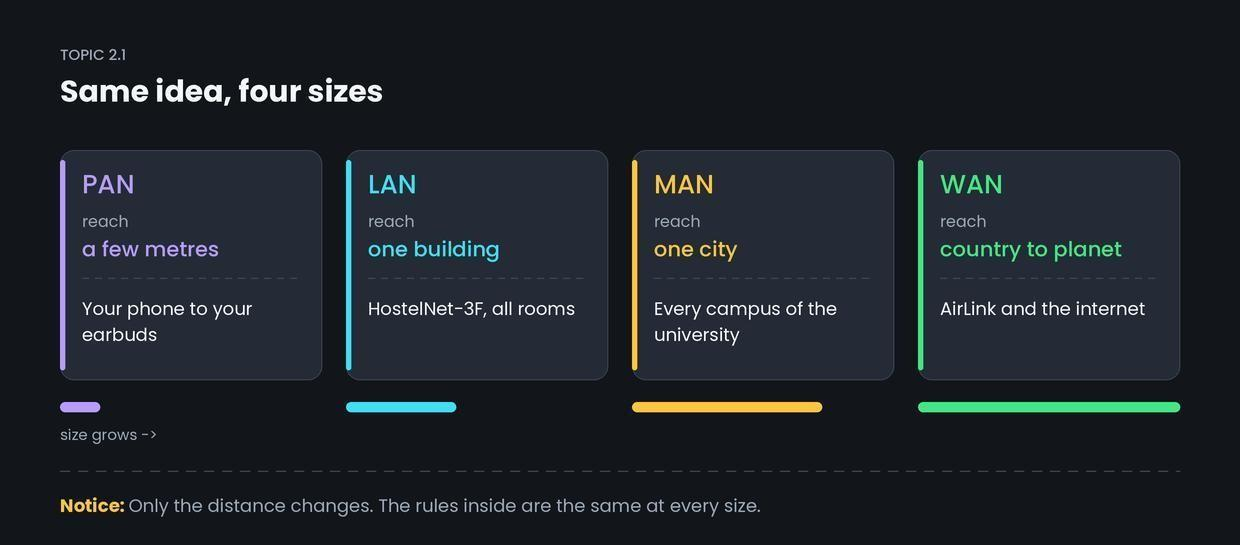
- PAN (Personal Area Network) — a few metres, around one person. Phone to earbuds, laptop to mouse.
- LAN (Local Area Network) — one building or campus. HostelNet-3F is a LAN. You own the equipment.
- MAN (Metropolitan Area Network) — one city. All campuses of the university joined together.
- WAN (Wide Area Network) — city to country to planet. AirLink's long-distance lines. The internet is the largest WAN there is.
One more you will hear: WLAN (Wireless LAN). It is just a LAN using radio instead of cable. Wi-Fi is a WLAN.
How it works
To label any network you see, ask four things in order.
- How far does it reach — metres, a building, a city, or further?
- Who owns the cable — you, your college, or a telecom company?
- Metres and one person means PAN. One building means LAN. One city means MAN. Anything wider means WAN.
- If it uses radio instead of wire, add a W in front: WLAN.
Common confusion
Students think LAN means fast and WAN means slow. Actually, the labels describe distance and ownership, not speed.
A modern WAN link between two data centres can be far faster than an old college LAN. The reason WANs often feel slower is distance and hops, which is latency the thing you met in Topic 1.3.
Interview angle
Asked as: "Difference between LAN, MAN and WAN?" A warm-up question. Answer it in under 30 seconds and move on.
Model answer:
They differ by geographic reach and ownership. A LAN covers one building or campus, is privately owned, and uses cheap high-speed links. A MAN covers a city, often joining several LANs, usually run by a large organisation or a city provider. A WAN spans cities or countries and runs on leased telecom infrastructure. The internet is the biggest WAN. A PAN is the smallest — a few metres around one person, like Bluetooth earbuds.
- 1.
HostelNet-3F covers every room on one floor of one building. It is a
- 2.
Which statement is correct?
- 3.
Bluetooth earbuds paired to a phone form a
- 4.
WLAN is best described as