DBMS · Module 1 — Foundations
Why DBMS? (File System Problems)
A DBMS is centralized storage plus enforced rules, which is exactly what plain files can't give you — no redundancy control, no consistency, no concurrency handling, no recovery.
Sign in to track your score
It's results day at your college. Aisha checks the notice board and sees she got an A in DBMS 101. She checks the online portal — it says B. She emails the office, and the office opens a third file that says her name is "Ayesha" and she isn't enrolled in DBMS 101 at all.
Nobody lied. Nobody deleted anything. So how did one student end up with three different truths?
Why & what
Because three offices were each keeping their own file. The exam office had a spreadsheet, the department had another, the admin office had a third — and nothing on earth was forcing those three files to agree with each other. That's not carelessness; it's what happens automatically the moment shared data lives in ordinary files. Files will happily store anything you type, including nonsense and contradictions.
A DBMS (Database Management System) is software that stores data in one central place and enforces rules about what counts as valid, who is allowed to change it, and what happens when two people change it at once.
The important half of that sentence is the second half. Storage is the easy part. Rules are the point.
How it works
Let's take our one tiny fact — Aisha, DBMS 101, Prof. Rao, grade A — and watch it break in a file-based system, step by step.
- Redundancy. Aisha's name, roll number, and course get typed into all three offices' files. The same fact is now stored three times, in three places, by three people.
- Inconsistency. Prof. Rao changes her grade from A to A+ in his department file. He has no reason to know the other two files exist. Two files now say A, one says A+ — and all three look equally official.
- Concurrency problem. Two clerks open the exam file at the same time. Clerk 1 fixes Aisha's spelling, Clerk 2 enters her grade. Whoever hits Save second overwrites the other's work, silently.
- No recovery. The power cuts out mid-save. The file is now half-written — Aisha's row exists but her grade is gone. There's no "undo the incomplete change" button in a file.
- No access control. The file is in a shared folder, so anyone who can read the grade column can also read the fee column, and can also just delete a row.
Now the same fact in a DBMS. Aisha exists as one row in a Student table. Her grade exists as one row in a Grade table, pointing at her enrollment. Prof. Rao updates that one row, and everyone — notice board, portal, office — reads the same updated value, because there's nothing else to read.
Pause here. Cover the list below and try it yourself: for each of the five problems above, can you name the DBMS feature that kills it? Then check.
| File-system problem | What the DBMS does about it |
|---|---|
| Redundancy | Centralized storage — one fact, stored once |
| Inconsistency | Single source of truth + constraints |
| Concurrent access clashes | Locking / concurrency control |
| Crash mid-write | Transactions + recovery (all-or-nothing) |
| Everyone sees everything | Authorization (grant/revoke per user) |
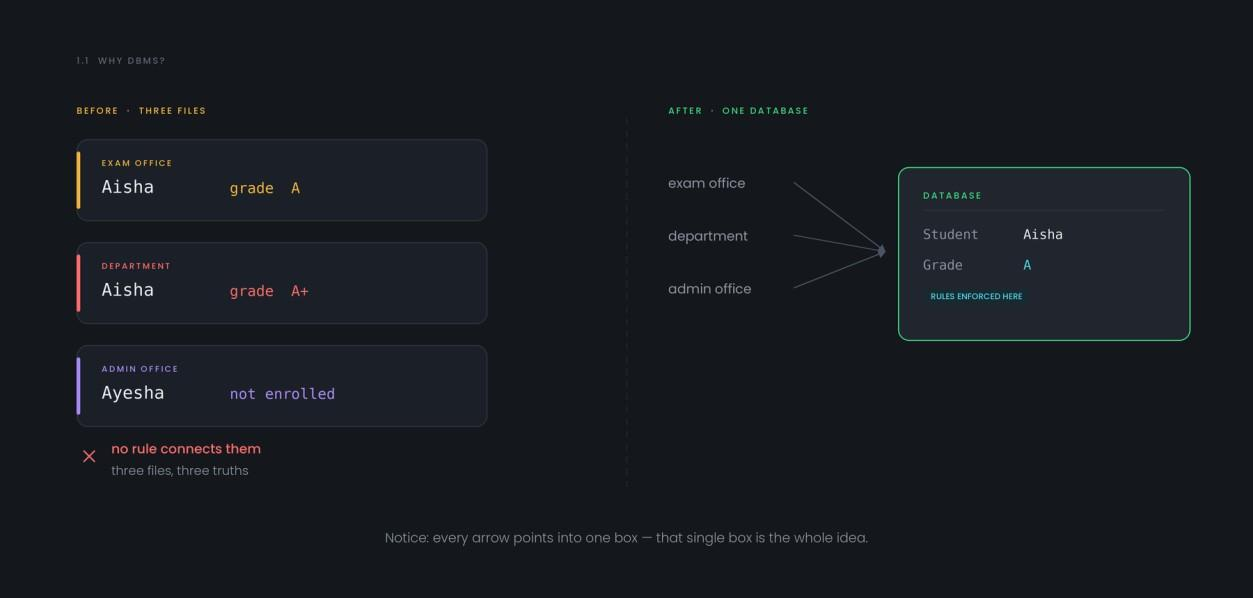
Notice: every arrow points into one box. That single box is the entire idea of a DBMS.
Common confusion
Beginners often think "using a DBMS" just means "using Excel, or typing SQL." It doesn't. Excel stores data but enforces almost nothing — it will let you type "banana" into a grade column and won't stop two people from clobbering each other's edits. SQL is just the language you talk to a database in. The DBMS is the software behind it that actually refuses bad data, manages simultaneous users, and recovers from crashes. Storage without rules is a file. Storage with rules is a DBMS.
Interview angle
- "Why choose a DBMS over flat files for a large application?" — Name at least two concrete failure modes (redundancy leading to inconsistency, no crash recovery, no concurrency control) and pair each with the DBMS feature that solves it. Vague answers like "it's more organized" score badly.
- "Give one situation where a plain file is actually the better choice." — Show judgement: single user, small data, write-once logs or config files, where the overhead of a DBMS buys you nothing.
- "What does 'data inconsistency' mean — give an example." — Define it as the same fact having different values in different places, then give a one-line example (grade A in one file, A+ in another) rather than repeating the definition twice.
Recap
A DBMS is centralized storage plus enforced rules, which is exactly what plain files can't give you — no redundancy control, no consistency, no concurrency handling, no recovery.
- 1.
Two users update the same row at the same time and one update disappears. Which DBMS feature prevents this?
- 2.
A DBMS is best described as