DBMS · Module 1 — Foundations
DBMS vs. RDBMS
An RDBMS is a DBMS that stores data in tables and enforces the links between them with keys — so RDBMS is a subset of DBMS, not an alternative to it.
You now know what a DBMS is. So what is that extra R doing in RDBMS — and why does every job description ask for one and not the other?
Why & what
A DBMS gives you central storage and rules, but it doesn't automatically know that facts are connected to each other. Aisha's enrollment is meaningless without Aisha. If nothing enforces that link, you can end up with an enrollment for a student who doesn't exist.
An RDBMS (Relational DBMS) is a DBMS that stores data as tables of rows and columns, and lets you enforce links between those tables using keys.
So RDBMS isn't a rival of DBMS. It's a DBMS with the relational model switched on.
How it works
Same one fact: Aisha, DBMS 101, Prof. Rao, grade A.
- The flat way. Keep everything in one wide table: roll number, name, course code, course name, instructor, grade — all in a single row.
- The problem. Prof. Rao teaches 60 students, so his name is retyped 60 times. Fix his spelling and you must fix 60 rows, or the data disagrees with itself again.
- The relational way. Split it: a Student table (roll number, name) and an Enrollment table (roll number, course code, grade). Aisha appears once in Student.
- The link. Enrollment.roll_no is declared a foreign key pointing at Student.roll_no. That declaration is a rule, not a comment.
- The payoff. Try inserting an enrollment for roll number 999, who isn't in Student — the RDBMS rejects it. In the flat version, nothing would have stopped you.
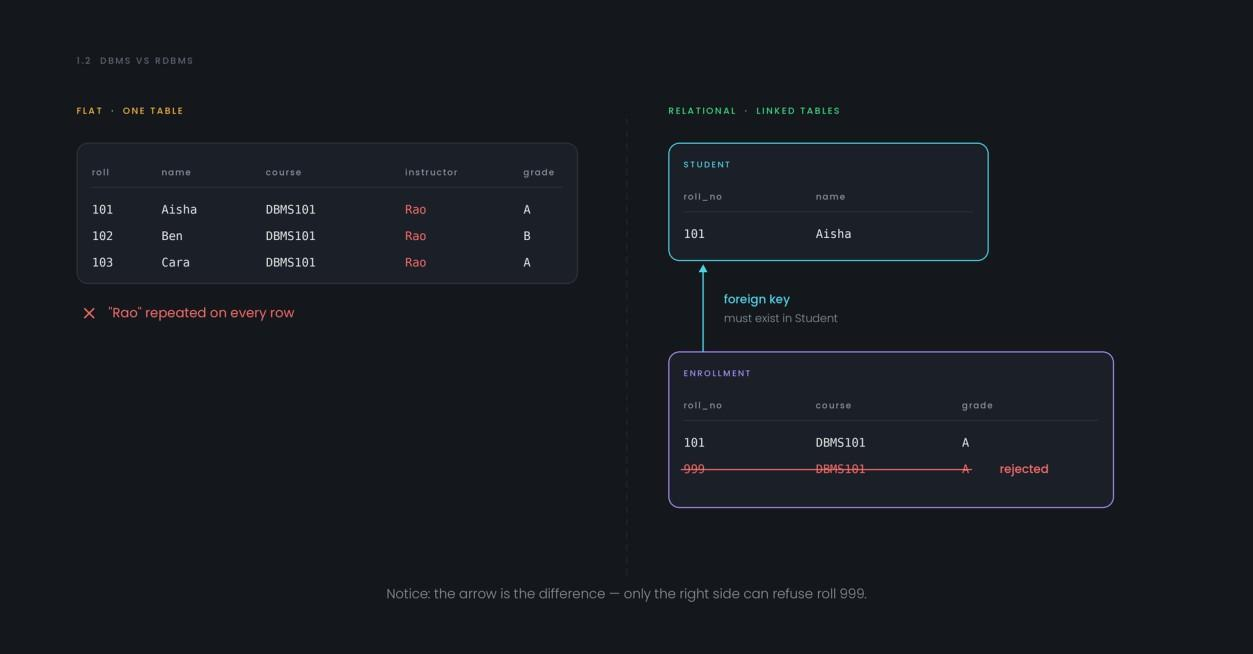
Notice: the arrow is the whole difference. Only the right-hand side can refuse roll 999.
Common confusion
Learners treat "DBMS" and "RDBMS" as two competing things you pick between. They're not — RDBMS is a subtype of DBMS. Every RDBMS is a DBMS; not every DBMS is relational (a plain file-based or key-value store isn't). Saying "we used a DBMS, not an RDBMS" is like saying "I drove a vehicle, not a car."
Interview angle
- "Is MySQL a DBMS or an RDBMS?" — Both, and say why: RDBMS is a specialization of DBMS, so calling MySQL an RDBMS is the more precise answer, not a different one.
- "What exactly does the relational model add on top of a plain DBMS?" — Tables with rows and columns, keys to link them, and constraints (especially foreign keys) that the engine enforces for you.
- "Name one thing an RDBMS prevents that a non-relational store might not." — Orphaned records: an enrollment referencing a student who doesn't exist.
Quiz: skip — reinforced via Interview Angle instead.
Recap
An RDBMS is a DBMS that stores data in tables and enforces the links between them with keys — so RDBMS is a subset of DBMS, not an alternative to it.