Puzzles
Weighing & Balance
Every weighing on a balance scale is a three-way question, not a two-way one, and every reading on a digital scale is a number carrying far more information than it looks like at first. The skill in these puzzles is asking how much information a single weighing can really give you, then designing every weighing to use all of it.
1. Find the Heavy Coin
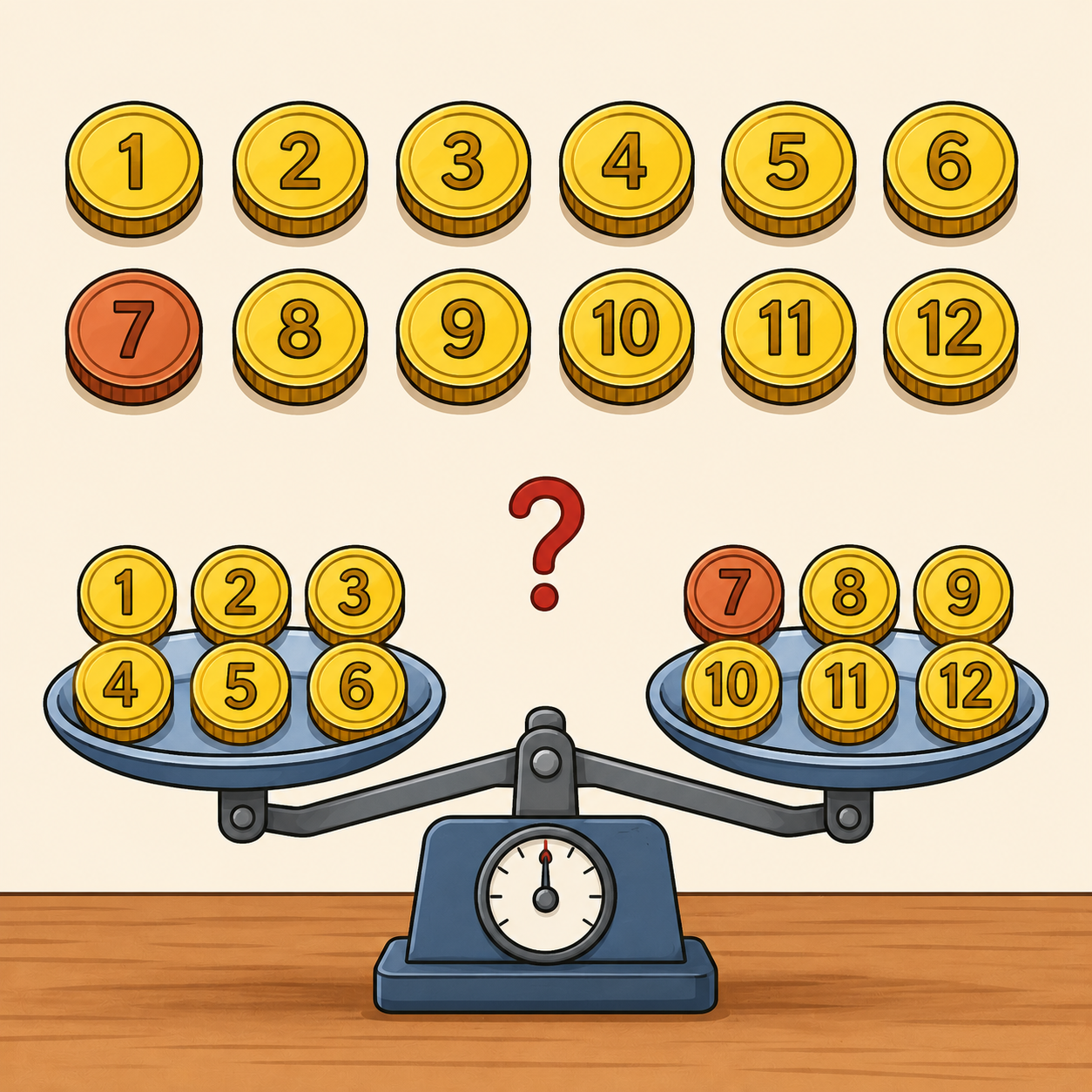
You have 3 identical-looking coins, and exactly one is heavier than the other two. You have a two-pan balance scale.
Rules
- The scale compares two coins directly
- The fake coin is known to be heavier
- No weights are provided
Your task — Find the fewest weighings needed to identify the heavier coin.
Difficulty — Easy
Hint 1 — Weigh two coins directly.
Hint 2 — A balance still tells you something.
Hint 3 — One weighing is always enough.
Main idea — Weighing any two of the three coins against each other immediately reveals the heavier coin, either directly or by elimination.
Solution
- Place any two of the three coins on the balance, one per pan.
- If one side is heavier, that coin is the fake.
- If the two balance, the coin left off the scale is the heavier one.
Reasoning
Since only one coin is heavier, comparing any two coins either identifies the heavier one directly, if it's among the two weighed, or proves it's the one set aside, if the two on the scale balance.
A single weighing always distinguishes all three possibilities, one for each coin being the fake, so one weighing is both necessary and sufficient.
2. Nine Balls: One Heavier
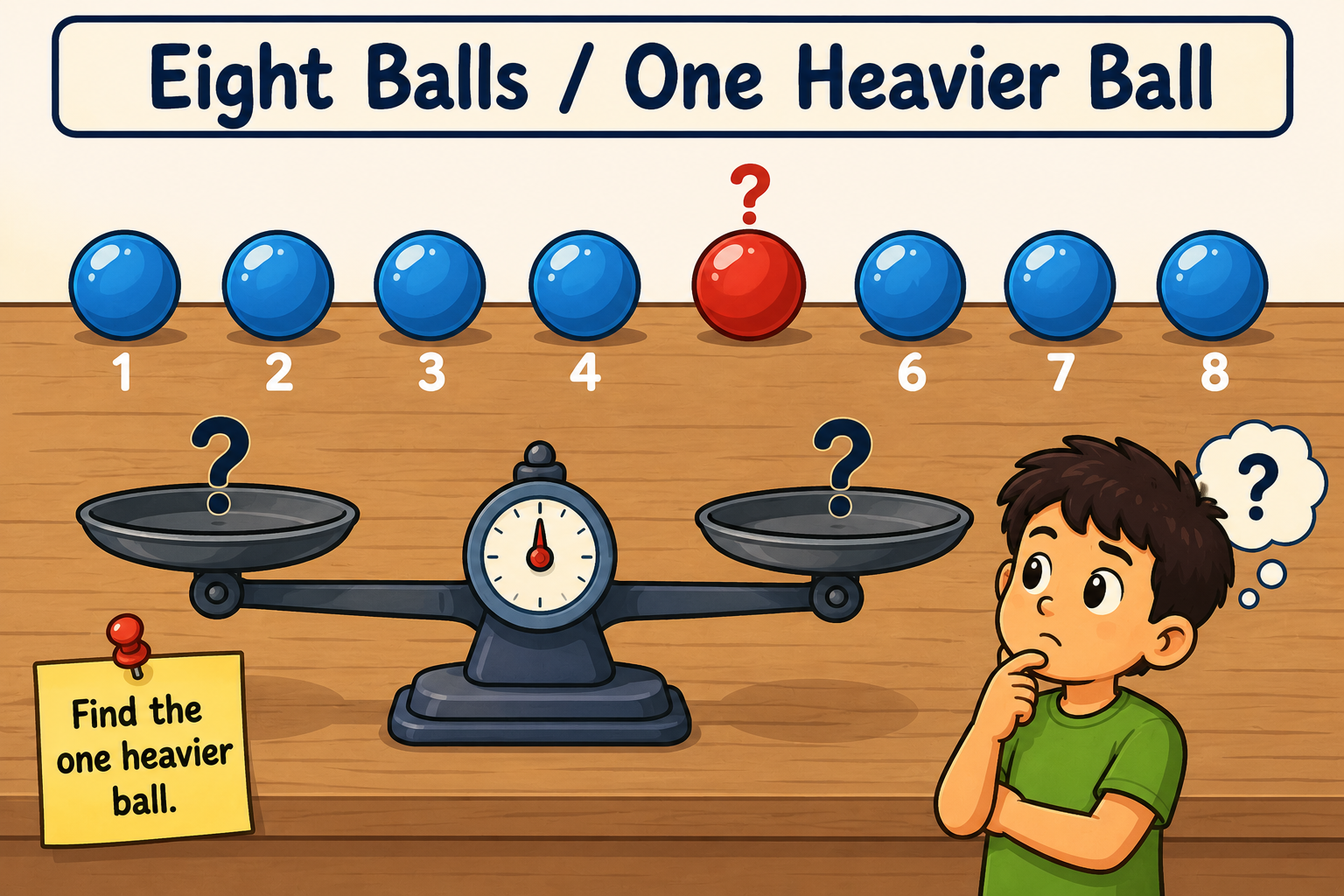
You have 9 identical-looking balls, and exactly one is heavier than the rest. You have a two-pan balance scale.
Rules
- The scale compares two groups directly
- The fake ball is known to be heavier
- No weights are provided
Your task — Find the fewest weighings needed to guarantee identifying the heavier ball.
Difficulty — Medium
Hint 1 — Split into three equal groups.
Hint 2 — Weigh two of the three groups.
Hint 3 — Repeat the split on the answer.
Main idea — Splitting 9 balls into three equal groups of three uses the balance's three-way outcome perfectly, and repeating the same split on the winning group finishes the job in one more step.
Solution
- Divide the 9 balls into three groups of 3, and weigh any two groups against each other.
- Whichever group is heavier, or the group left aside if they balance, contains the fake ball.
- Weigh any two balls from that group of 3 against each other; the heavier one is the fake, or if they balance, the third ball is the fake.
Reasoning
Splitting evenly into three groups makes full use of every weighing's three possible outcomes, cutting the field of candidates to a third of its size each time.
Because 9 divided by 3, then by 3 again, equals 1, exactly two rounds of splitting are needed, making two weighings both necessary and sufficient, and showing the general pattern that a fixed number of weighings can always handle 3 to that power many balls.
3. Ten Bags, One Counterfeit
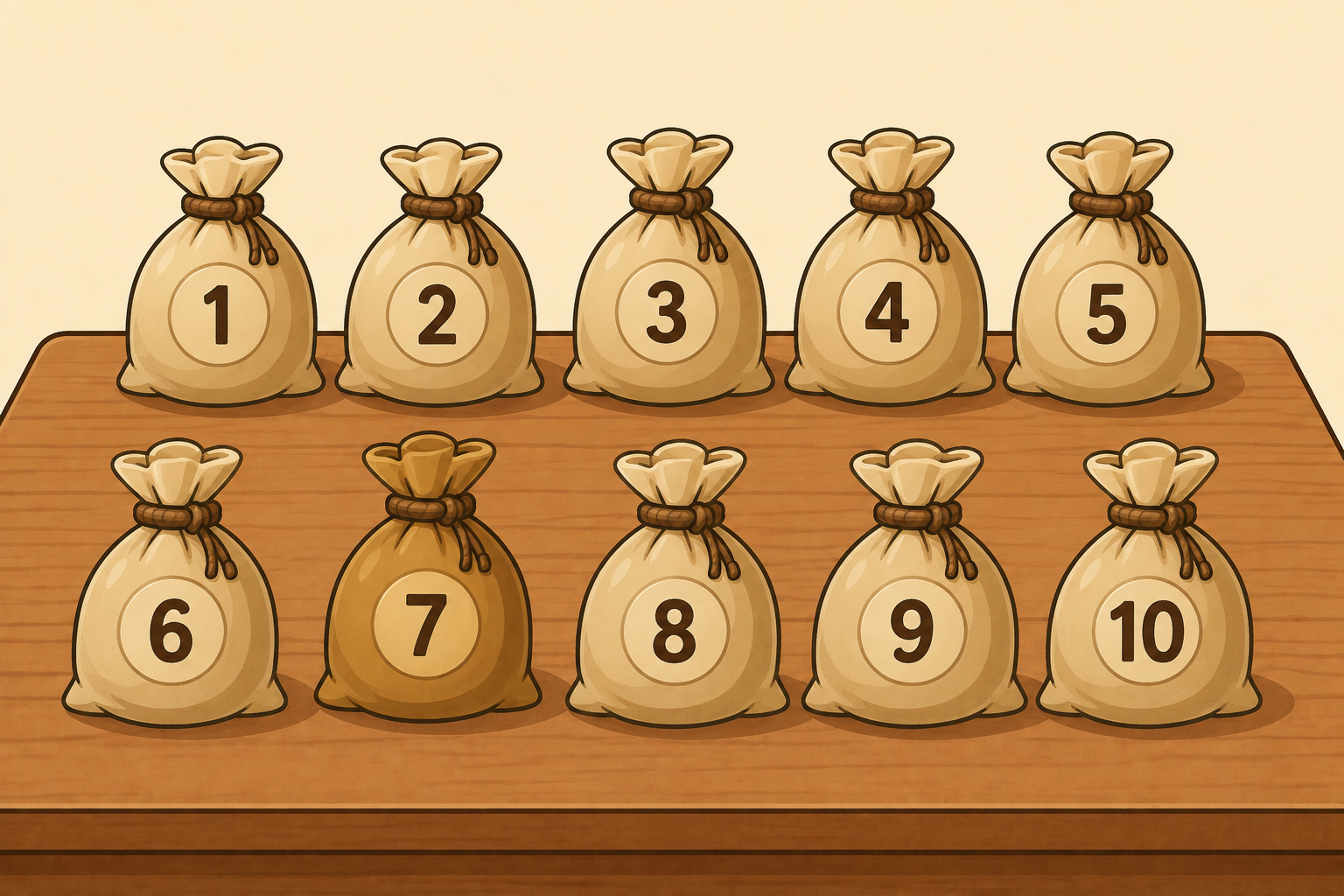
You have 10 bags, each containing many coins. Every coin in 9 of the bags weighs exactly 10 grams, but every coin in one specific bag weighs 11 grams instead. You have a digital scale that reports an exact weight, and you may use it only once.
Rules
- Each bag holds many identical coins
- One bag's coins each weigh 11 grams
- The scale gives one exact reading
Your task — Find which bag contains the heavier coins using just one weighing.
Difficulty — Hard
Hint 1 — Take a different amount per bag.
Hint 2 — Take 1 coin from bag 1, 2 from bag 2.
Hint 3 — Compare the total to the expected weight.
Main idea — Taking a distinct number of coins from each bag, matching the bag's own number, turns the extra weight from the fake coins into a direct pointer to which bag they came from.
Solution
- Take 1 coin from bag 1, 2 coins from bag 2, 3 from bag 3, and so on up to 10 coins from bag 10.
- Weigh all of these coins together at once on the digital scale.
- Subtract the expected weight, if every coin were genuine, from the actual reading. The difference in grams equals the number of the counterfeit bag.
Reasoning
If bag number k is the counterfeit one, exactly k coins on the scale are 1 gram too heavy, adding exactly k extra grams to the total beyond what all-genuine coins would weigh.
Since this extra amount directly matches the bag's own number, and no two bags can produce the same extra weight, one single overall weighing is enough to identify the counterfeit bag exactly.
4. The Three Weighings Challenge
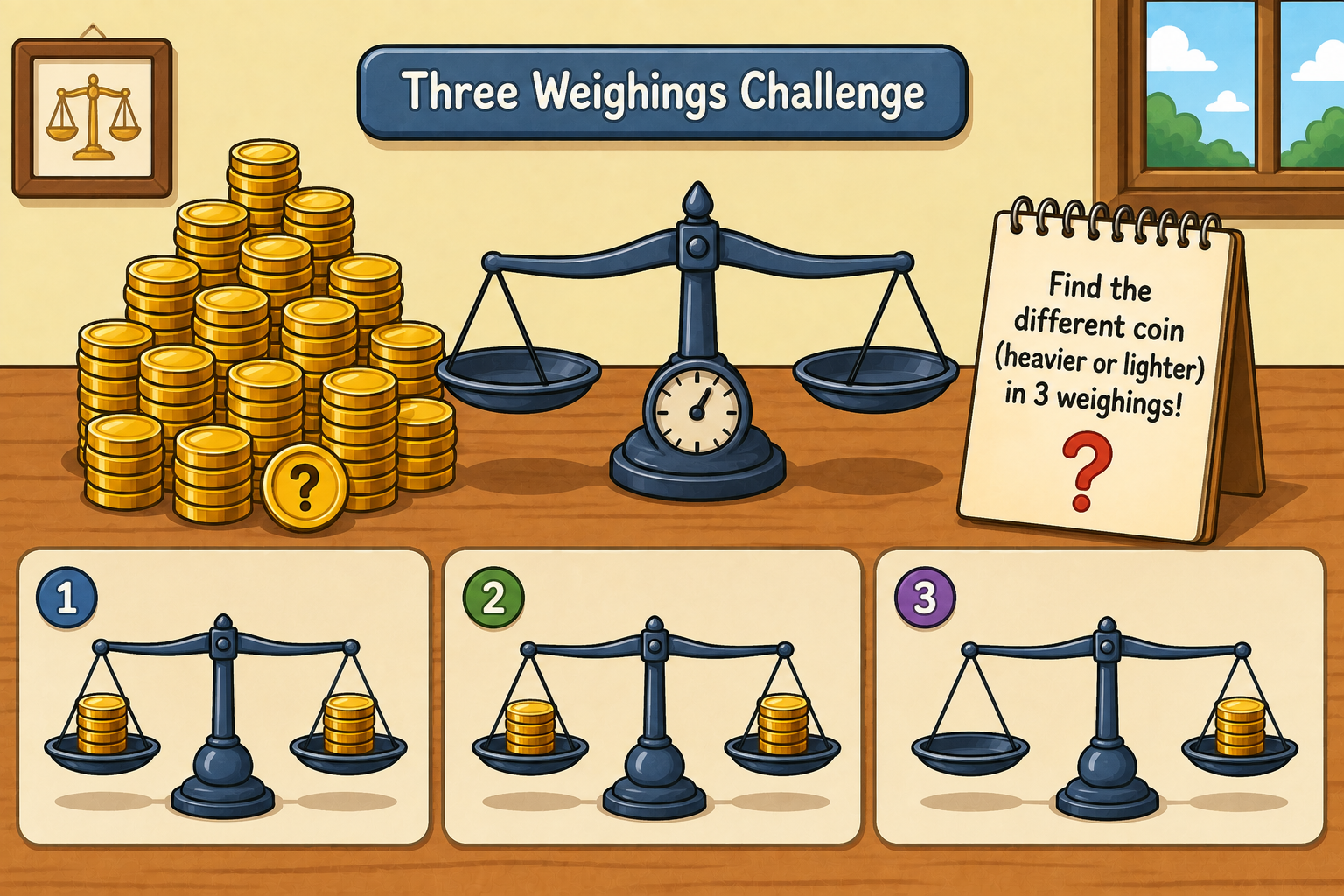
You have a two-pan balance scale, no weights, and exactly 3 weighings available. You have a set of identical-looking coins, and exactly one of them is counterfeit, either heavier or lighter than the rest, though you don't know which.
Rules
- Exactly 3 weighings are allowed
- The fake coin's direction is unknown
- No weights are provided
Your task — Find the maximum number of coins you can test with these 3 weighings while still always finding the counterfeit and its direction.
Difficulty — Hard
Hint 1 — Each weighing has 3 outcomes.
Hint 2 — Three weighings give 27 total sequences.
Hint 3 — Each coin needs two of those sequences.
Main idea — Since every coin could be either heavier or lighter, each coin needs two of the possible outcome sequences reserved for it, so the maximum coin count is bounded by how many sequences three weighings can produce.
Solution
- Three weighings, each with 3 possible outcomes, can produce up to 3 cubed, or 27, distinct outcome sequences.
- Since exactly one coin is guaranteed to be counterfeit, every outcome sequence can be assigned to represent one coin being heavier or lighter.
- Dividing 27 by 2 and rounding down gives a maximum of 13 coins that can always be resolved in exactly 3 weighings.
Reasoning
Every coin needs two distinguishable outcome sequences reserved for it, heavier or lighter, so the total number of coins manageable is bounded by half of the total sequences available.
With 27 sequences from 3 weighings, 13 coins is the true maximum, one more than the commonly cited 12-coin version of this puzzle, since 12 coins only need 24 of the 27 sequences, leaving enough room to push the count to 13 with a carefully designed weighing scheme.