Puzzles
Logic & Deduction
These puzzles ask you to extract a definite conclusion from information that seems incomplete at first glance. The real skill isn't calculation. It's noticing information that's already available but not obviously usable, then structuring a plan that turns ambiguity into a certain answer.
1. Three Switches and Three Bulbs
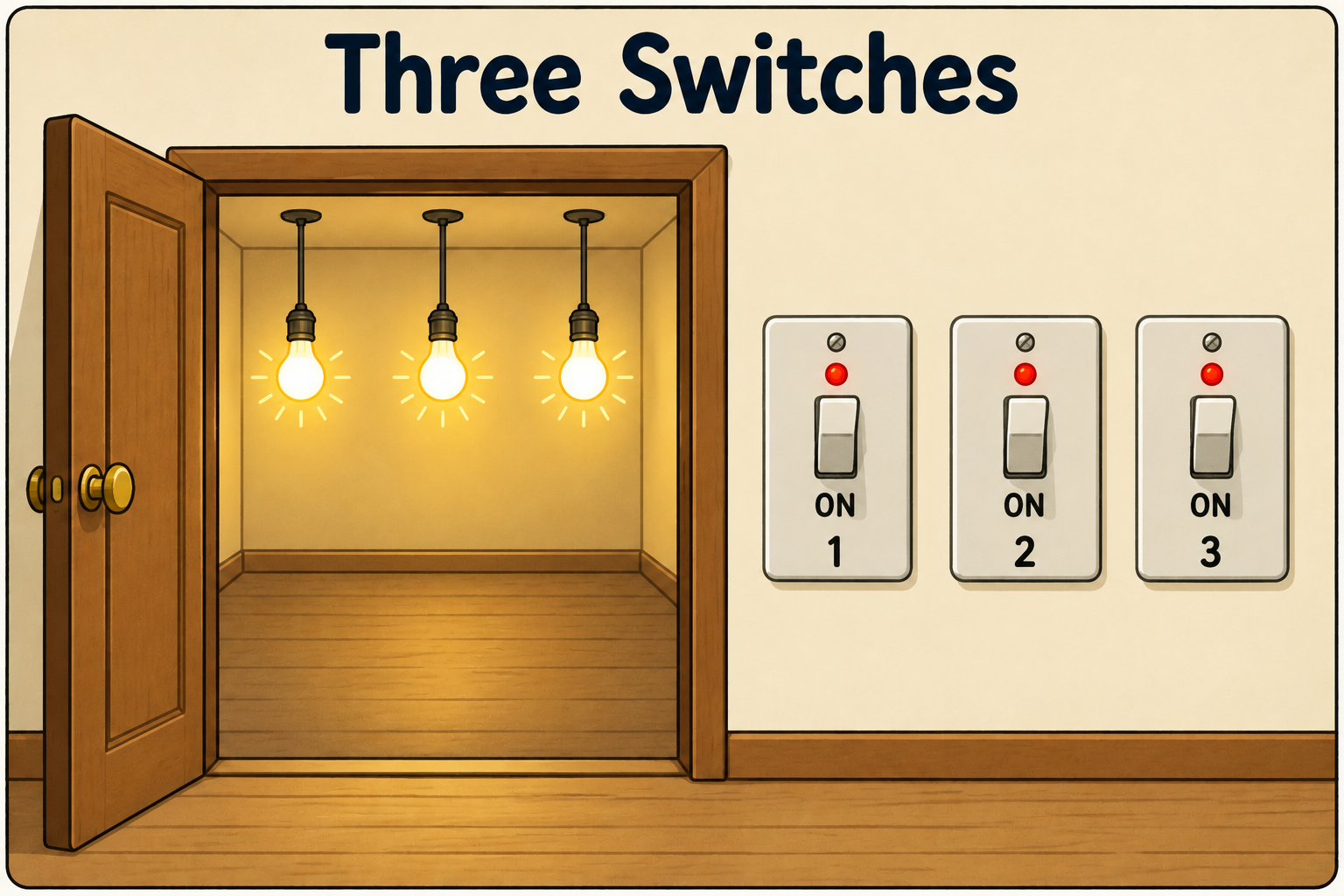
You stand outside a room with three switches on the wall. Each switch controls exactly one of three bulbs inside, but you don't know which switch matches which bulb. You may enter the room only once, and once inside you can see the bulbs but not touch the switches.
Rules
- Use the switches freely before entering
- Enter the room only once
- Switches cannot be touched inside
Your task — Find a plan for the switches that lets you match every switch to its bulb after a single visit.
Difficulty — Easy
Hint 1 — More than just on or off?
Hint 2 — Bulbs also give off heat.
Hint 3 — Use warmth as a clue.
Main idea — A bulb can store information through temperature, giving a third state beyond on and off.
Solution
- Turn Switch 1 on for five minutes.
- Turn Switch 1 off, then turn Switch 2 on.
- Leave Switch 3 off throughout.
- Enter and check which bulb is lit, warm, or cool.
- Lit is Switch 2, warm is Switch 1, cool is Switch 3.
Reasoning
After this sequence, the bulbs fall into three distinct states: lit, warm but dark, and cool and dark. The lit bulb must belong to Switch 2, since it is the only switch left on.
The warm bulb must belong to Switch 1, since only that bulb was heated before being switched off. The cool bulb must belong to Switch 3, since it was never turned on.
These three states are mutually exclusive and cover all three bulbs, so the mapping is fully determined in a single visit.
2. Two Doors and Two Guards
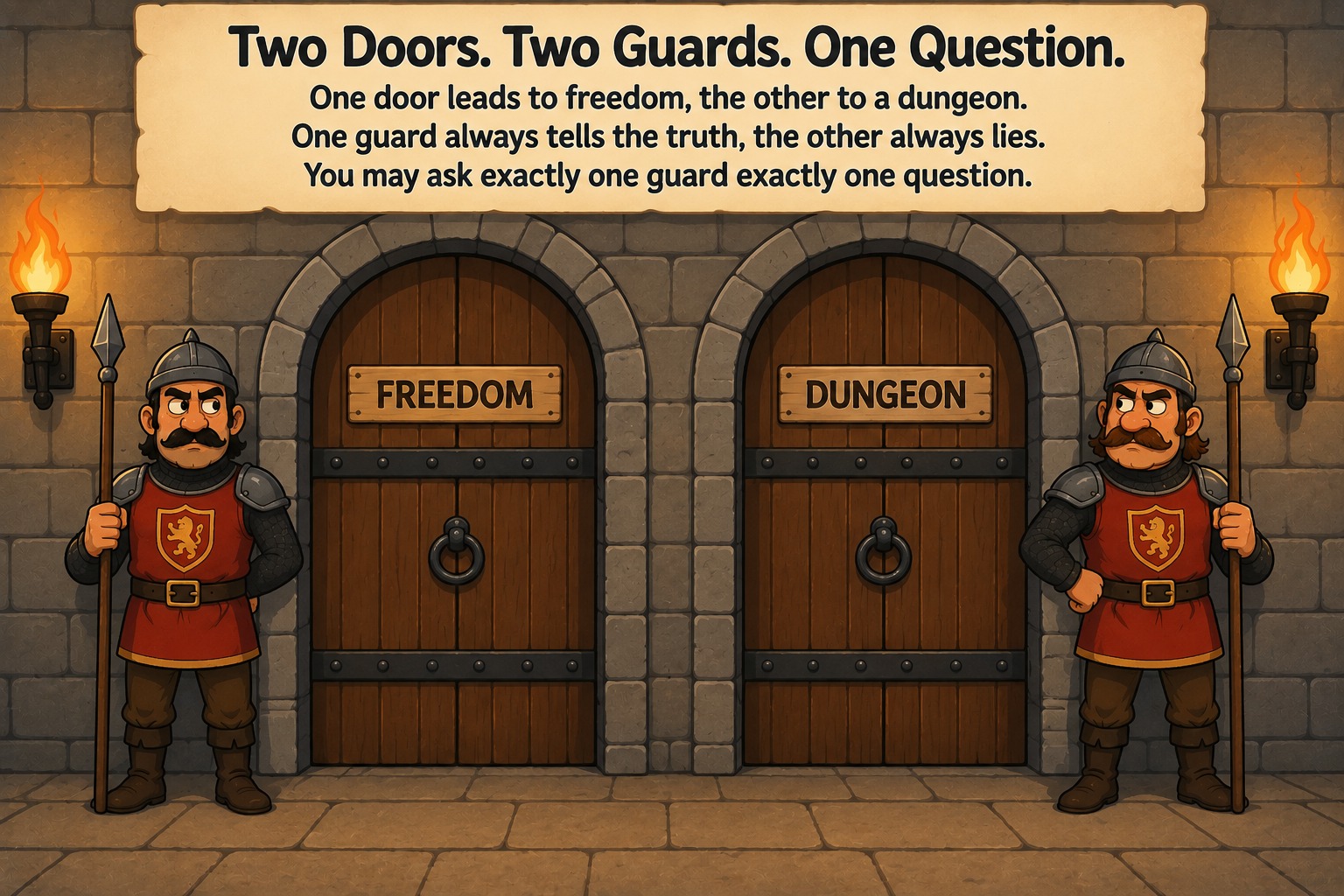
Two identical doors stand before you. One leads to freedom, the other to a dungeon. A guard stands at each door. One guard always tells the truth, the other always lies, but you don't know which is which. You may ask exactly one guard exactly one question.
Rules
- Only one question, to one guard
- Answers are yes or no only
- One guard lies, one tells the truth
Your task — Find the single question that reveals which door leads to freedom, no matter which guard you ask.
Difficulty — Medium
Hint 1 — Make both guards answer alike.
Hint 2 — Ask about the other guard's answer.
Hint 3 — A lie about a lie flips back.
Main idea — Asking a guard to report the other guard's answer cancels out the lie, so both guards give the same, reversed answer.
Solution
- Ask either guard, pointing to either door: "If I asked the other guard whether this door leads to freedom, would he say yes?"
- Take the opposite of the answer as true.
- Yes means the dungeon; no means freedom.
Reasoning
Ask the truth-teller, and he honestly reports the liar's lie, so his answer is false. Ask the liar, and he lies about the truth-teller's honest answer, so his answer is also false.
Either way, the answer you hear is the reverse of reality, so inverting it always gives the correct door.
3. Three Boxes: Apples, Oranges & Mixed
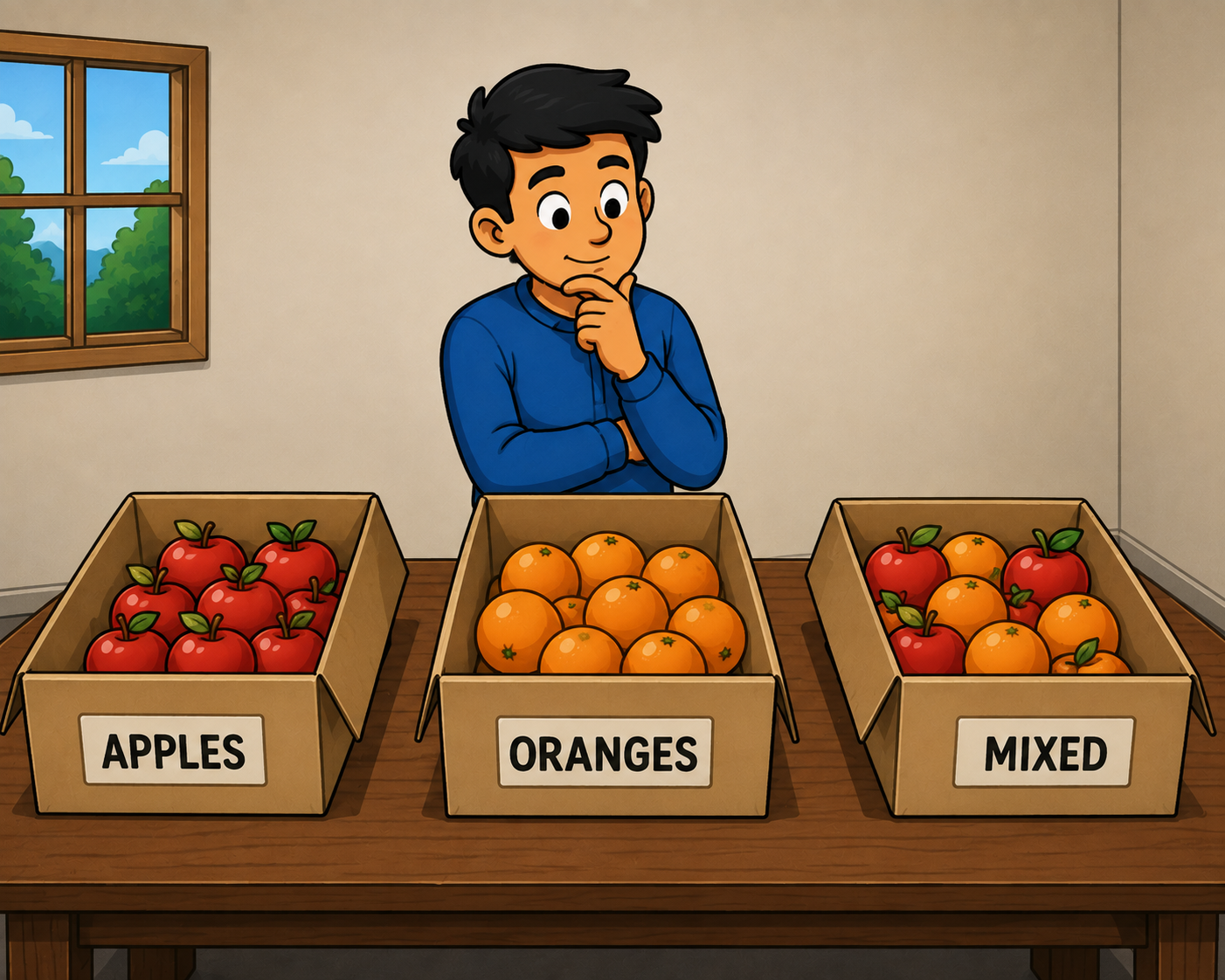
Three boxes sit in front of you, labeled "Apples," "Oranges," and "Mixed." One box truly holds only apples, one only oranges, and one a mix of both, but every single label is wrong. You may reach into one box of your choosing, without looking, and pull out one fruit.
Rules
- All three labels are wrong
- You may draw one fruit total
- You must then relabel all three boxes
Your task — Decide which box to draw from, and explain how one fruit lets you correctly relabel all three boxes.
Difficulty — Easy
Hint 1 — Which label can't lie twice?
Hint 2 — The Mixed box can't be mixed.
Hint 3 — Draw from the Mixed box.
Main idea — Since every label is wrong, the box marked Mixed cannot actually be mixed, so a single fruit from it reveals its true, pure contents.
Solution
- Draw one fruit from the box labeled "Mixed."
- That box must actually be all apples or all oranges, matching the fruit you drew.
- The box labeled with the opposite fruit cannot hold that fruit or the one just identified, so it must be Mixed.
- The last box takes the only label left.
Reasoning
Because every label is wrong, the box marked Mixed cannot be mixed, so it must be entirely one fruit, which the draw reveals directly.
The box labeled with the other fruit's name cannot truly hold that fruit, and it cannot hold the fruit just identified either, so by elimination it must be the mixed box, leaving only one label for the last box.
4. The Prisoners and Hats

Ten prisoners are lined up facing forward, so each can see the hats of everyone ahead of them but not their own or anyone behind. Each hat is black or white, assigned in any arrangement. Starting from the back, each prisoner must say only the word "black" or "white," and everyone hears every answer given so far.
Rules
- Only say black or white
- See only the hats ahead
- Everyone hears every prior answer
Your task — Devise a strategy that guarantees at least 9 of the 10 prisoners state their own hat color correctly.
Difficulty — Hard
Hint 1 — First answer need not be theirs.
Hint 2 — Count black hats you can see.
Hint 3 — Announce a parity, not a guess.
Main idea — The first prisoner can sacrifice their own certainty to broadcast one piece of information, the parity of black hats ahead, letting everyone else deduce their own color exactly.
Solution
- The back-most prisoner counts the black hats ahead and says "black" if that count is odd, "white" if even.
- Each following prisoner combines that parity, the hats still visible ahead, and all answers already heard, to work out their own hat color.
- Every prisoner states the color they have deduced.
Reasoning
The first prisoner's word is a code for a count, not a claim about their own hat, so it costs at most their own certainty of survival.
Every later prisoner can subtract the hats they see and the answers already given from the announced parity, which isolates their own hat color with no ambiguity. Since this deduction is forced at every step, all nine remaining prisoners answer correctly.
5. 100 Prisoners and 100 Boxes

100 prisoners are each numbered 1 to 100. A room holds 100 boxes, also numbered 1 to 100, each containing a slip with one prisoner's number, arranged in an order unknown to the prisoners. One at a time, each prisoner may open up to 50 boxes and must find their own number. Boxes are reset between visits, and all 100 prisoners must succeed for the group to go free.
Rules
- Each prisoner opens at most 50 boxes
- No communication once it starts
- All 100 must succeed to win
Your task — Find a shared strategy giving the group a real chance of success, far better than random guessing.
Difficulty — Hard
Hint 1 — Follow numbers, not random boxes.
Hint 2 — Boxes form linked chains.
Hint 3 — Start with your own number.
Main idea — Following the number inside each box breaks the boxes into loops, and success depends on the length of your own loop.
Solution
- Prisoner N opens box N first.
- Open the box matching the number just found, and repeat.
- Stop at your own number, or after 50 boxes.
Reasoning
The boxes form a permutation split into closed loops, and a prisoner using this strategy is simply tracing the loop that contains their own number.
A prisoner succeeds only if their loop is 50 boxes or shorter, and the whole group succeeds when no loop exceeds 50, which happens about 31 percent of the time. This is provably the best possible strategy for this problem.
6. The Missing Dollar Puzzle
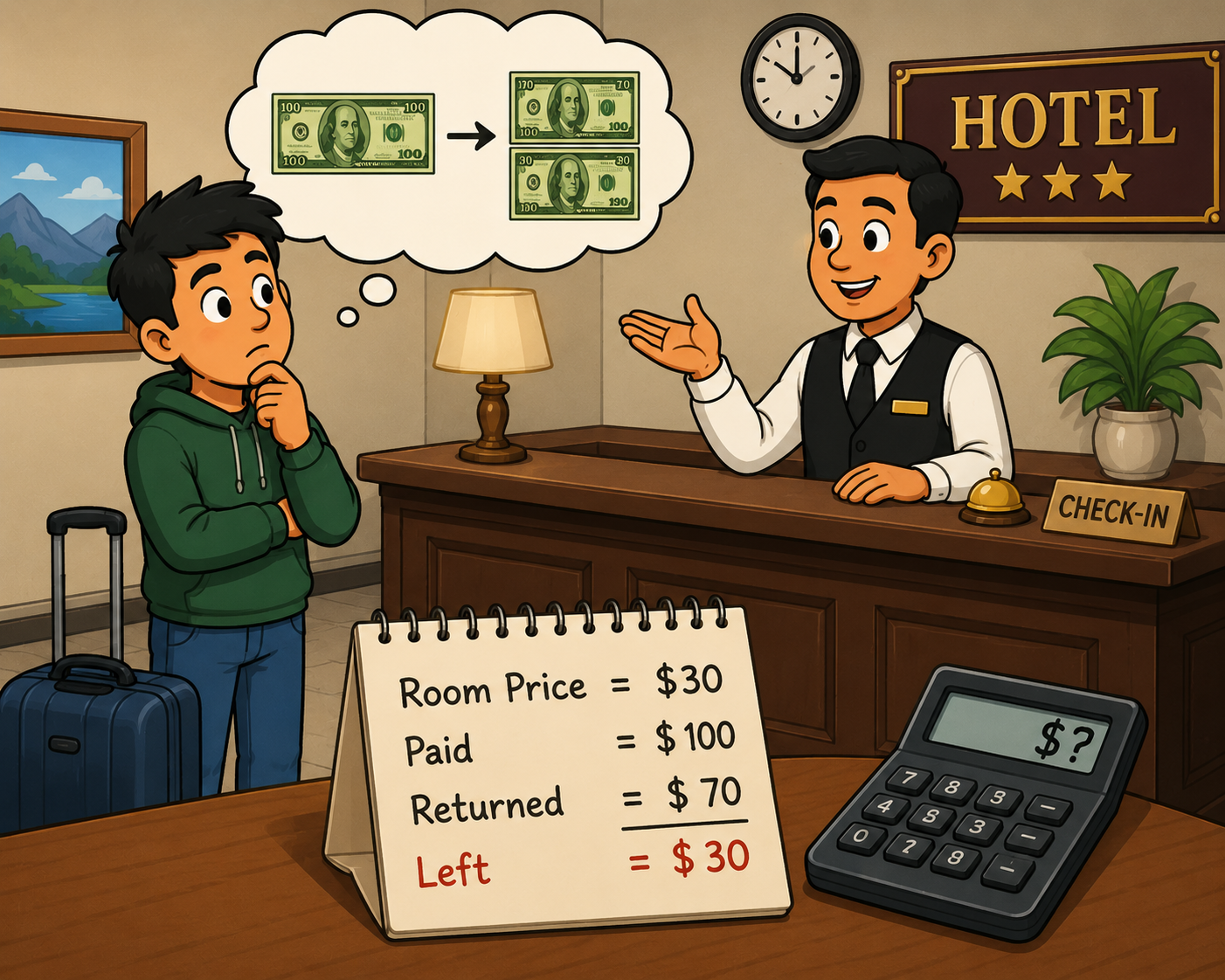
Three guests check into a hotel room and pay ten dollars each, thirty dollars total. The manager realizes the room only costs twenty five dollars and sends a bellhop to return five dollars. Unable to split five dollars three ways evenly, the bellhop gives each guest one dollar back and keeps two dollars for himself. Each guest has now paid nine dollars, twenty seven dollars total, and the bellhop holds two dollars, for twenty nine dollars.
Rules
- Guests paid thirty dollars total
- The room actually cost twenty five
- The bellhop returned three, kept two
Your task — Explain why twenty seven plus two comes to twenty nine instead of thirty, and show where the dollar really is.
Difficulty — Medium
Hint 1 — Look at what is being added.
Hint 2 — Twenty seven already contains the two.
Hint 3 — Don't add an included amount twice.
Main idea — The twenty seven dollars the guests paid already contains the bellhop's two dollars inside it, so adding that two again double-counts money already there.
Solution
- The guests' twenty seven dollars splits into twenty five for the room and two in the bellhop's pocket.
- Add the three dollars returned to the guests: twenty seven plus three equals thirty, the original amount.
- No dollar is missing; the error was adding the bellhop's two dollars to the twenty seven instead of the three dollars returned.
Reasoning
The correct total is twenty five for the room, plus two for the bellhop, plus three returned to the guests, which equals thirty and matches the original payment exactly.
The confusion comes from adding two numbers that were never meant to be combined: the guests' net payment already includes the bellhop's cut, so adding it again counts that money twice while ignoring the three dollars actually returned.