Puzzles
Probability & Expected Value
These puzzles test whether your intuition about chance matches the actual math. The real skill is setting up the right sample space or equation, since a wrong framing often looks perfectly reasonable while producing a completely wrong answer.
1. Three Coins: Probability of Heads
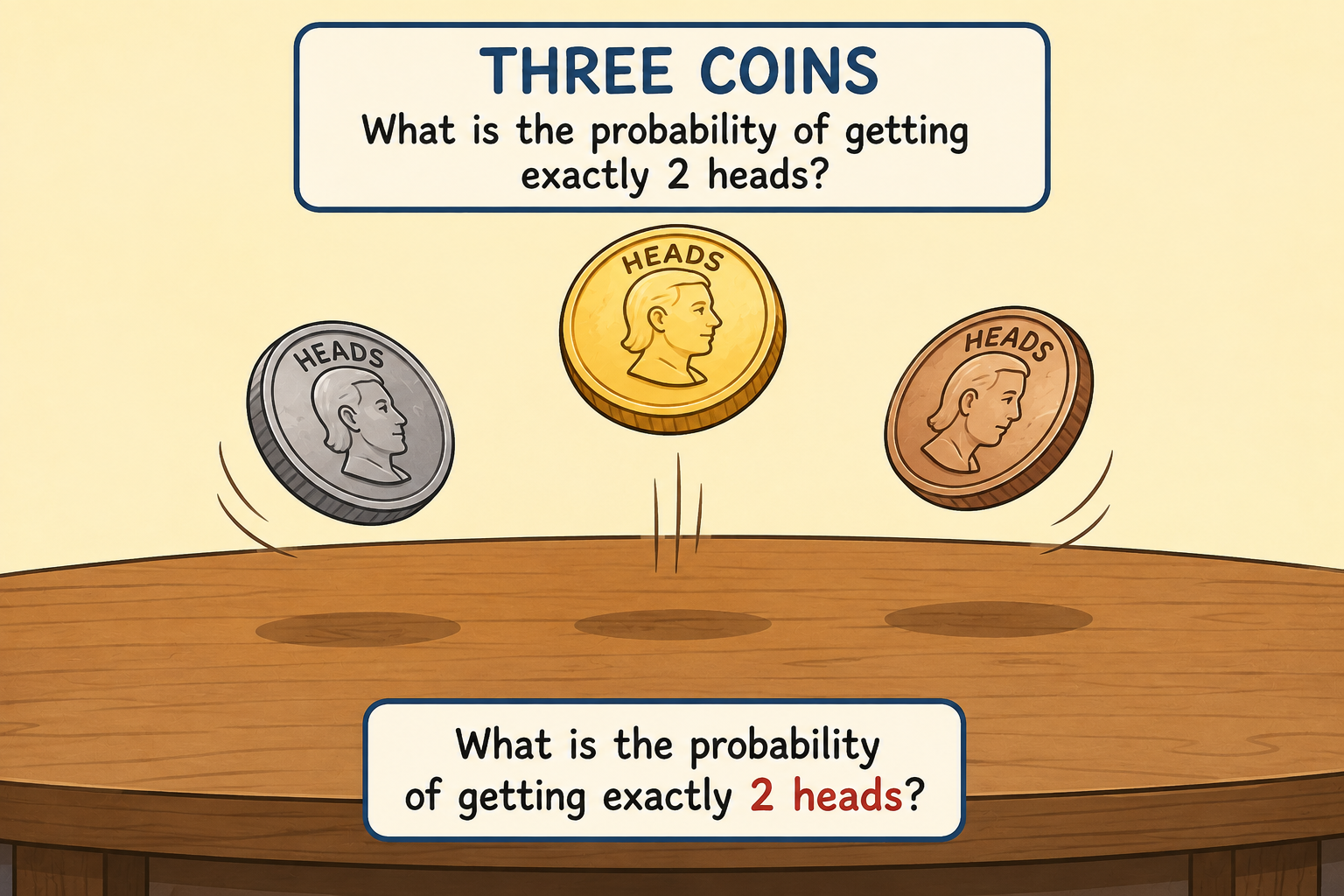
You flip three fair coins at the same time, each independent of the others.
Rules
- Each coin is fair, 50/50
- All three flips are independent
- You want at least two heads
Your task — Find the probability that at least two of the three coins land on heads.
Difficulty — Easy
Hint 1 — List every possible outcome.
Hint 2 — How many outcomes total?
Hint 3 — Count only outcomes with 2+ heads.
Main idea — With a small number of equally likely outcomes, counting the favorable ones directly is faster than any formula.
Solution
- List all 8 equally likely outcomes of three coin flips.
- Four of them have at least two heads: HHH, HHT, HTH, THH.
- The probability is 4 out of 8, which is one half.
Reasoning
Because each coin is fair and independent, all 8 possible sequences of heads and tails are equally likely.
Simply counting how many of those 8 sequences satisfy "at least two heads" and dividing by the total gives the exact probability, no further tools needed.
2. Conditional Probability with Two Bags
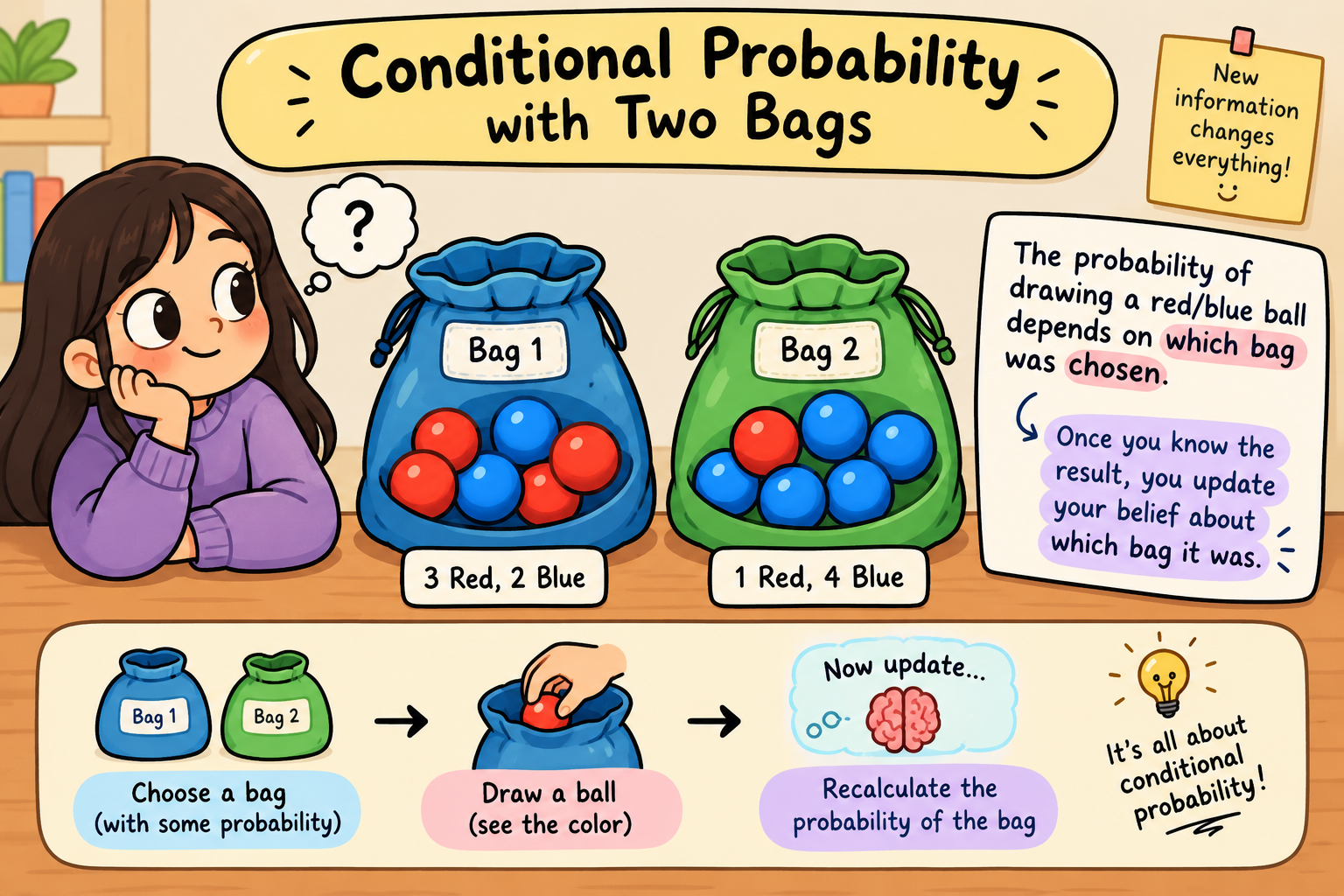
Bag A holds 2 white and 3 black balls. Bag B holds 4 white and 2 black balls. You pick one of the two bags at random, then draw one ball from it, and the ball turns out to be white.
Rules
- Each bag is equally likely to be chosen
- One ball is drawn at random
- The ball drawn is white
Your task — Find the probability that the white ball came from Bag A.
Difficulty — Easy
Hint 1 — This calls for Bayes' rule.
Hint 2 — Find the chance of white from each bag.
Hint 3 — Weigh each bag by how likely white is.
Main idea — Observing a white ball should shift your belief toward whichever bag makes white more likely, not leave the odds at fifty-fifty.
Solution
- P(white from A) is 2 out of 5, and P(white from B) is 4 out of 6.
- The overall chance of drawing white is the average of these two, weighted equally: 8 out of 15.
- P(Bag A given white) equals P(white from A) times one half, divided by the overall chance of white, giving 3 out of 8.
Reasoning
Bayes' rule updates the fifty-fifty starting assumption using how likely each bag actually was to produce the observed white ball.
Since Bag B has a higher fraction of white balls than Bag A, seeing white makes Bag B more likely to be the source, which is why Bag A's updated probability drops below one half, to three eighths.
3. Two Children Problem
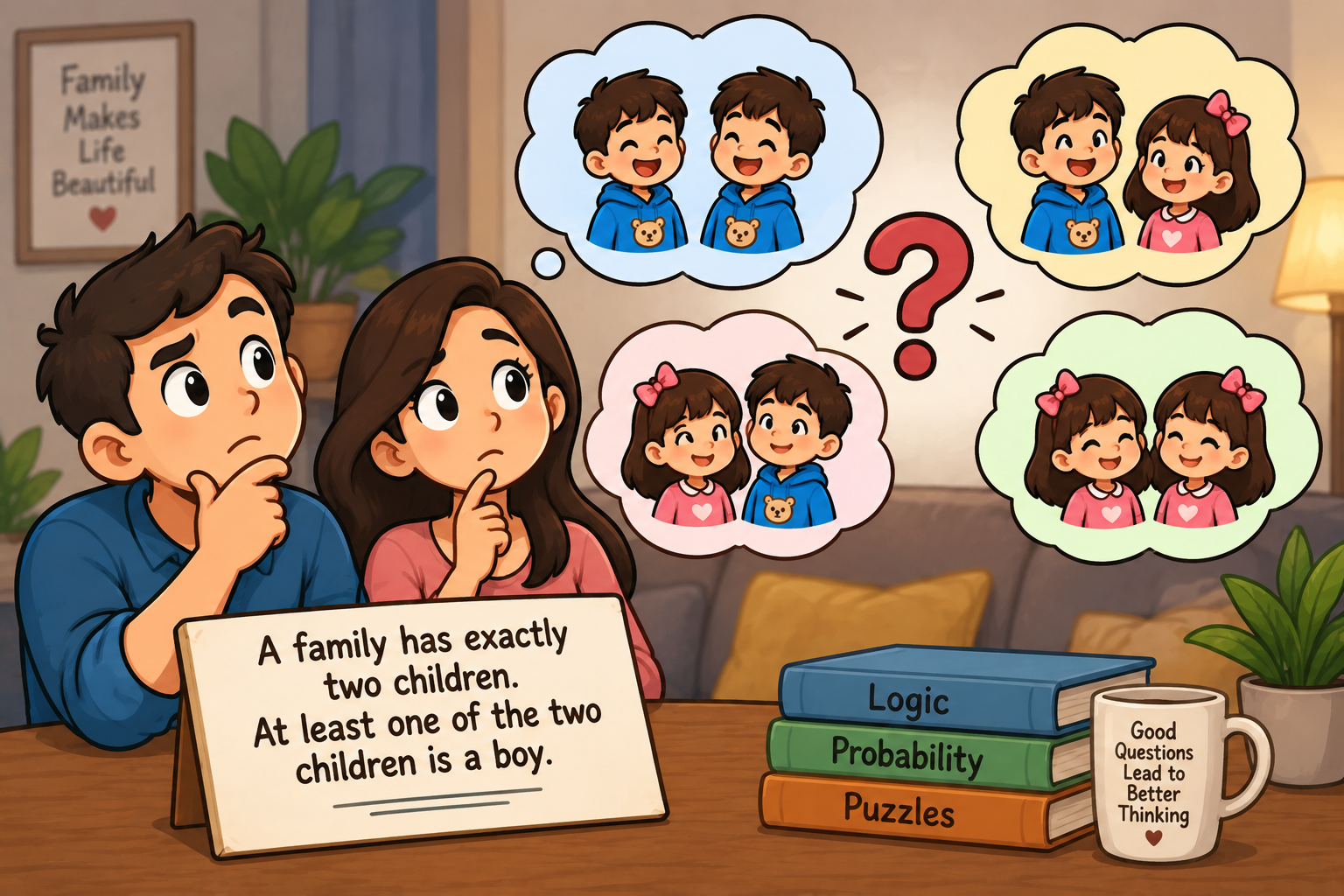
A family has exactly two children. You're told that at least one of the two children is a boy, with no other information about birth order or which child.
Rules
- Each child is equally likely to be a boy or girl
- The genders of the two children are independent
- At least one child is confirmed a boy
Your task — Find the probability that both children are boys.
Difficulty — Medium
Hint 1 — List every gender combination.
Hint 2 — One combination is now impossible.
Hint 3 — Count remaining cases with two boys.
Main idea — The condition "at least one boy" removes only the all-girls case, leaving three, not two, equally likely possibilities.
Solution
- List the four equally likely combinations: boy-boy, boy-girl, girl-boy, girl-girl.
- Remove girl-girl, since it contradicts the given information.
- Only one of the remaining three combinations, boy-boy, has two boys, giving a probability of one third.
Reasoning
Before any information, all four gender combinations for two children are equally likely.
Learning that at least one child is a boy eliminates only the girl-girl case, leaving three equally likely outcomes rather than two, so the answer is one third rather than the commonly assumed one half.
4. The Monty Hall Problem
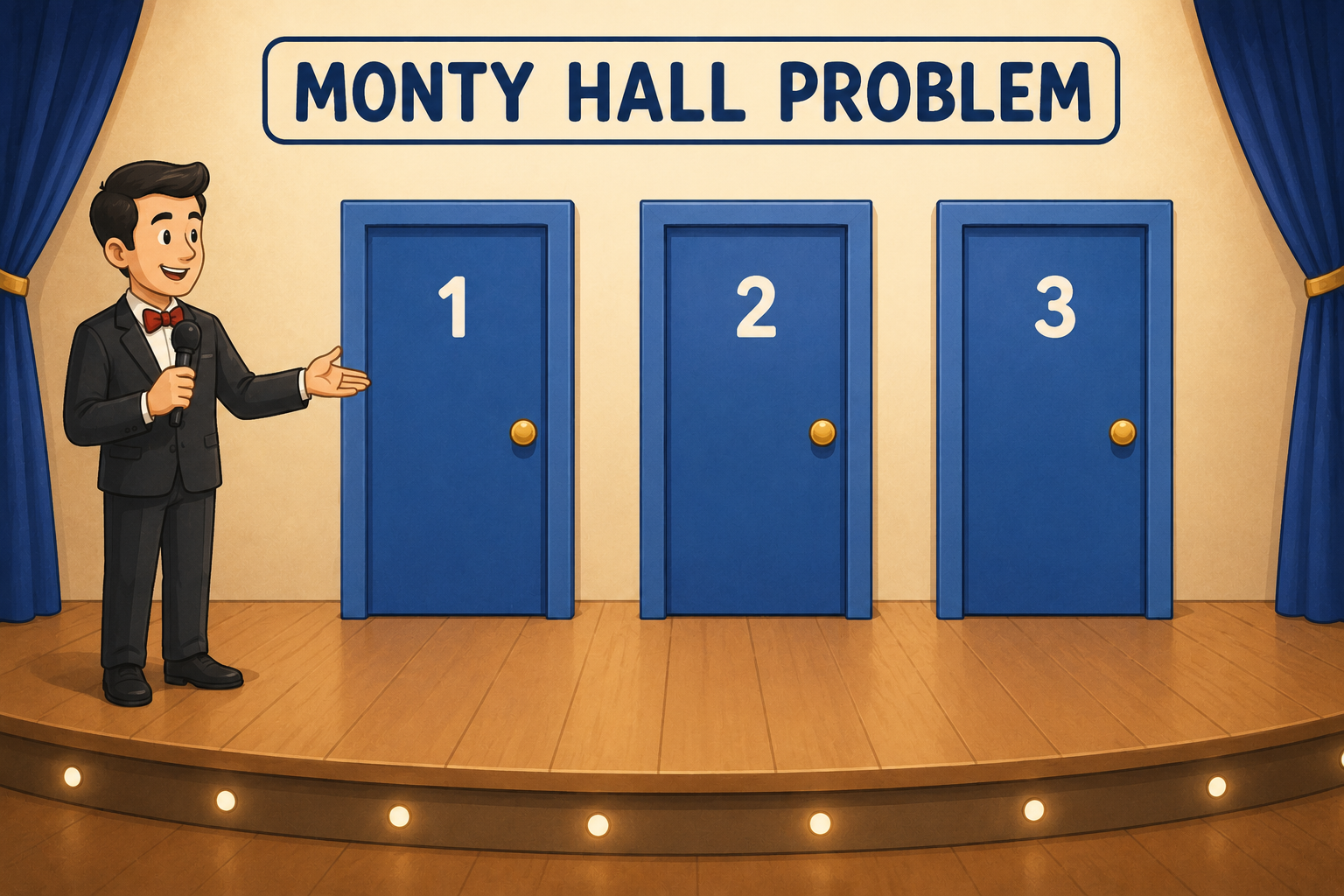
You're on a game show facing three doors. One hides a car, the other two hide goats. You pick a door. The host, who knows what's behind every door, then opens a different door than yours, always revealing a goat, and offers you the choice to switch to the remaining unopened door or stay with your original pick.
Rules
- The host always reveals a goat
- The host never opens your chosen door
- You may switch once, or stay
Your task — Determine whether switching improves your odds of winning the car, and by how much.
Difficulty — Medium
Hint 1 — The host's move isn't random.
Hint 2 — Your first pick's odds are fixed.
Hint 3 — Switching claims both unchosen doors' odds.
Main idea — The host's forced, informed reveal transfers the combined probability of the two doors you didn't pick onto the single door left standing.
Solution
- Your original door has a one in three chance of hiding the car.
- The other two doors together hold a two in three chance.
- The host removes one of those two, always a goat, without changing that combined two in three.
- Switching gives you that two in three chance; staying keeps only your original one in three.
Reasoning
Because the host always avoids the car and always avoids your door, his reveal carries no randomness and never changes the two in three probability that the car sits behind one of the doors you didn't pick.
Once one of those two doors is opened and shown to be a goat, all of that two in three probability concentrates onto the single remaining unopened door, making switching the better choice twice as often as staying.
5. The Birthday Paradox
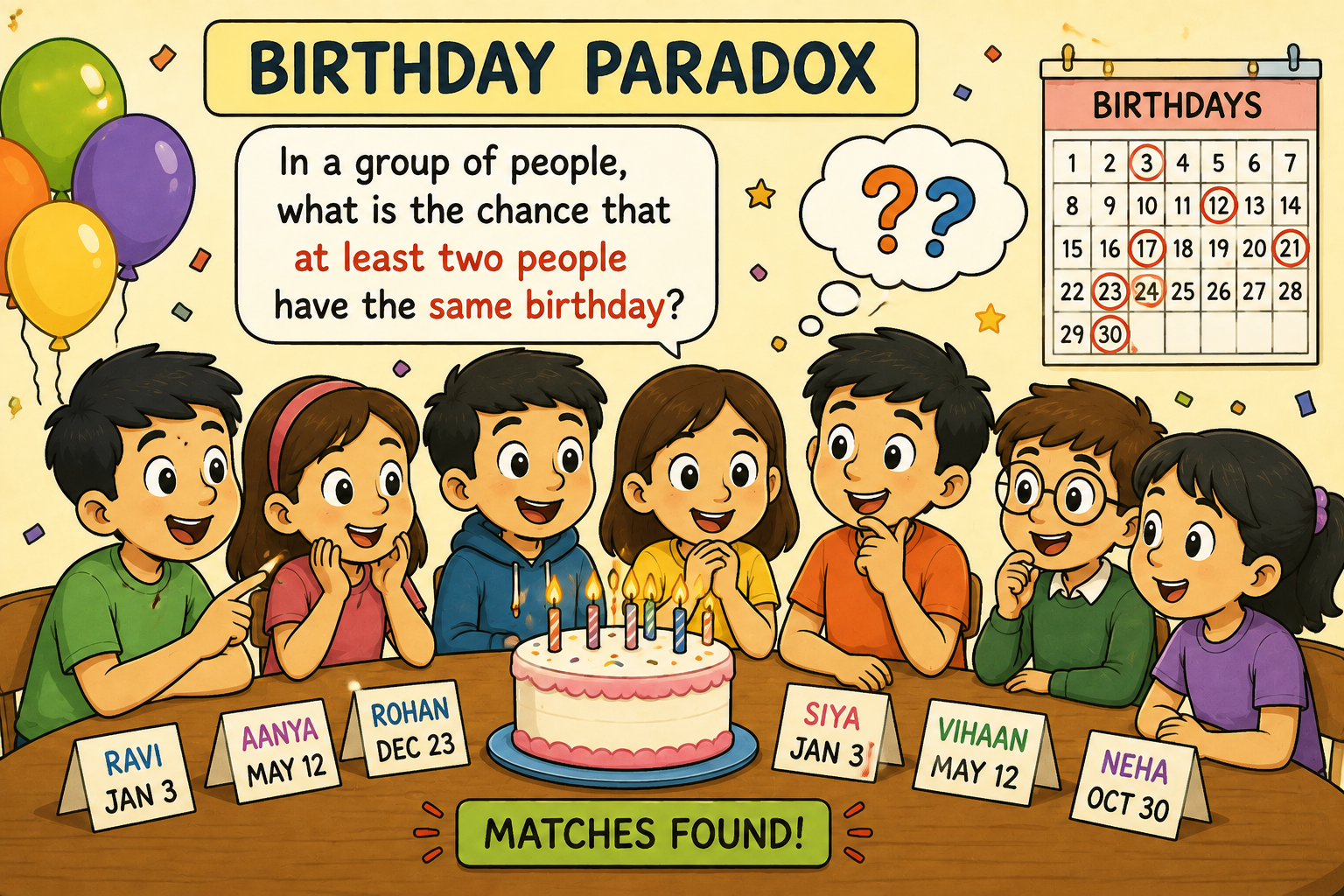
You're in a room with 23 people. Assume every birthday is equally likely and independent across the 365 days of the year, ignoring leap years.
Rules
- 365 equally likely birthdays
- Birthdays are independent of each other
- The room holds 23 people
Your task — Find the probability that at least two people in the room share a birthday.
Difficulty — Hard
Hint 1 — Compute the no-match case instead.
Hint 2 — Multiply shrinking fractions together.
Hint 3 — Subtract that product from one.
Main idea — It's far easier to calculate the chance that nobody shares a birthday, then subtract that from one, than to count all the matching pairs directly.
Solution
- Multiply the chances that each new person avoids every birthday already taken: 365/365 times 364/365 times 363/365, continuing down to 343/365 for all 23 people.
- This product works out to roughly 0.49.
- Subtract from one: the probability that at least two people share a birthday is about 0.51, just over half.
Reasoning
Each additional person must avoid all birthdays already used by the group, so the probability of no match at all shrinks with every new person added, compounding quickly.
The surprise comes from counting pairs, not people: 23 people create 253 distinct pairs to compare, which is why a shared birthday becomes more likely than intuition suggests well before the group approaches 365 people.
6. Expected Tosses for Two Consecutive Heads
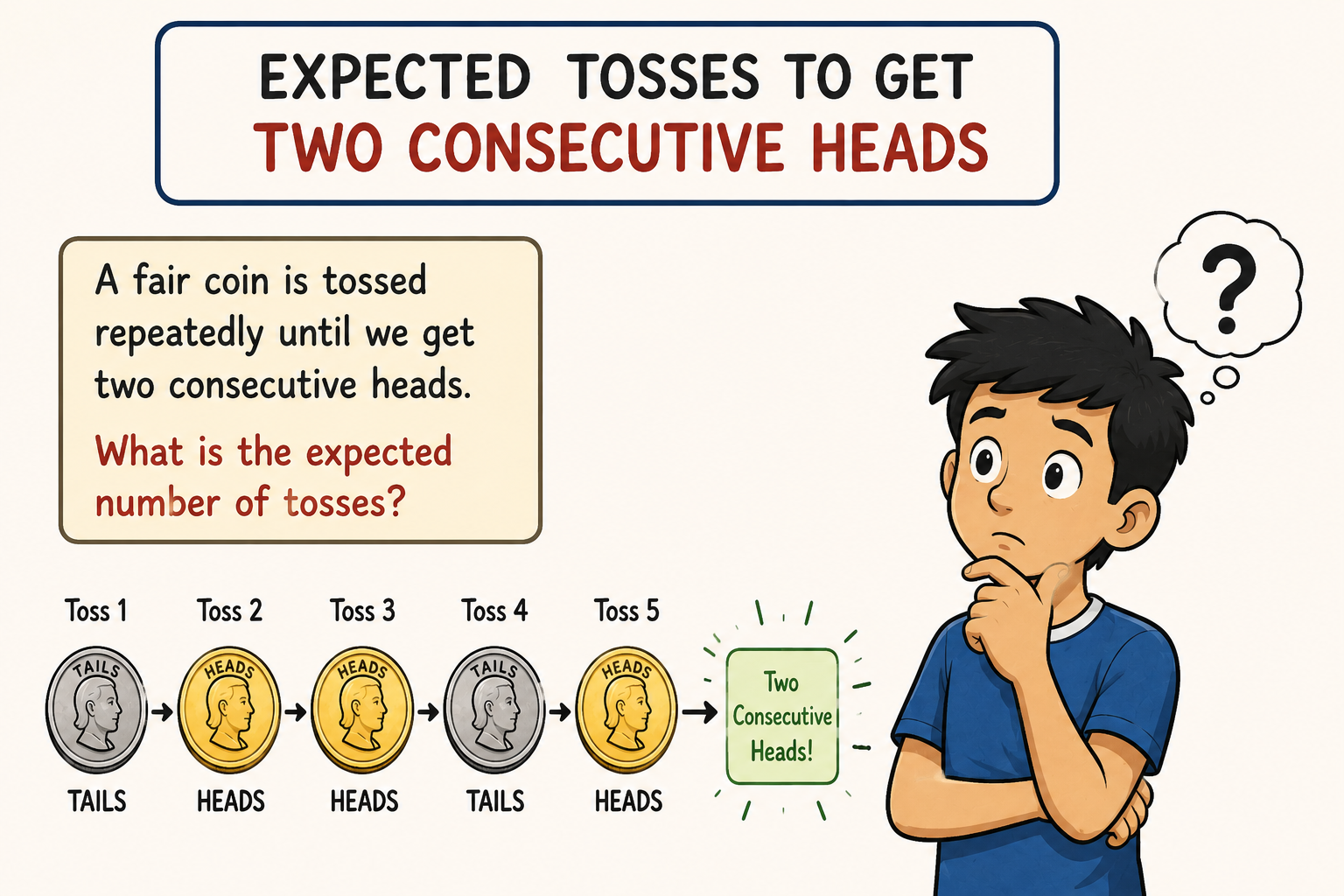
You flip a fair coin repeatedly, stopping the moment you see two heads in a row for the first time.
Rules
- The coin is fair and independent each flip
- You stop at the first HH streak
- Every flip made counts toward the total
Your task — Find the expected number of flips needed to see two heads in a row.
Difficulty — Hard
Hint 1 — Track your current streak state.
Hint 2 — Write an equation per state.
Hint 3 — Solve the two equations together.
Main idea — Splitting the process into states, no streak and one head in a row, turns the problem into a small system of linear equations.
Solution
- Let E0 be the expected flips remaining from no streak, and E1 from a one-head streak.
- From state E0: E0 equals 1 plus half of E1 plus half of E0.
- From state E1: E1 equals 1 plus half of E0, since a tail resets to state E0.
- Solving both equations together gives E0 equal to 6.
Reasoning
Each state's expected remaining flips depends only on what the very next flip does: it either advances the streak toward HH or resets it back to the start.
Writing one equation per state and solving the resulting system shows that six flips are needed on average before two heads appear in a row, a result that isn't obvious from intuition alone.
7. The Drunkard's Walk
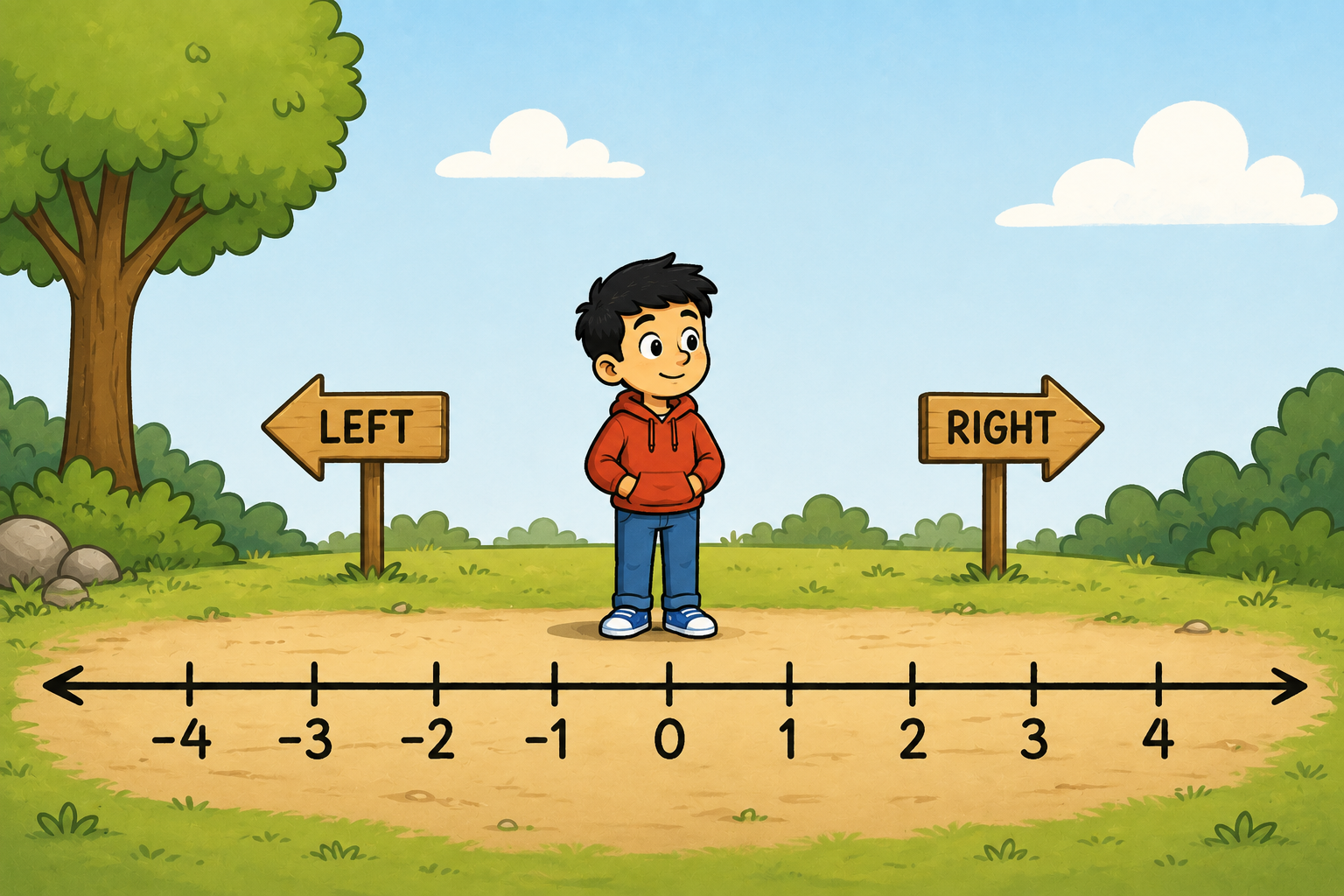
A drunkard starts at position 0 on a number line. At every step, he moves one unit right with probability one half, or one unit left with probability one half, independently of all previous steps.
Rules
- Each step is plus one or minus one
- Each step is equally likely, independent
- He starts exactly at position 0
Your task — Find the expected position after n steps, and describe how his distance from the start behaves as n grows.
Difficulty — Hard
Hint 1 — Average of plus one and minus one?
Hint 2 — Use linearity of expectation.
Hint 3 — Distance still grows, position doesn't drift.
Main idea — Because every step is equally likely to cancel a previous one, the expected position stays at zero forever, even as the walker typically drifts farther from the start.
Solution
- Each single step has an expected value of zero, since a half chance of plus one and a half chance of minus one average to zero.
- By linearity of expectation, the expected position after n steps is n times zero, which is zero.
- Even so, the expected distance from zero grows roughly with the square root of n, not with zero.
Reasoning
Since the steps are independent and symmetric, positive and negative moves cancel out on average, which keeps the expected position pinned at zero no matter how many steps are taken.
That cancellation in the average doesn't mean the walker stays near the start: the variance of the position grows linearly with the number of steps, so a typical walk ends up a distance proportional to the square root of n away, showing why expected value alone can hide the real spread of a random process.