Puzzles
Number Theory & Mathematical Logic
These puzzles use the structure of numbers themselves, sums, factors, remainders, and fixed rules, to reach a single, defensible answer. The skill is finding the right arithmetic identity or property to exploit, rather than searching or guessing.
1. The Missing Number, by Sum
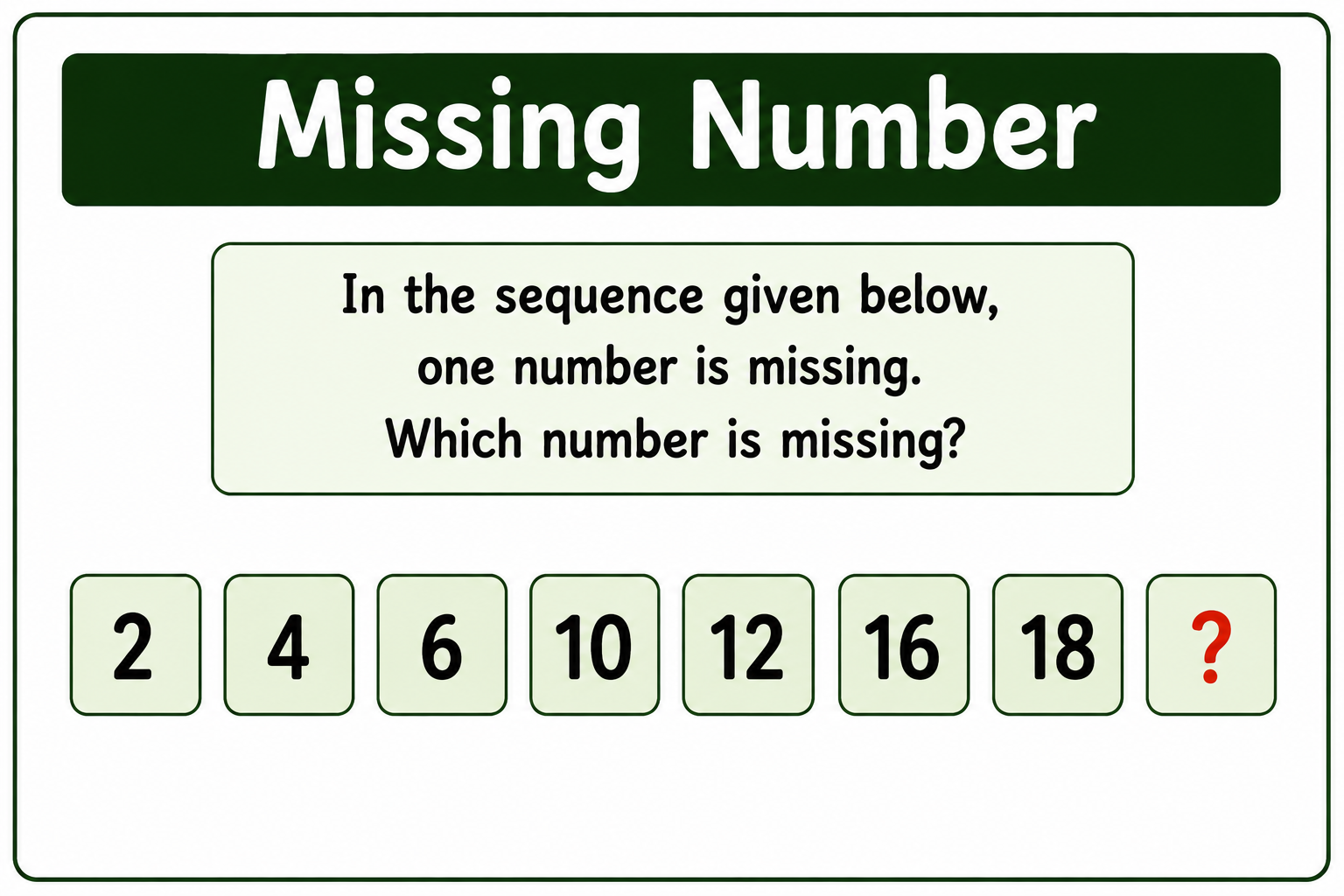
An array contains every integer from 1 to n exactly once, except one number is missing. You may scan the array only once.
Rules
- Numbers 1 through n, one missing
- Each remaining number appears exactly once
- Only a single pass is allowed
Your task — Find the missing number using a technique based on sums rather than bitwise operations.
Difficulty — Easy
Hint 1 — Sum of 1 to n has a formula.
Hint 2 — Sum the array too.
Hint 3 — Subtract the two sums.
Main idea — The formula for the sum of the first n integers gives the expected total, and subtracting the array's actual sum from it isolates exactly the missing number.
Solution
- Compute the expected sum of 1 through n using n(n plus 1) divided by 2.
- Compute the actual sum of every number present in the array.
- Subtract the actual sum from the expected sum. The result is the missing number.
Reasoning
Since every number from 1 to n should appear exactly once, the sum of a complete array is fixed and predictable from a simple formula, so a single missing number creates a gap equal to exactly that number.
This sum-based method finds the answer in one pass, though for very large n it can risk overflow in a way the XOR-based version of this puzzle does not, which is why both techniques are worth knowing.
2. The Age Problem
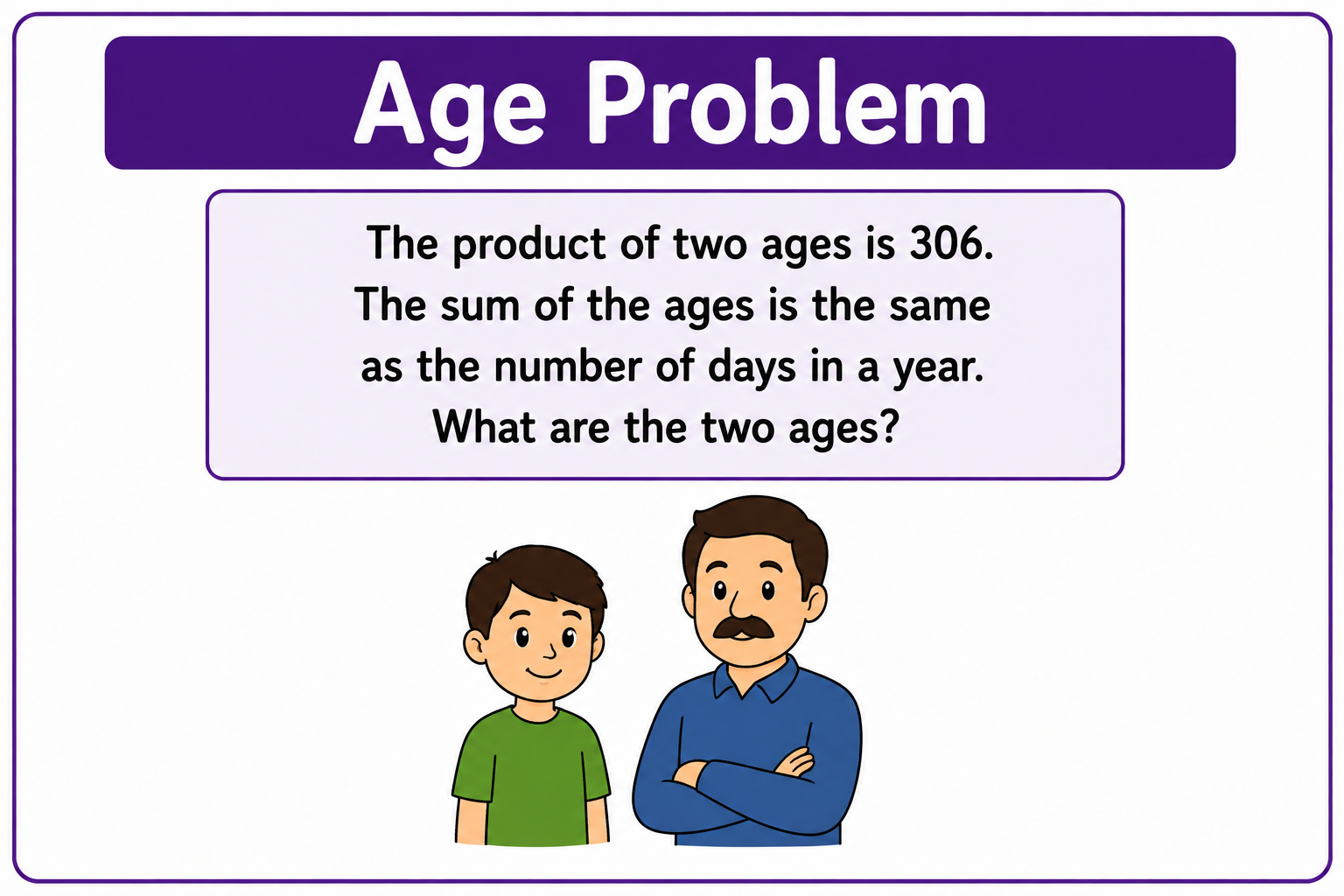
A father is currently exactly 3 times as old as his son. In 12 years, he will be exactly twice as old as his son.
Rules
- Father is now 3 times the son's age
- In 12 years, father is twice the son's age
- Both ages increase by the same amount yearly
Your task — Find both of their current ages.
Difficulty — Medium
Hint 1 — Let the son's age be a variable.
Hint 2 — Write both facts as equations.
Hint 3 — Solve for the son's age first.
Main idea — Translating each sentence directly into an algebraic equation turns a word puzzle into a simple system that solves for one variable at a time.
Solution
- Let the son's current age be s, so the father's current age is 3s.
- In 12 years, the father is 3s plus 12 and the son is s plus 12, giving the equation 3s plus 12 equals 2 times (s plus 12).
- Solving gives s equal to 12, so the son is 12 and the father is 36.
Reasoning
Every relationship in the puzzle becomes a linear equation once ages are represented algebraically, and since both people age at the same rate, adding 12 years shifts both sides equally without changing the underlying relationship.
Solving the resulting single-variable equation pins down both ages uniquely, showing how age-difference puzzles reduce to straightforward algebra despite sounding tricky in words.
3. The Divisibility Puzzle
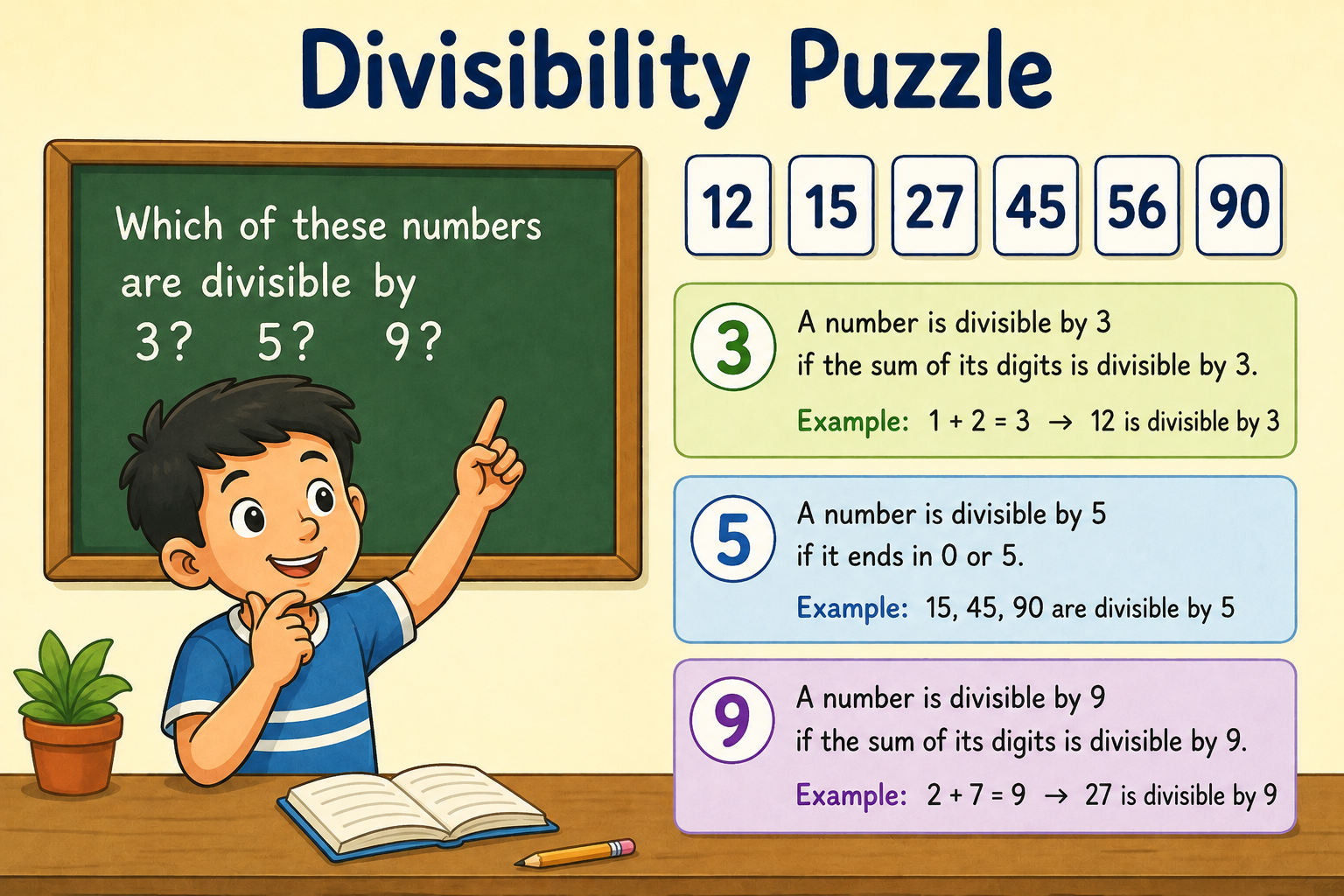
You want the smallest positive number that is evenly divisible by every integer from 1 through 10.
Rules
- Must divide evenly by 1 through 10
- You want the smallest such number
- All ten divisions must leave no remainder
Your task — Find that smallest number.
Difficulty — Medium
Hint 1 — Think prime factors, not the numbers.
Hint 2 — Take the highest power of each prime.
Hint 3 — Multiply those highest powers together.
Main idea — A number divisible by everything from 1 to 10 must contain the highest power of every prime appearing in that range, and multiplying just those highest powers together gives the smallest such number.
Solution
- List the prime factorizations of 1 through 10, noting that 8 is 2 cubed and 9 is 3 squared.
- For each prime, take the highest power appearing among 1 through 10: 2 cubed from 8, 3 squared from 9, 5 from 5 or 10, and 7 from 7.
- Multiply these highest powers together: 8 times 9 times 5 times 7, which equals 2520.
Reasoning
Any number divisible by all of 1 through 10 must be divisible by each of their prime power components individually, and the smallest number satisfying every requirement at once is exactly their least common multiple.
Using only the highest power of each prime, rather than multiplying every number together directly, avoids unnecessary repeated factors and gives the true minimum, 2520.
4. The Integer Sequence Puzzle
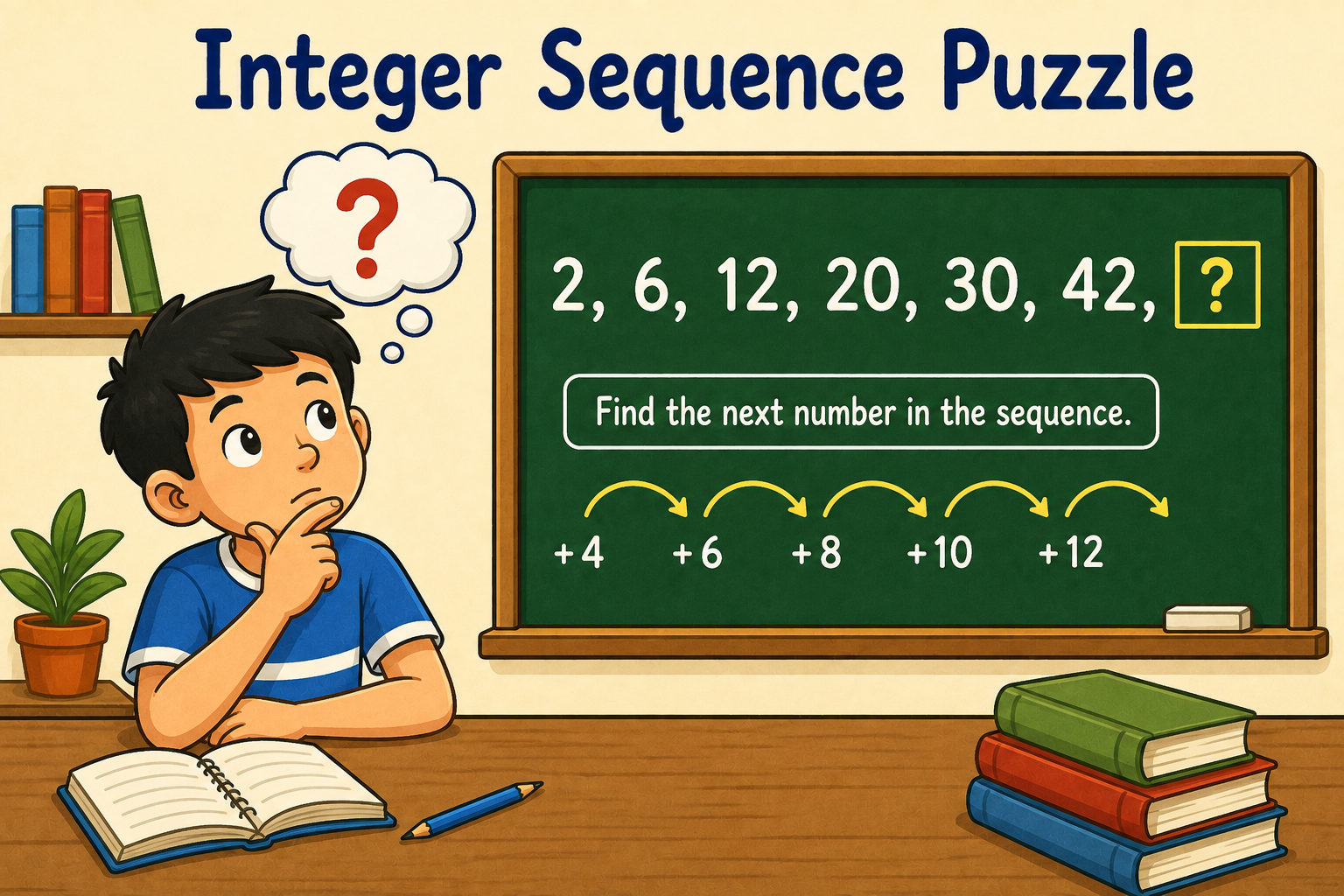
Consider the sequence 1, 3, 6, 10, 15, 21.
Rules
- The sequence starts at 1
- Each term follows one describable rule
- The rule must fit every given term exactly
Your task — Find the next term in the sequence and state the general rule that generates it.
Difficulty — Medium
Hint 1 — Look at the gaps between terms.
Hint 2 — Those gaps grow by exactly one.
Hint 3 — These are the triangular numbers.
Main idea — The differences between consecutive terms increase by exactly one each time, which is the defining property of the triangular numbers, each one the sum of all integers up to n.
Solution
- The differences between consecutive terms are 2, 3, 4, 5, 6, increasing by 1 each time.
- The next difference should be 7, so the next term is 21 plus 7, which is 28.
- In general, the n-th term equals n(n plus 1) divided by 2, the formula for the sum of the first n integers.
Reasoning
Because each difference grows by exactly 1, the sequence is built by repeatedly adding the next integer, precisely how triangular numbers are defined.
Checking the formula n(n plus 1) divided by 2 against every given term confirms it matches exactly, giving one defensible rule rather than a guess, unlike ambiguous pattern-matching sequences that could fit several different rules.
5. The Remainder Puzzle
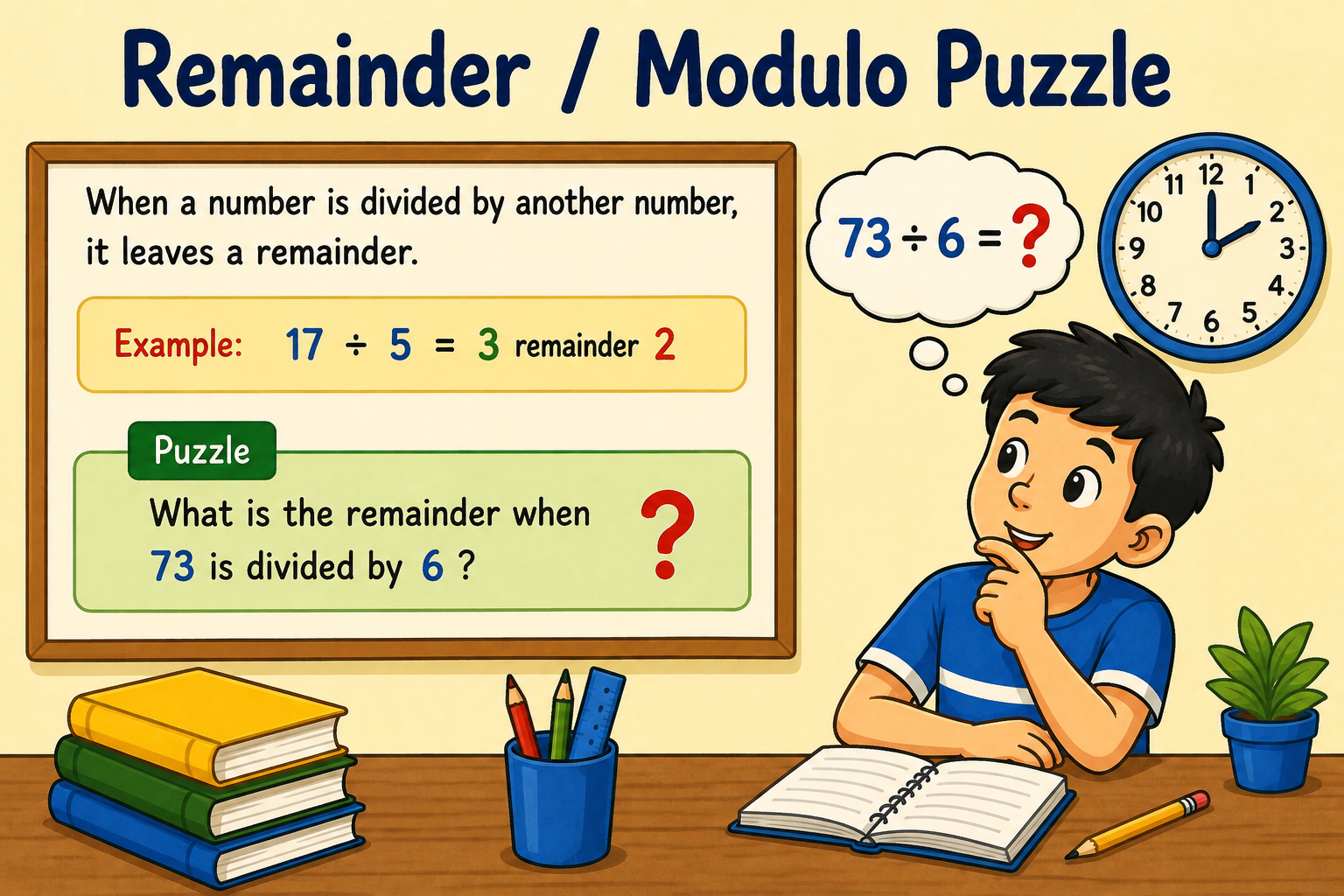
Find the smallest positive integer that leaves a remainder of 2 when divided by 3, a remainder of 3 when divided by 4, and a remainder of 1 when divided by 5.
Rules
- Remainder 2 when divided by 3
- Remainder 3 when divided by 4
- Remainder 1 when divided by 5
Your task — Find the smallest positive integer satisfying all three conditions at once.
Difficulty — Hard
Hint 1 — Satisfy one condition at a time.
Hint 2 — Build candidates from the hardest condition.
Hint 3 — Check each candidate against the rest.
Main idea — Solving one remainder condition at a time and testing each growing candidate against the next condition narrows the search to a single smallest answer, the core idea behind the Chinese Remainder Theorem.
Solution
- List numbers leaving remainder 3 when divided by 4: 3, 7, 11, 15, 19, and so on.
- Check each against remainder 2 when divided by 3: 3 fails, 7 fails, 11 works, since 11 equals 3 times 3 plus 2.
- Confirm 11 also leaves remainder 1 when divided by 5: 11 equals 5 times 2 plus 1, which checks out, so 11 is the smallest number satisfying all three conditions.
Reasoning
Building the candidate list for one condition and testing each against the next narrows the search efficiently, rather than checking every integer blindly.
Because the divisors 3, 4, and 5 share no common factors, exactly one answer exists in every stretch of 60 consecutive numbers, their product, and 11 is the smallest positive one, the same reasoning that scales up to the full Chinese Remainder Theorem for larger systems.