Puzzles
Sequence & Pattern Recognition
Every sequence here is fixed by a rule that fits every given term exactly, never by a rule that merely seems to fit. The skill is finding that one rule and proving it holds across every example given, not just guessing whatever comes next.
1. The Look-and-Say Sequence
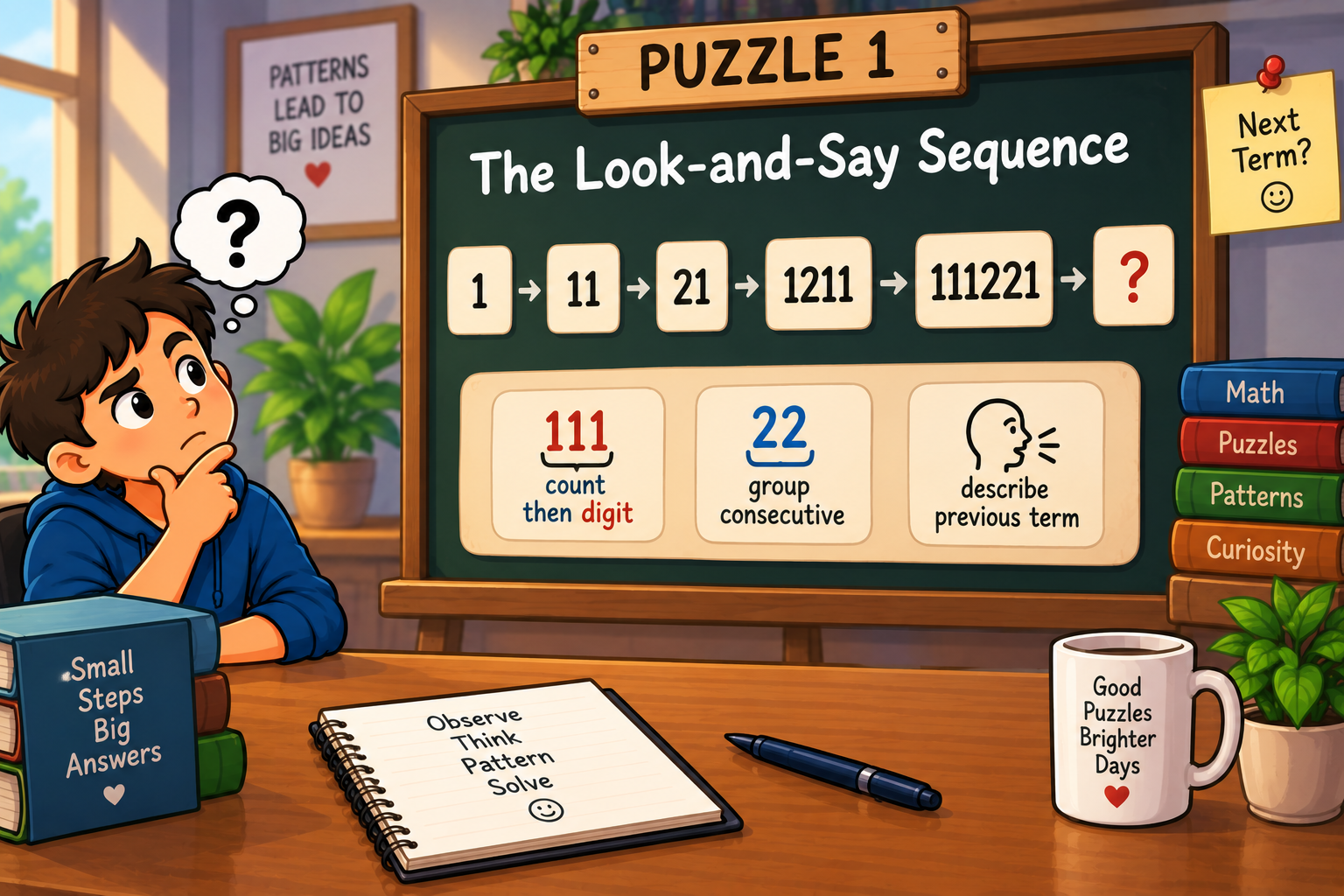
The sequence begins: 1, 11, 21, 1211, 111221.
Rules
- Each term describes the previous term aloud
- Digits are grouped by consecutive repeats
- Groups are read as count then digit
Your task — Find the next term in the sequence after 111221.
Difficulty — Medium
Hint 1 — Read the term out loud.
Hint 2 — Group repeated digits together.
Hint 3 — Write count, then digit, per group.
Main idea — Each term is generated by literally describing the digits of the previous term, counting how many of each digit appear in a row and writing that count immediately before the digit.
Solution
- Read 111221 by grouping repeated digits: three 1s, two 2s, one 1.
- Convert each group into "count, digit": three 1's becomes 31, two 2's becomes 22, one 1 becomes 11.
- Concatenating these gives the next term: 312211.
Reasoning
The rule is entirely mechanical: look at the current term, describe it digit-group by digit-group, and write that description as the next term, which is why this is called the look-and-say sequence.
Because the grouping of consecutive identical digits in any string is always unique, there is exactly one correct next term, with no ambiguity about which grouping to use.
2. The Missing Number in the Sequence
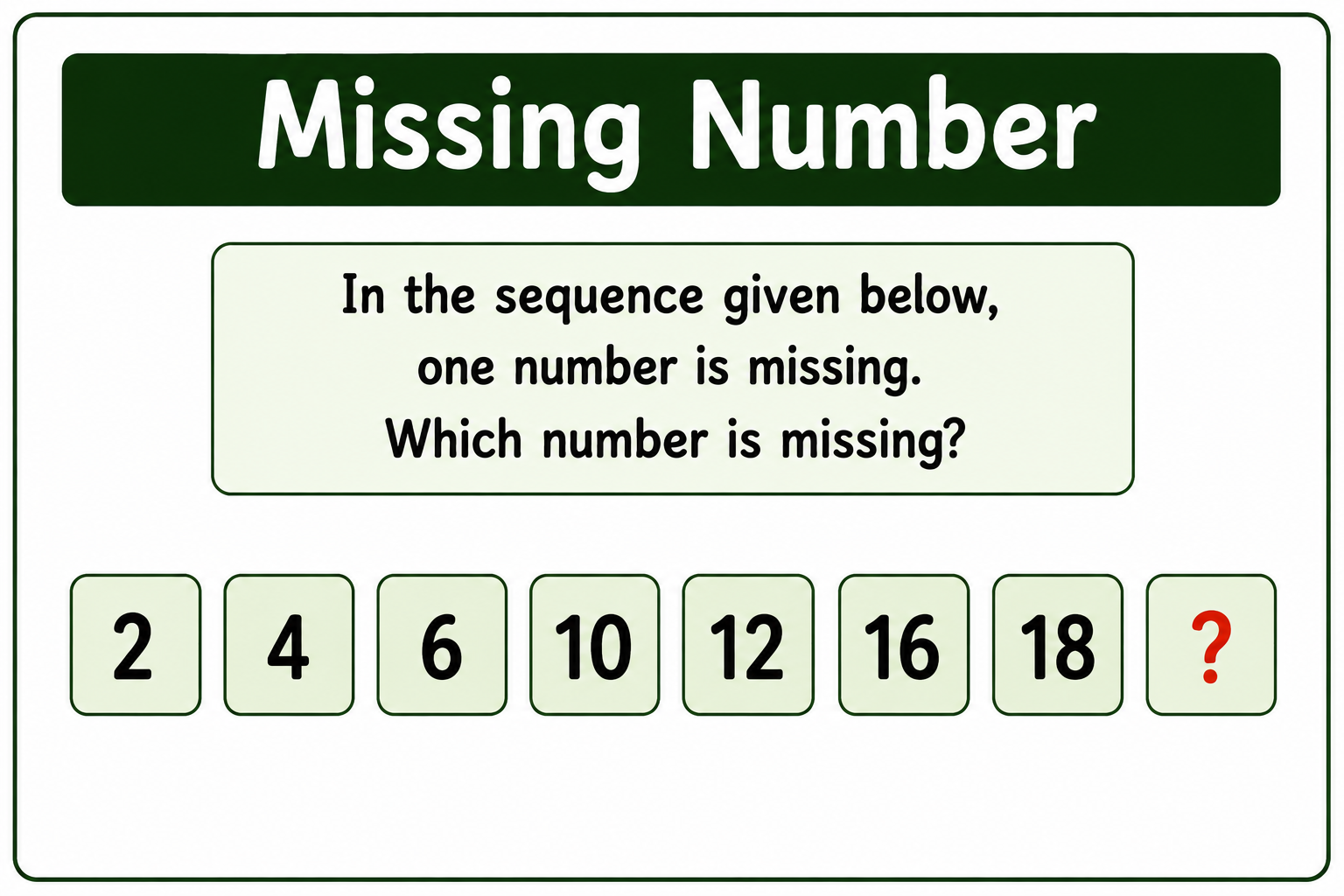
Consider the sequence 2, 5, 10, 17, blank, 37.
Rules
- The sequence follows one fixed, describable rule
- The rule must fit every given term exactly
- Exactly one term is missing
Your task — Find the missing number and describe the rule behind the sequence.
Difficulty — Easy
Hint 1 — Subtract 1 from each term.
Hint 2 — Compare what's left to squares.
Hint 3 — Each term is a square plus one.
Main idea — Subtracting 1 from every term reveals the perfect squares 1, 4, 9, 16, 25, 36, showing that each term is simply a square number plus one.
Solution
- Subtract 1 from each given term: 1, 4, 9, 16, and 36.
- These results are consecutive perfect squares, missing only 25 in that pattern.
- Adding 1 back gives the missing term: 25 plus 1, which is 26.
Reasoning
Once the pattern is recognized as "square number plus one," every term is forced by its position, since the n-th term must equal n squared plus 1.
Checking this formula against all five given terms confirms it fits exactly, making 26 the only number that keeps the rule consistent, not merely a plausible guess.
3. Fibonacci Variations
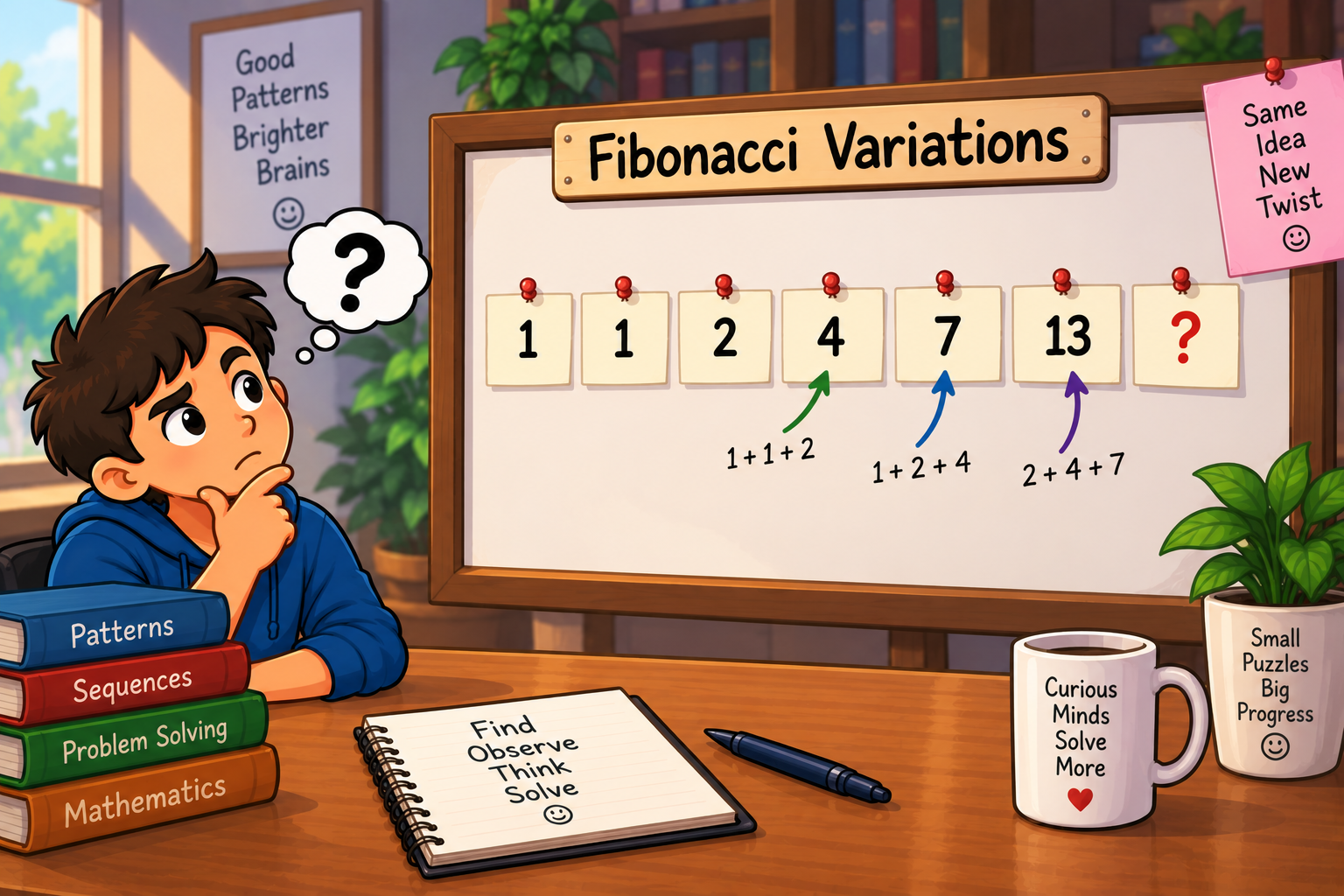
A sequence starts 1, 1, 2, and every term after that is the sum of the three preceding terms, not just two.
Rules
- The first three terms are 1, 1, 2
- Each new term sums the previous three
- The sequence continues indefinitely
Your task — Find the first eight terms of this sequence, and state the general rule.
Difficulty — Medium
Hint 1 — Fibonacci uses two terms back.
Hint 2 — This one adds one more term.
Hint 3 — Add the three most recent terms.
Main idea — This directly extends the ordinary Fibonacci rule: instead of summing the two previous terms, each new term sums the three previous terms, a sequence sometimes called Tribonacci.
Solution
- Start with the given terms: 1, 1, 2.
- The 4th term is 1 plus 1 plus 2, which is 4.
- Continuing this rule gives the first eight terms: 1, 1, 2, 4, 7, 13, 24, 44.
Reasoning
Each new term depends only on the three terms directly before it, so once the starting values are fixed, the entire sequence is completely determined with no ambiguity.
This variation shows how changing one detail in a recurrence, how many previous terms get summed, produces a related but distinctly different sequence with its own name and growth rate.
4. The Number Pyramid
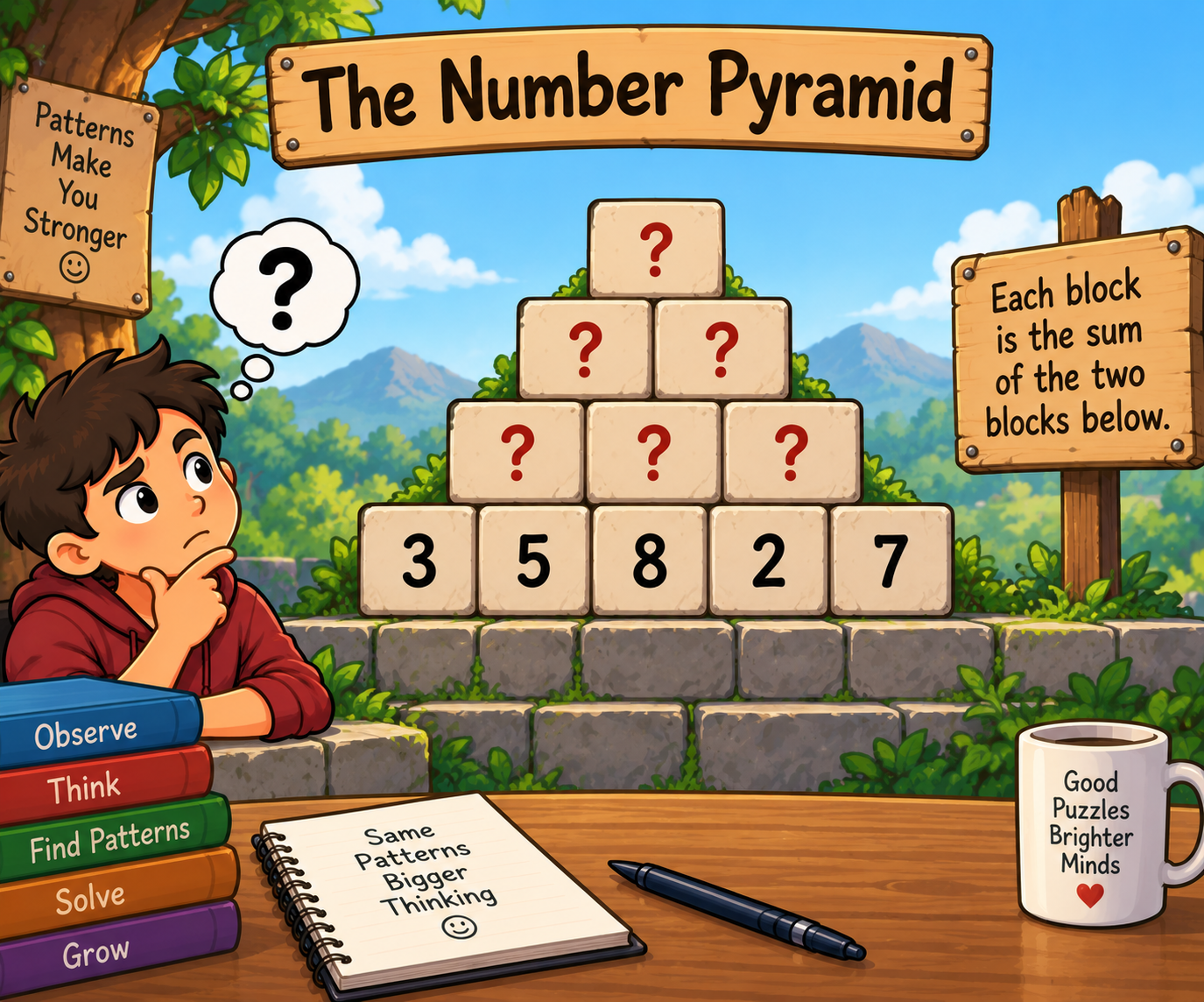
A pyramid of numbers has 5 numbers on its bottom row: 3, 5, 8, 2, 7. Every number above the bottom row is the sum of the two numbers directly below it.
Rules
- The bottom row has 5 given numbers
- Each cell above sums the two cells below
- The pyramid narrows by one cell per row
Your task — Find the single number at the very top of the pyramid.
Difficulty — Medium
Hint 1 — Build the pyramid row by row.
Hint 2 — Add adjacent pairs each time.
Hint 3 — Four rows lead to the top.
Main idea — Since every cell is completely determined by the two cells beneath it, building the pyramid one row at a time from the bottom up eventually forces a single, unique value at the top.
Solution
- Row 4, from the bottom row 3, 5, 8, 2, 7: 3+5=8, 5+8=13, 8+2=10, 2+7=9.
- Row 3, from 8, 13, 10, 9: 8+13=21, 13+10=23, 10+9=19.
- Row 2, from 21, 23, 19: 21+23=44, 23+19=42.
- Row 1, the top: 44 plus 42, which is 86.
Reasoning
Because each entry is simply the sum of the two entries below it, the entire pyramid is fully determined the moment the bottom row is fixed, with no choices at any step.
Working strictly bottom-up and adding adjacent pairs guarantees the correct top value, since each cell depends entirely on the row directly beneath it.
5. The Matchstick Sequence
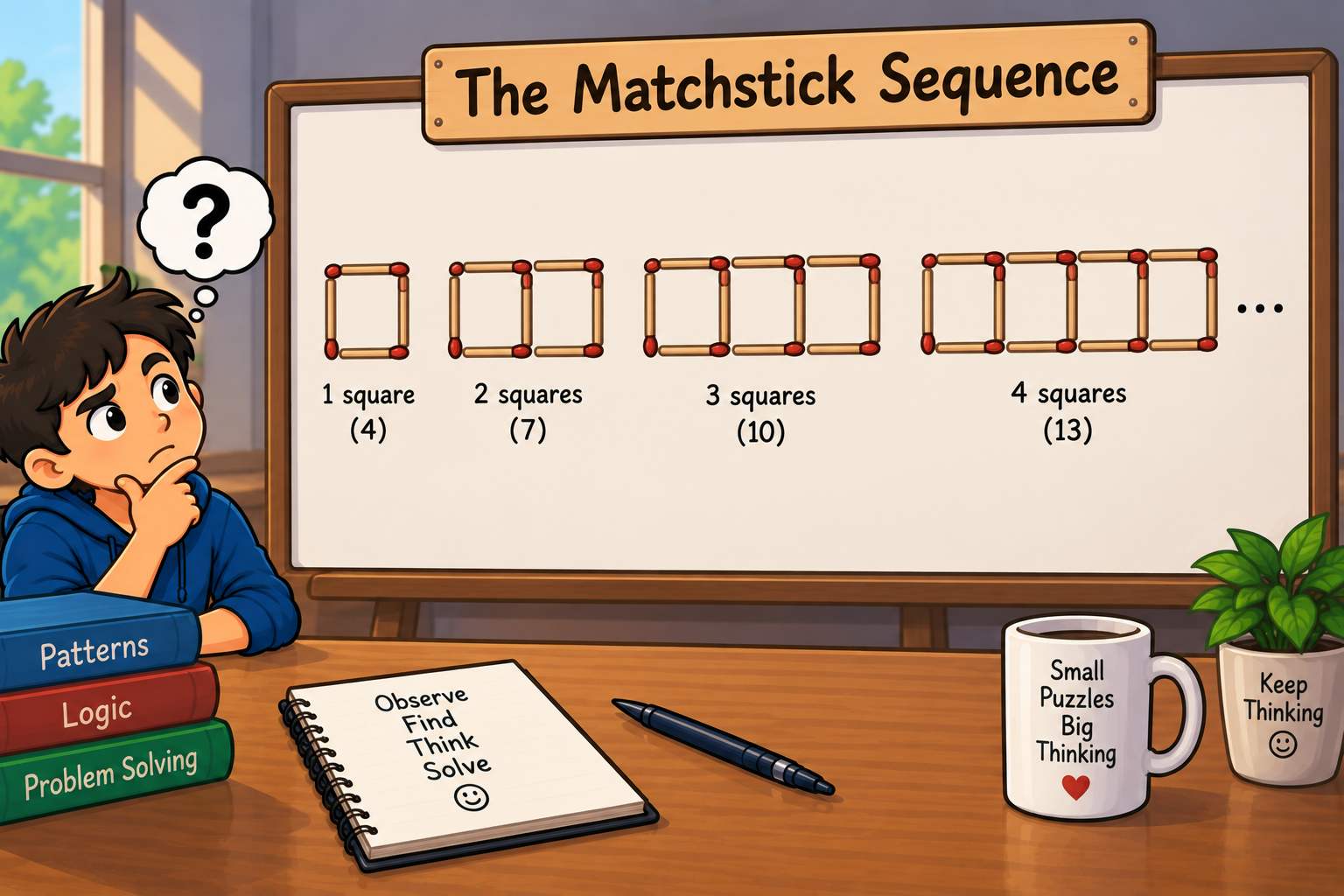
Matchsticks build a row of squares side by side, each new square sharing one side with the square before it. The first figure uses 4 matchsticks for one square, and each additional square added uses 3 more matchsticks.
Rules
- Squares are built in a single row
- Adjacent squares share one matchstick side
- The first square uses 4 matchsticks total
Your task — Find a formula for the total matchsticks needed for a row of n squares, and check it for n equal to 10.
Difficulty — Easy
Hint 1 — The first square costs 4 sticks.
Hint 2 — Each extra square costs 3 more.
Hint 3 — Add that extra cost n minus 1 times.
Main idea — Only the very first square needs all 4 of its sides built from scratch, and every square after that reuses one shared side, needing only 3 new matchsticks.
Solution
- The first square uses 4 matchsticks.
- Every additional square adds exactly 3 more matchsticks, since one side is already shared with the previous square.
- For n squares, the total is 4 plus 3 times (n minus 1). For n equal to 10, that's 4 plus 27, or 31 matchsticks.
Reasoning
Because each new square after the first only adds its own three new sides, the growth in matchstick count is a simple linear function of the number of squares, not four times that number.
Verifying the formula against small cases, one square needs 4 and two squares need 7, confirms the pattern before applying it to larger values like 10.
6. Pattern of Squares
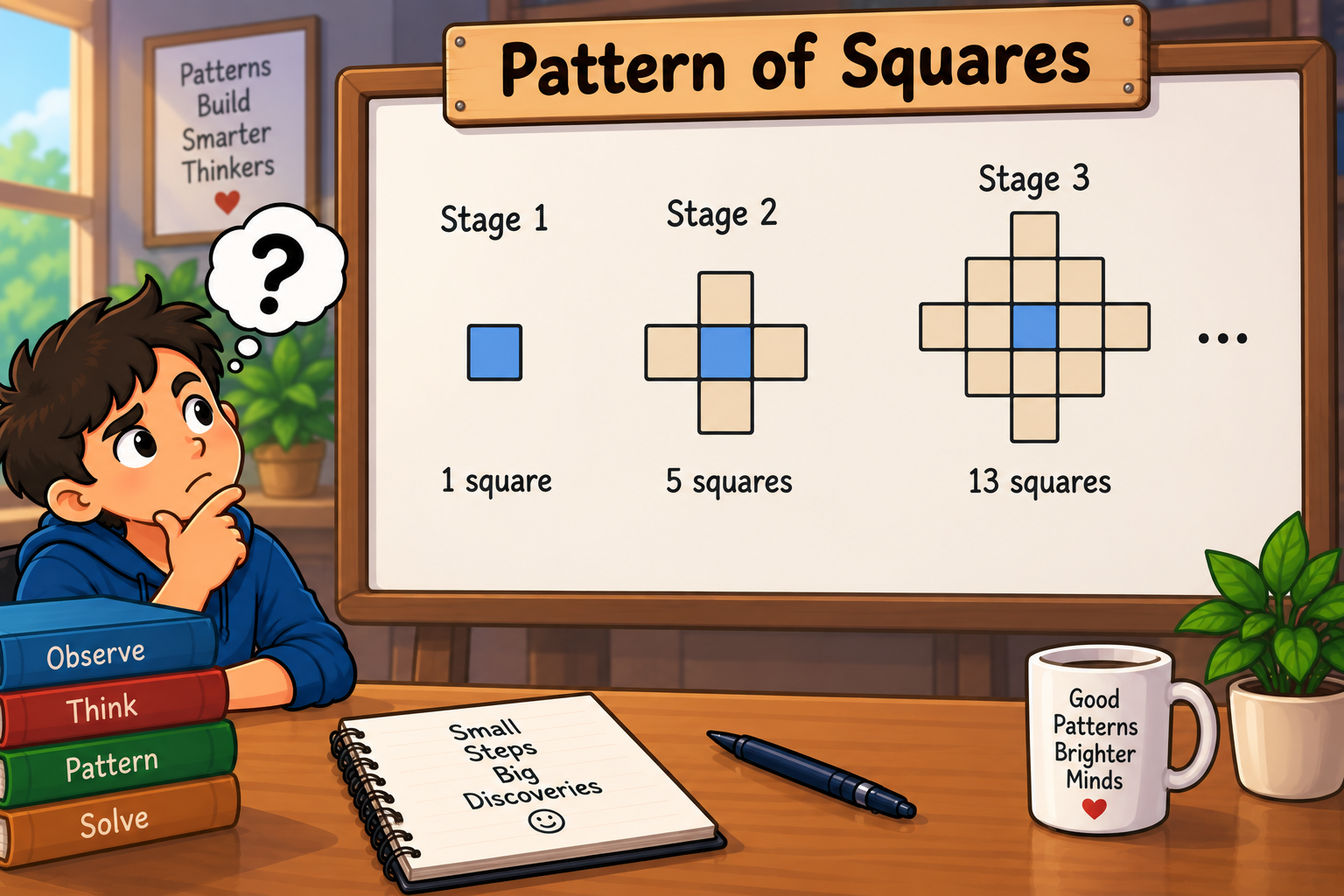
A pattern of small unit squares grows outward from a single central square, adding a complete ring of new squares around the previous shape at each stage. Stage 1 has 1 square, stage 2 has 5 squares total, and stage 3 has 13 squares total.
Rules
- Stage 1 begins with 1 square
- Each new stage adds one complete ring
- Ring sizes grow in a fixed way
Your task — Find the total number of squares in stage 6 of this pattern.
Difficulty — Medium
Hint 1 — Look at how much each ring adds.
Hint 2 — Ring sizes: 4, 8, 12.
Hint 3 — These are multiples of 4.
Main idea — Each new ring adds exactly 4 more squares than the ring before it, since a ring's size grows in multiples of 4 as it wraps further around the center.
Solution
- The squares added at each stage form the pattern 4, 8, 12, 16, each one 4 more than the last.
- Adding these up: stage 1 is 1, stage 2 is 5, stage 3 is 13, stage 4 is 25, stage 5 is 41, stage 6 is 61.
- Stage 6 has a total of 61 squares.
Reasoning
Since each ring adds a fixed, predictable amount more than the last, the running total at any stage is the sum of 1 plus all the ring sizes added so far, which can also be written as the formula 2 times n squared minus 2n plus 1 for stage n.
Checking this formula against stage 6 confirms 61, matching the step-by-step total exactly.
7. Growing Shapes
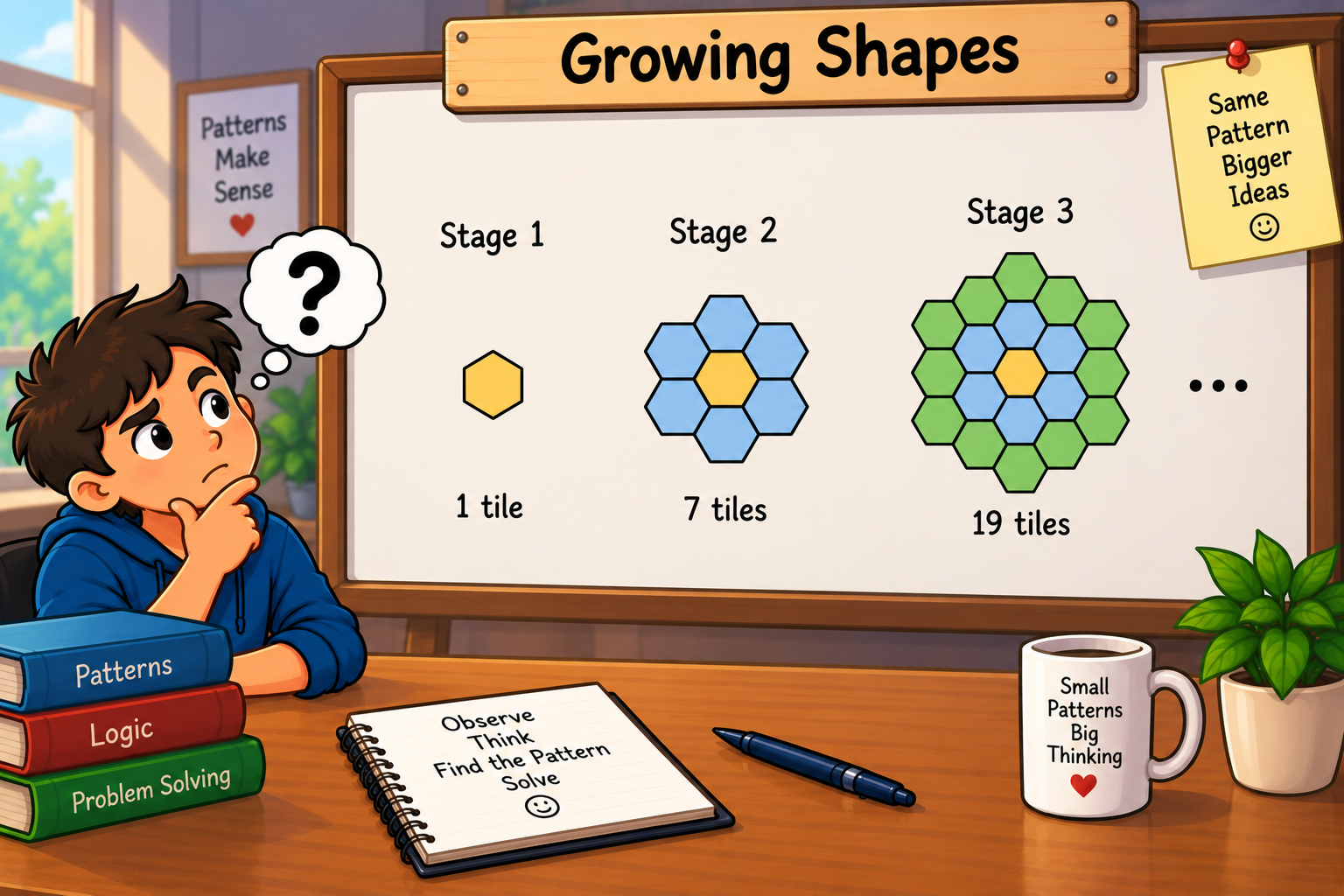
A pattern of small hexagonal tiles grows outward from a single central tile, adding a complete ring of new tiles around the shape at each stage. Stage 1 has 1 tile, stage 2 has 7 tiles total, and stage 3 has 19 tiles total.
Rules
- Stage 1 begins with 1 tile
- Each stage adds one complete ring
- Ring sizes grow in a fixed way
Your task — Find the total number of tiles in stage 5 of this pattern.
Difficulty — Medium
Hint 1 — Look at how much each ring adds.
Hint 2 — Ring sizes: 6, 12, 18.
Hint 3 — These are multiples of 6.
Main idea — Each new ring around a hexagonal pattern adds exactly 6 more tiles than the ring before it, since a hexagon's perimeter grows in steps of 6 as it expands outward.
Solution
- The tiles added at each stage form the pattern 6, 12, 18, each one 6 more than the last.
- Adding these up: stage 1 is 1, stage 2 is 7, stage 3 is 19, stage 4 is 37, stage 5 is 61.
- Stage 5 has a total of 61 tiles.
Reasoning
Because each ring adds a fixed, growing amount tied to the hexagon's six sides, the running total can also be written directly as the formula 3 times n squared minus 3n plus 1 for stage n.
Checking this formula against stage 5 confirms 61, matching the step-by-step total exactly, the same kind of centered polygonal number pattern that appears throughout combinatorial geometry.
8. The Hidden Mathematical Pattern
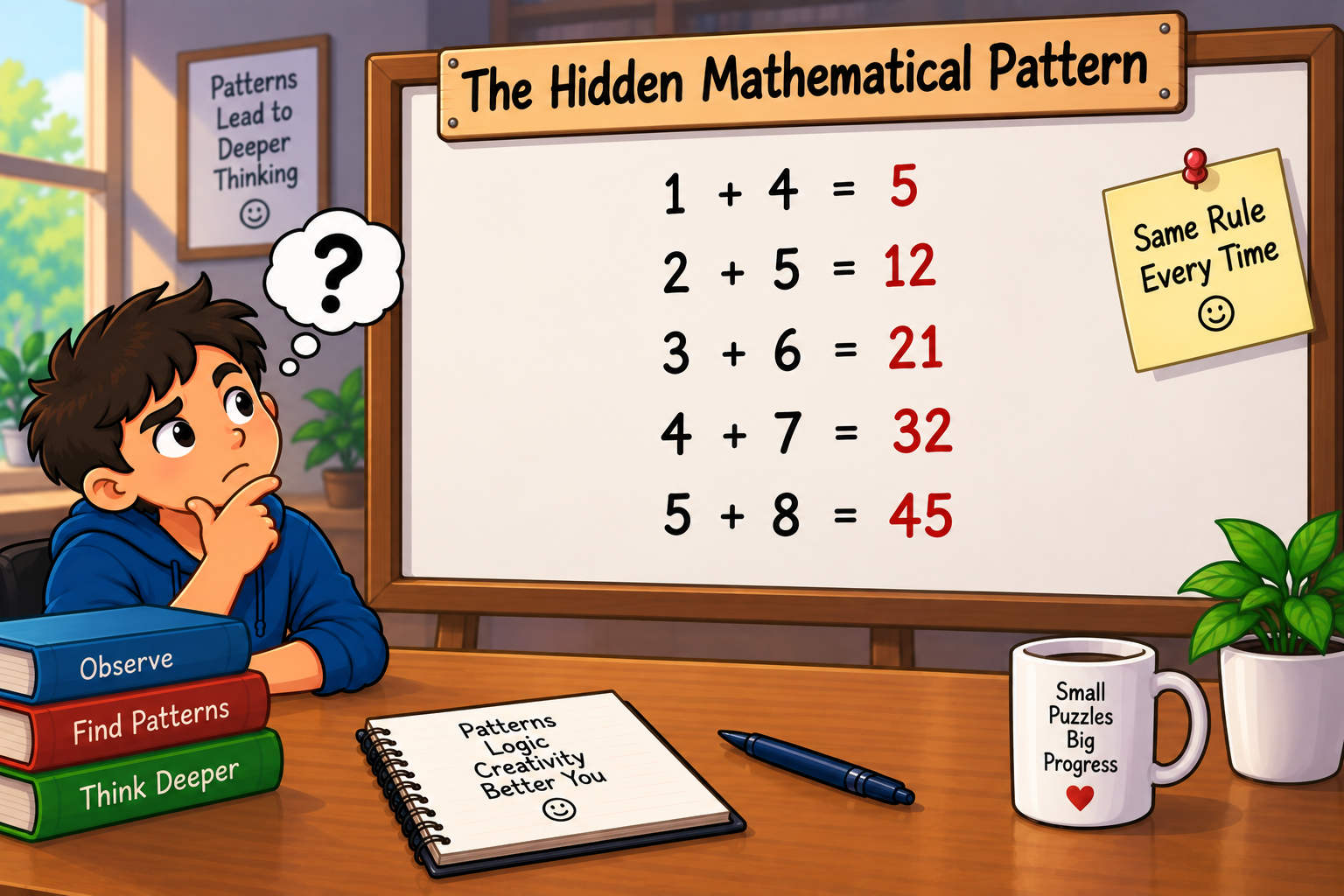
Consider the pattern: 1+4=5, 2+5=12, 3+6=21, 4+7=32, 5+8=45.
Rules
- Every equation follows the same hidden rule
- The rule must fit all five equations exactly
- The two numbers are never simply added directly
Your task — Using the same hidden rule, find the value of 8 plus 11.
Difficulty — Hard
Hint 1 — The two numbers aren't just added.
Hint 2 — Try multiplying the first by something.
Hint 3 — Multiply the first by (second plus 1).
Main idea — Each result comes from multiplying the first number by one more than the second number, a rule that fits every equation given exactly.
Solution
- Test the rule "first number times (second number plus 1)" against every equation: 1 times 5 is 5, 2 times 6 is 12, 3 times 7 is 21, 4 times 8 is 32, 5 times 9 is 45. All five match exactly.
- Apply the same rule to 8 and 11: 8 times (11 plus 1), which is 8 times 12.
- This equals 96.
Reasoning
A hidden pattern puzzle is only defensible if a single rule explains every given example without exception, and this multiplication rule does exactly that across all five equations, not just one or two.
Because the rule is confirmed by a full set of examples rather than guessed from just one, applying it to 8 and 11 gives a uniquely correct answer of 96, not merely a plausible-sounding one.