Puzzles
Constraints & Creative Thinking
In every one of these puzzles, the obvious first approach doesn't work, and the real skill is noticing which assumption is silently making the problem harder than it needs to be. Once that hidden constraint is questioned rather than accepted, the actual solution is usually simple to state.
1. Nine Dots, Four Lines
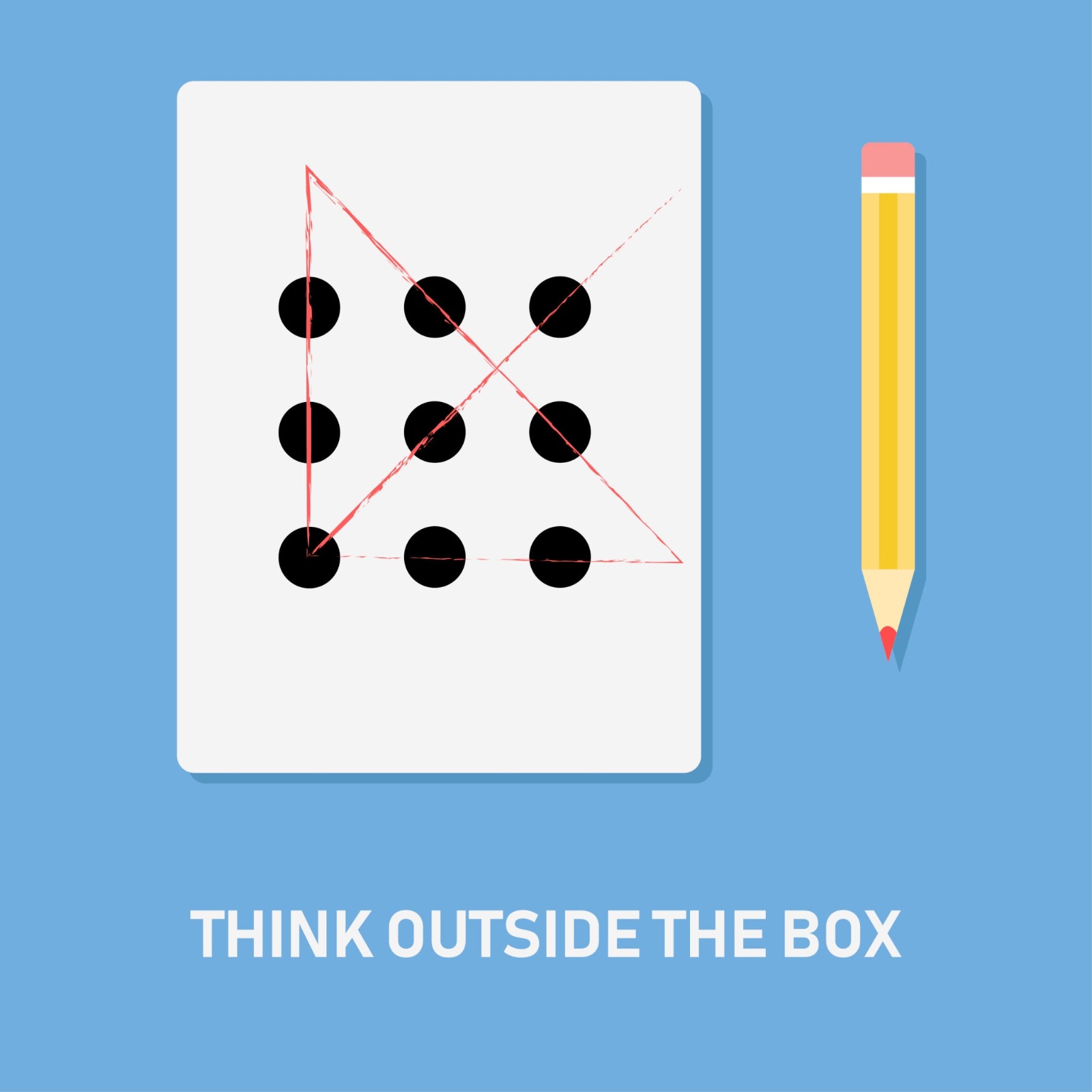
Nine dots are arranged in a 3 by 3 grid. Using a single continuous pen stroke made of exactly 4 straight line segments, connect all 9 dots.
Rules
- Exactly 4 straight line segments are used
- The pen never lifts between segments
- No rule says lines must stay inside the grid
Your task — Find a way to connect all 9 dots under these conditions.
Difficulty — Medium
Hint 1 — Assume the lines must stay inside the square.
Hint 2 — That assumption is the actual obstacle.
Hint 3 — Let lines extend past the grid's edge.
Main idea — The puzzle only feels impossible if you assume every line must stay within the boundary formed by the dots themselves, an assumption the rules never actually state.
Solution
- Start at a corner dot and draw a line through the two other dots in that row, continuing past the grid's edge.
- Angle back diagonally through a middle dot, continuing past the grid's edge on the opposite side.
- Draw a line straight through another full row or column, extending past the edge again.
- Draw a final diagonal line back through the remaining unconnected dots, completing the stroke.
Reasoning
The classic difficulty of this puzzle comes entirely from an unstated, self-imposed boundary, since nothing in the rules restricts the lines to the square outlined by the dots themselves.
Once a solver allows lines to extend beyond that imagined boundary, connecting all 9 dots in exactly 4 straight strokes becomes straightforward, which is precisely why this puzzle is used to illustrate creative thinking under constraints that are assumed rather than real.
2. The Rope Burning Puzzle
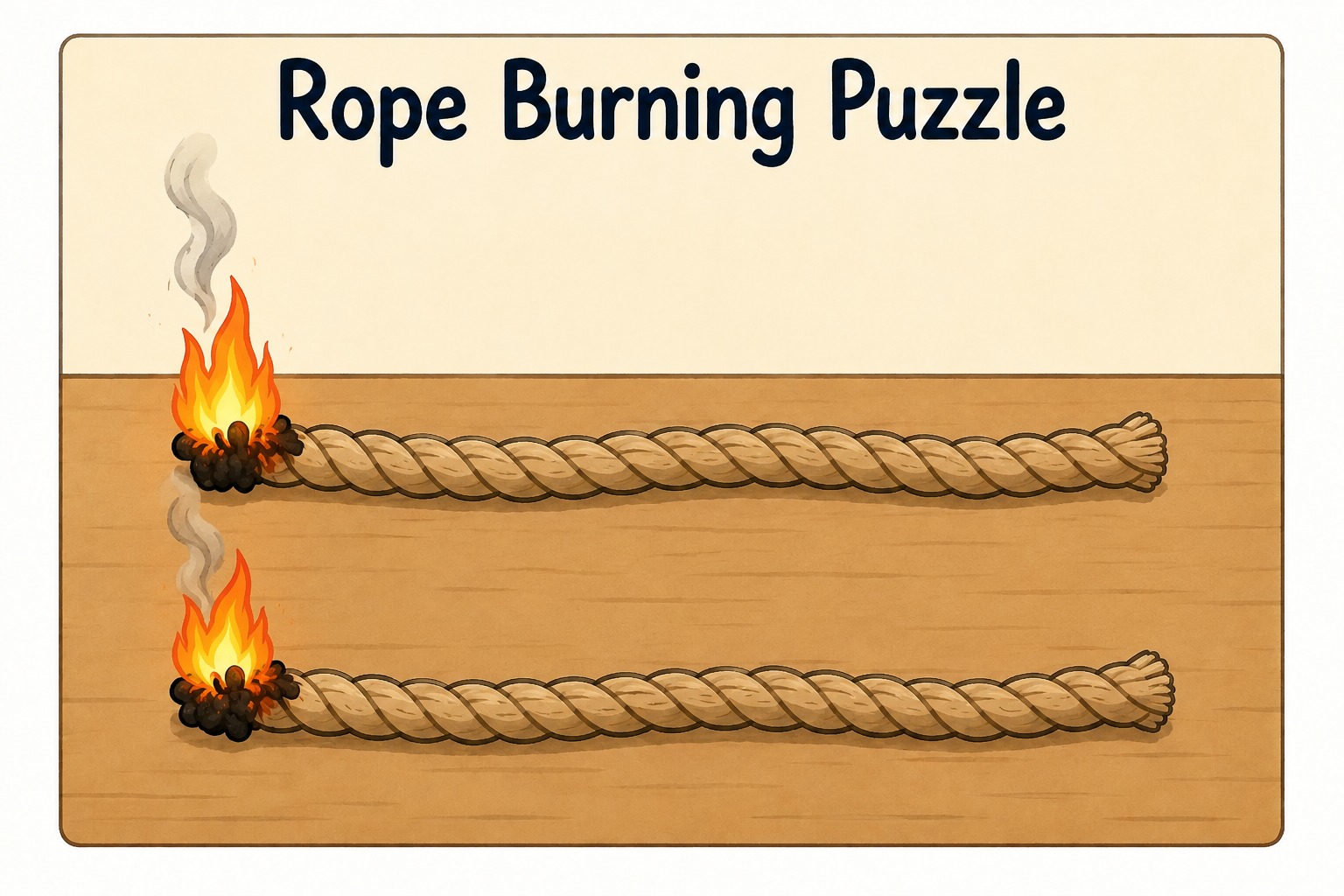
You have two ropes, each of which takes exactly 60 minutes to burn completely from one end to the other, but each rope burns unevenly along its length, so half the rope might burn in 10 minutes while the other half takes 50. You have matches, and can light a rope at either end, or both ends at once.
Rules
- Each full rope always burns for exactly 60 minutes
- Burning is uneven, so distance means nothing
- Ropes can be lit at one or both ends
Your task — Find a way to measure exactly 45 minutes using only these two ropes and matches.
Difficulty — Hard
Hint 1 — Lighting both ends changes the rate.
Hint 2 — Both ends finishes in half the time.
Hint 3 — Stagger when you light the second rope.
Main idea — Lighting a rope at both ends at once always burns it completely in exactly half its normal time, regardless of how unevenly it burns internally, giving a reliable way to measure half of any known duration.
Solution
- Light the first rope at both ends and the second rope at only one end, at the same starting moment.
- The first rope, burning from both ends, finishes in exactly 30 minutes, regardless of its uneven burn rate.
- The instant the first rope finishes, light the second end of the second rope too. It has 30 minutes worth of unburned rope left, so burning both remaining ends finishes it in exactly 15 more minutes.
- Adding these together, 30 minutes plus 15 minutes, gives exactly 45 minutes total.
Reasoning
Because a rope burning from both ends always meets in the middle after exactly half its total time, no matter how unevenly it burns internally, this trick gives an exact time measurement even when the rope's burn rate can't be trusted at any single point.
Applying the double-ended trick a second time, to whatever portion is left of the second rope after 30 minutes, always halves whatever time remains, which is why 30 plus 15 reliably produces exactly 45 minutes.
3. River Crossing: Men and Boys
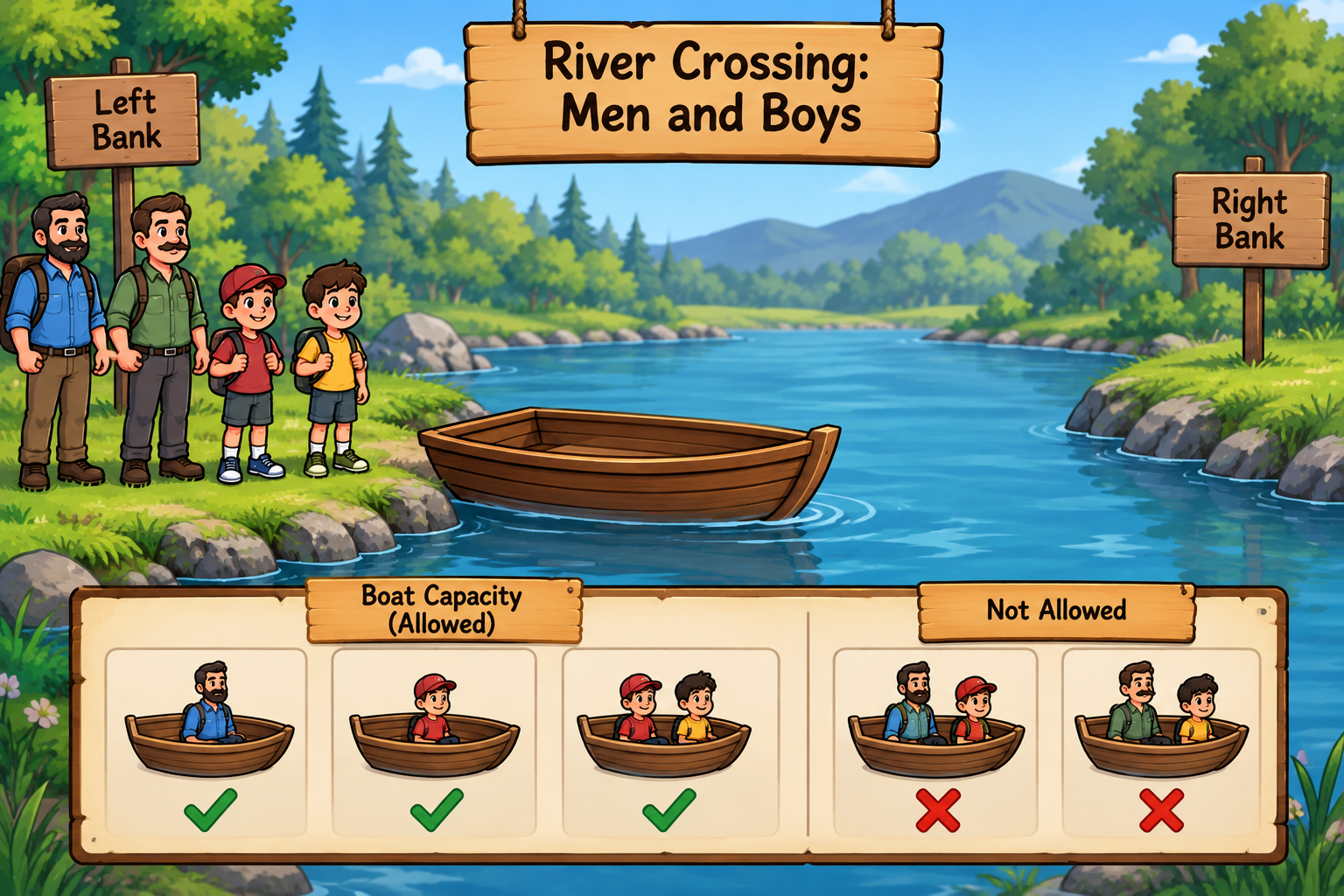
Two men and two boys need to cross a river using a small boat. The boat can carry either one man alone, or one or two boys together, but it can never carry a man and a boy at the same time.
Rules
- The boat holds 1 man alone, or 1-2 boys
- A man and a boy can never ride together
- The boat needs at least one rider to move
Your task — Find the minimum number of crossings needed to get everyone across.
Difficulty — Medium
Hint 1 — The boys must ferry the boat back.
Hint 2 — Get one man across, then reset the boys.
Hint 3 — Repeat the same cycle for the second man.
Main idea — Since a man can only cross alone, the two boys have to handle every return trip, which means each man's crossing costs a fixed, repeatable cycle of boy-only trips built around it.
Solution
- Both boys cross, then one boy returns.
- The first man crosses alone, then the boy who was waiting on the far side returns.
- Both boys cross again, then one boy returns.
- The second man crosses alone, then the remaining boy returns one last time.
- Both boys cross together, completing the trip in 9 total crossings.
Reasoning
Because a man can never share the boat with a boy, every time a man crosses, both boys must already be positioned so that one of them can bring the boat back afterward, which forces the same 4-crossing cycle, both boys over, one back, the man over, the other boy back, to repeat for each man.
With two men needing this treatment plus one final crossing to reunite both boys with both men, the total comes to exactly 9 crossings, and no shorter sequence can satisfy the constraint that a man and a boy never ride together.
4. Wolf, Goat, and Cabbage
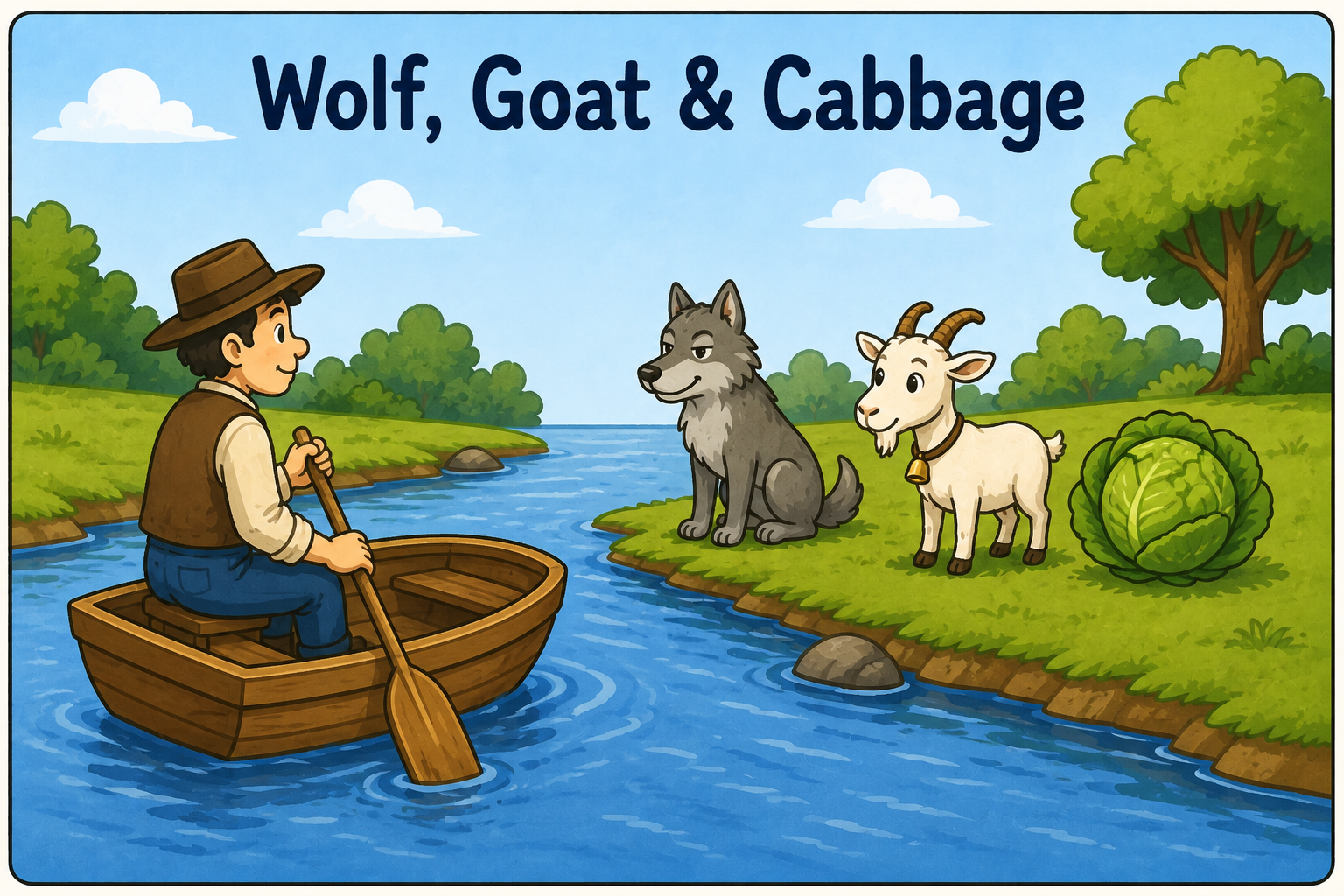
A farmer must cross a river with a wolf, a goat, and a head of cabbage, using a boat that holds only the farmer and one other item at a time. If left alone together without the farmer, the wolf will eat the goat, and the goat will eat the cabbage.
Rules
- The boat carries the farmer plus one item
- The wolf and goat can't be left alone
- The goat and cabbage can't be left alone
Your task — Find a sequence of crossings that gets the farmer, wolf, goat, and cabbage across safely.
Difficulty — Medium
Hint 1 — The goat is the real problem.
Hint 2 — Bring the goat over, then come back.
Hint 3 — Swap the goat back on one trip.
Main idea — The goat is the only item dangerous to both of its neighbors, so the trick is to briefly bring it back across the river at just the right moment, undoing what looks like a wasted step.
Solution
- The farmer takes the goat across first, leaving the wolf and cabbage safely together on the near side.
- The farmer returns alone, then takes the wolf across, but brings the goat back with him to the near side.
- The farmer leaves the goat on the near side and takes the cabbage across, joining the wolf and cabbage safely on the far side.
- The farmer returns alone one last time and brings the goat across, completing the crossing.
Reasoning
The goat is the only item that threatens one neighbor and is threatened by the other, so it must be shuttled back and forth to keep it separated from whichever dangerous pairing would otherwise form.
This apparent backtrack, bringing the goat back across after already moving it, is not wasted effort but the one move that breaks the puzzle's central constraint, which is why puzzles like this reward reconsidering the assumption that every crossing should make forward progress.
5. Measuring Water Without Standard Tools
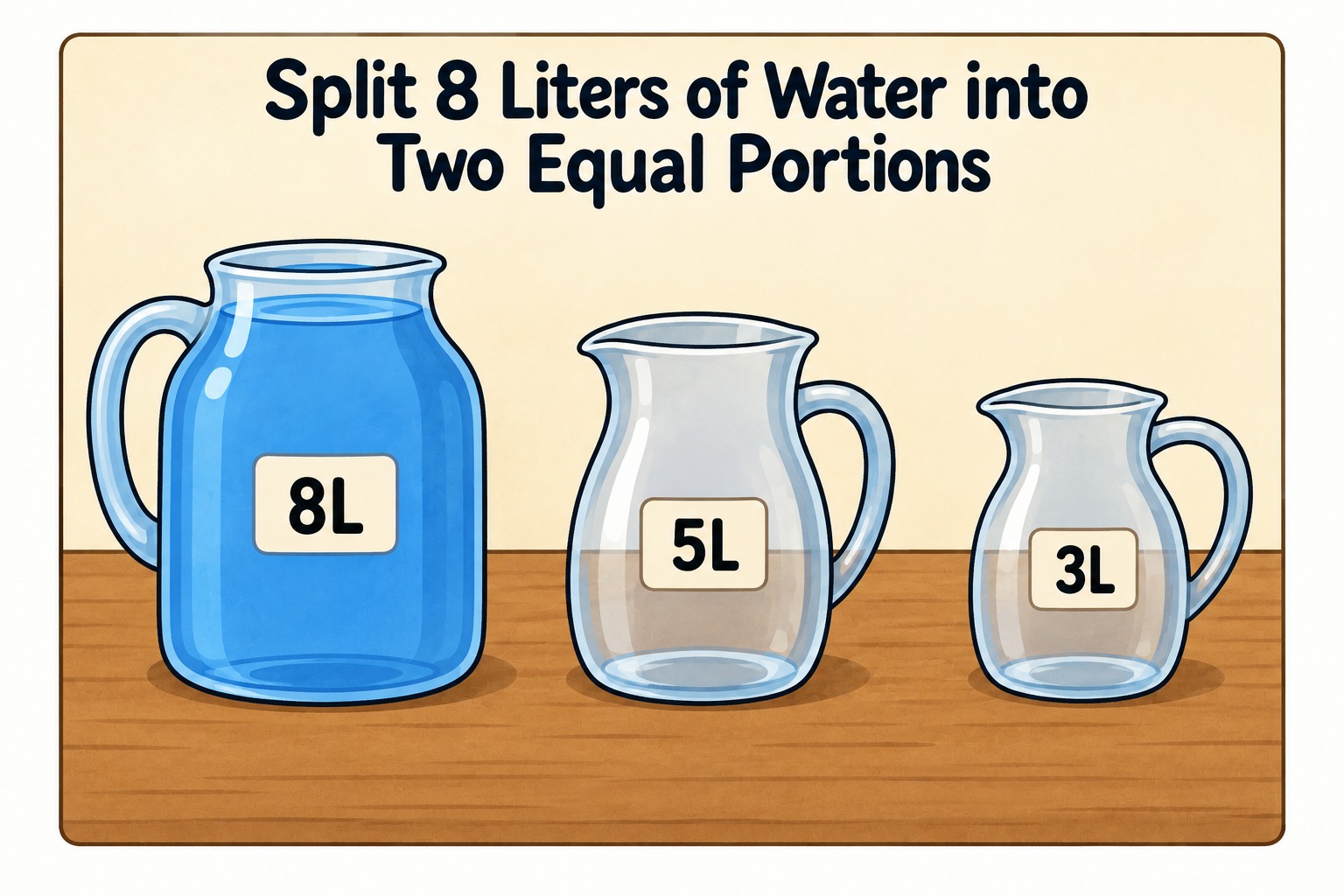
You have an 8-liter jug completely full of water, and two empty jugs that hold 5 liters and 3 liters, none of them marked with any measurements. You want to split the water into two equal portions of 4 liters each, using only these three jugs and no other tools.
Rules
- Jugs hold exactly 8, 5, and 3 liters
- No jug has any measurement markings
- You may only pour between the three jugs
Your task — Find a sequence of pours that leaves exactly 4 liters in two of the three jugs.
Difficulty — Hard
Hint 1 — Track all three jugs at once.
Hint 2 — Use the smallest jug to fine-tune.
Hint 3 — Several pours happen before 4 appears.
Main idea — Because none of the jugs can measure 4 liters directly, reaching exactly 4 requires passing water through several intermediate, seemingly unhelpful amounts before the right combination appears.
Solution
- Pour the 8-liter jug into the 5-liter jug until full, leaving 3 liters in the 8-liter jug.
- Pour the 5-liter jug into the 3-liter jug until full, leaving 2 liters in the 5-liter jug.
- Empty the 3-liter jug into the 8-liter jug, now holding 6 liters, then pour the 2 liters from the 5-liter jug into the empty 3-liter jug.
- Fill the 5-liter jug completely from the 8-liter jug, leaving 1 liter in the 8-liter jug.
- Top off the 3-liter jug, which holds 2 liters, using the 5-liter jug; this takes exactly 1 liter, leaving exactly 4 liters in the 5-liter jug.
- Pour the 3 liters now filling the 3-liter jug back into the 8-liter jug, which already had 1 liter, leaving exactly 4 liters there as well.
Reasoning
Since none of the three jug sizes, 8, 5, and 3, can isolate 4 liters in a single pour, the solution has to pass through several intermediate amounts, 3, then 2, then 6, before a combination lines up exactly on 4.
Tracking the total amount of water at every step, always exactly 8 liters split across the three jugs, confirms each pour is valid and that the final state, 4 and 4 with the third jug empty, is reachable using only whole, deliberate transfers between the three fixed sizes.