Puzzles
Time, Clock & Calendar
These puzzles treat time as something with its own arithmetic: steady rates, repeating cycles, and remainders after division. The skill is translating an everyday clock or calendar question into the right rate or modular equation, rather than reasoning about it hour by hour.
1. Angle Between Clock Hands
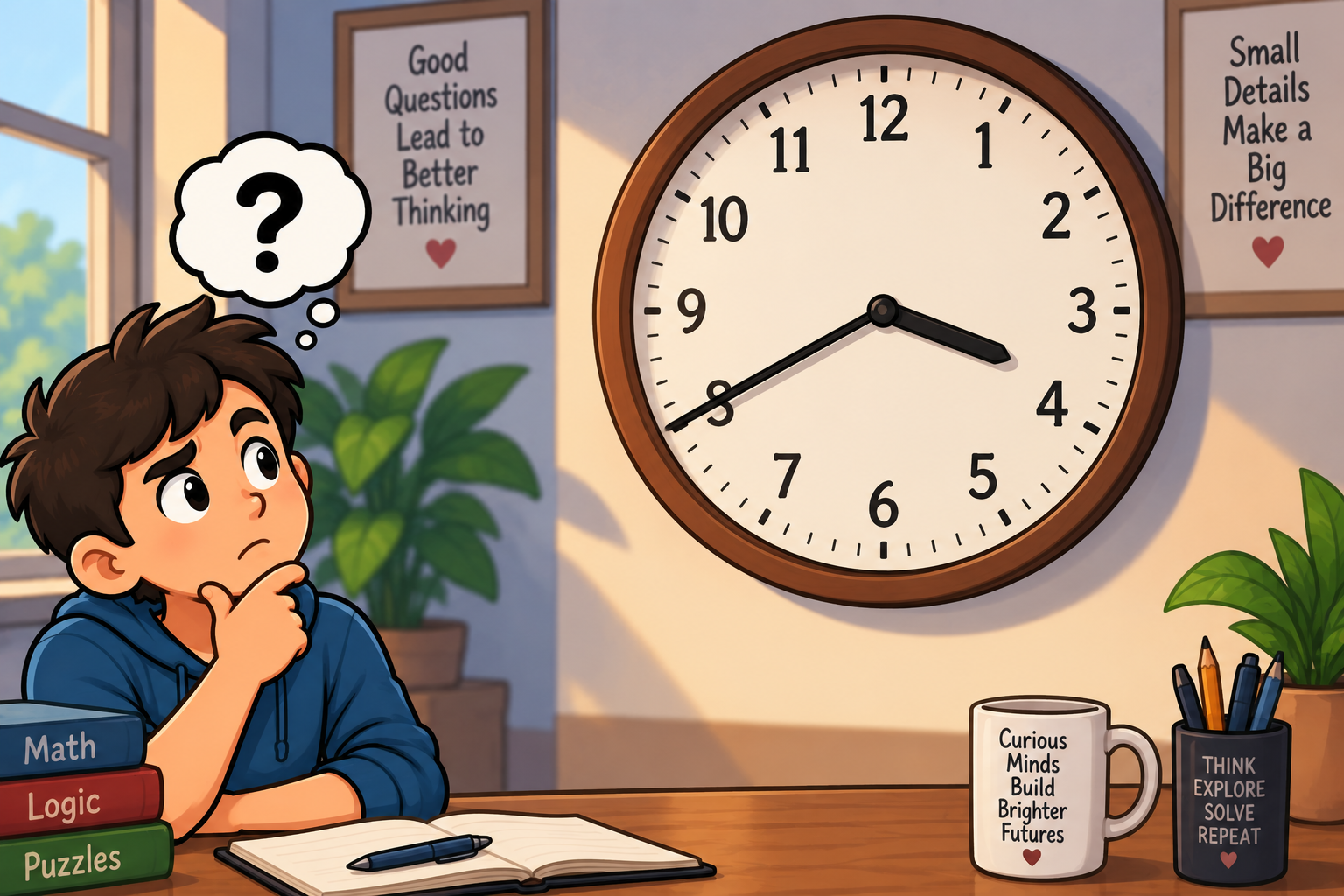
A clock shows the time 3:40.
Rules
- The hour hand moves gradually, not in jumps
- The minute hand moves 6 degrees per minute
- Measure the smaller of the two possible angles
Your task — Find the angle between the hour and minute hands at exactly 3:40.
Difficulty — Easy
Hint 1 — The hour hand moves between numbers too.
Hint 2 — Compute each hand's own angle.
Hint 3 — Subtract, then check it's under 180.
Main idea — Both hands have their own steady angular speed measured from 12, and the angle between them is simply the difference between those two positions.
Solution
- The minute hand is at 40 minutes times 6 degrees per minute, which is 240 degrees.
- The hour hand is at 3 hours times 30 degrees, plus 40 minutes times half a degree per minute, which is 90 plus 20, or 110 degrees.
- The difference is 240 minus 110, which is 130 degrees, already under 180, so that's the answer.
Reasoning
The hour hand doesn't jump between numbers, it creeps steadily forward, covering 30 degrees every hour, or half a degree every minute.
Once each hand's exact position is calculated as an angle from 12, the difference between them gives the angle directly, taking the smaller of the two possible angles around the circle whenever the raw difference exceeds 180 degrees.
2. Clock Hands Overlap
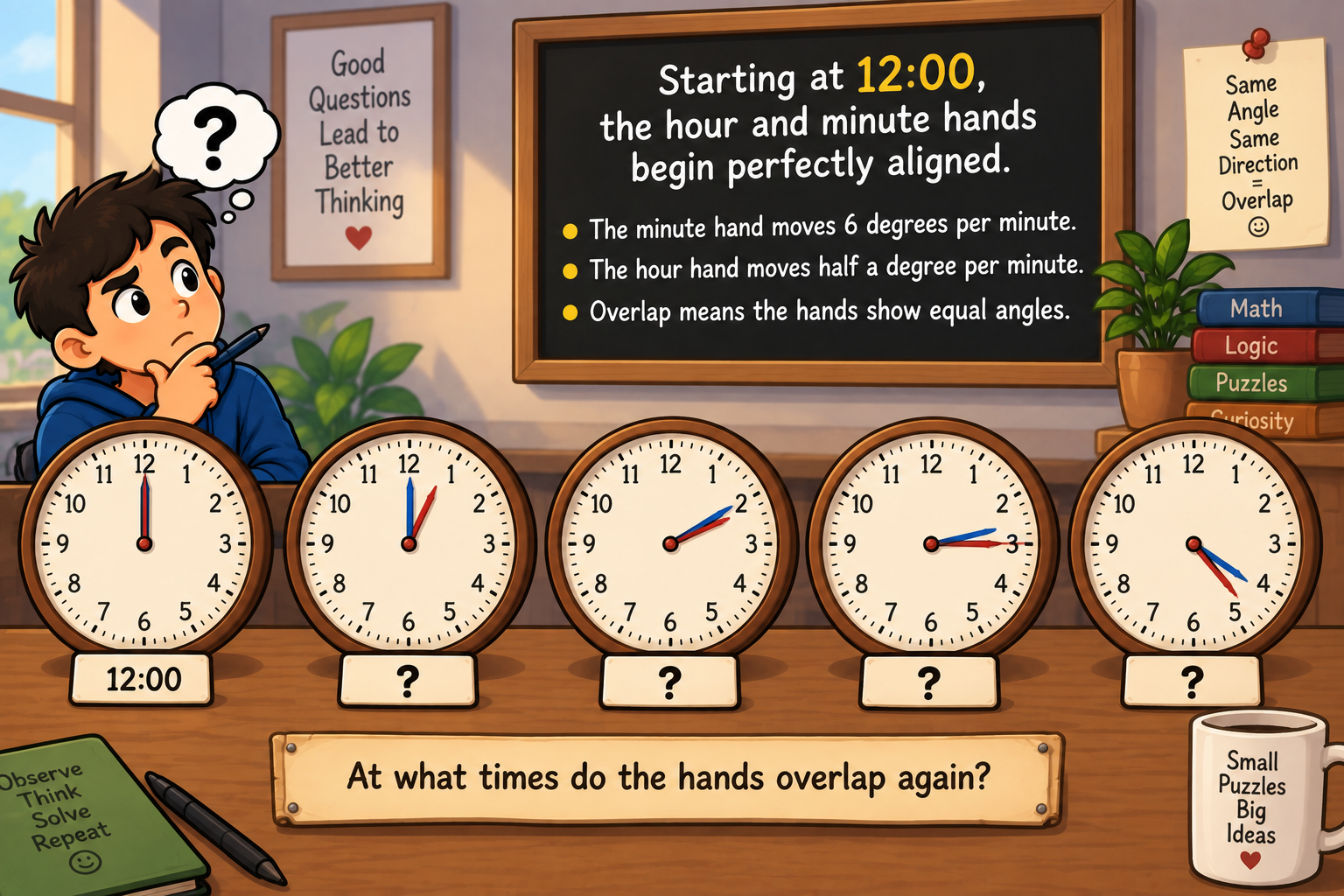
Starting at 12:00, the hour and minute hands begin perfectly aligned.
Rules
- The minute hand moves 6 degrees per minute
- The hour hand moves half a degree per minute
- Overlap means the hands show equal angles
Your task — Find how many minutes after 12:00 the hands next overlap exactly, and how often overlaps occur in 12 hours.
Difficulty — Medium
Hint 1 — The minute hand gains on the hour hand.
Hint 2 — Find their relative speed.
Hint 3 — Divide a full circle by that speed.
Main idea — Since the minute hand only gains ground on the hour hand at their difference in speed, the time between overlaps is simply a full circle divided by that relative speed.
Solution
- The minute hand gains on the hour hand at 6 minus 0.5, which is 5.5 degrees per minute.
- To lap the hour hand once, 360 degrees, the minute hand needs 360 divided by 5.5 minutes, about 65 and 5 elevenths minutes.
- Over a 12-hour period, this happens 11 times, since the minute hand only gains 11 full laps on the hour hand's much slower single lap.
Reasoning
The minute hand doesn't need a full new circle to catch the hour hand again, only to close the same 360-degree gap it just opened, which takes 360 divided by 5.5 minutes each time.
Because the minute hand gains only 11 full laps on the hour hand over 12 hours, not 12, the hands overlap exactly 11 times in that period, a common source of confusion in this puzzle.
3. Clock Hands Opposite
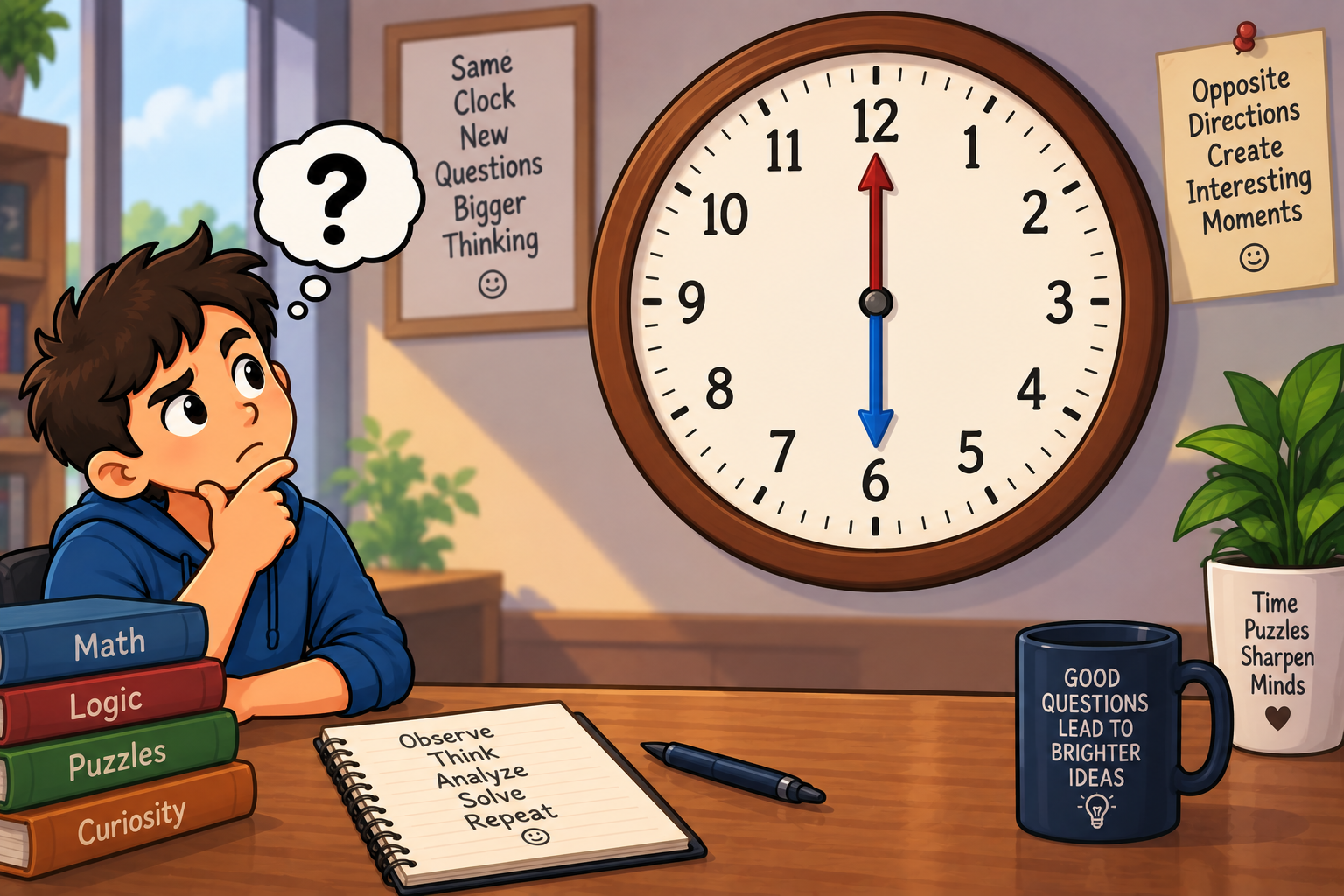
You want the times when the hour and minute hands point in exactly opposite directions, 180 degrees apart.
Rules
- Opposite means exactly 180 degrees apart
- Both hands move at their usual steady speeds
- Consider a full 12-hour period
Your task — Find how many minutes after 12:00 the hands are first exactly opposite, and how many times this happens in 12 hours.
Difficulty — Medium
Hint 1 — Same relative speed idea as overlap.
Hint 2 — This time the target gap is 180.
Hint 3 — Solve for when the gap returns to 180.
Main idea — Being opposite is just a fixed 180-degree gap rather than a zero gap, so the same relative-speed reasoning used for overlaps applies here with a different target.
Solution
- At 12:00 the gap between the hands is 0 degrees, and it needs to grow to 180 degrees.
- Since the minute hand gains on the hour hand at 5.5 degrees per minute, reaching a 180-degree gap takes 180 divided by 5.5 minutes, about 32 and 8 elevenths minutes after 12:00.
- After that, the gap returns to 180 degrees every 360 divided by 5.5 minutes, giving 11 opposite alignments in 12 hours.
Reasoning
The gap between the hands grows steadily at the same 5.5 degrees per minute relative speed used in the overlap puzzle, so reaching any target gap is just that target divided by the relative speed.
Because the gap cycles through every value once every 360 divided by 5.5 minutes, opposite alignments occur exactly as often as overlaps, 11 times every 12 hours.
4. The Broken Clock Puzzle
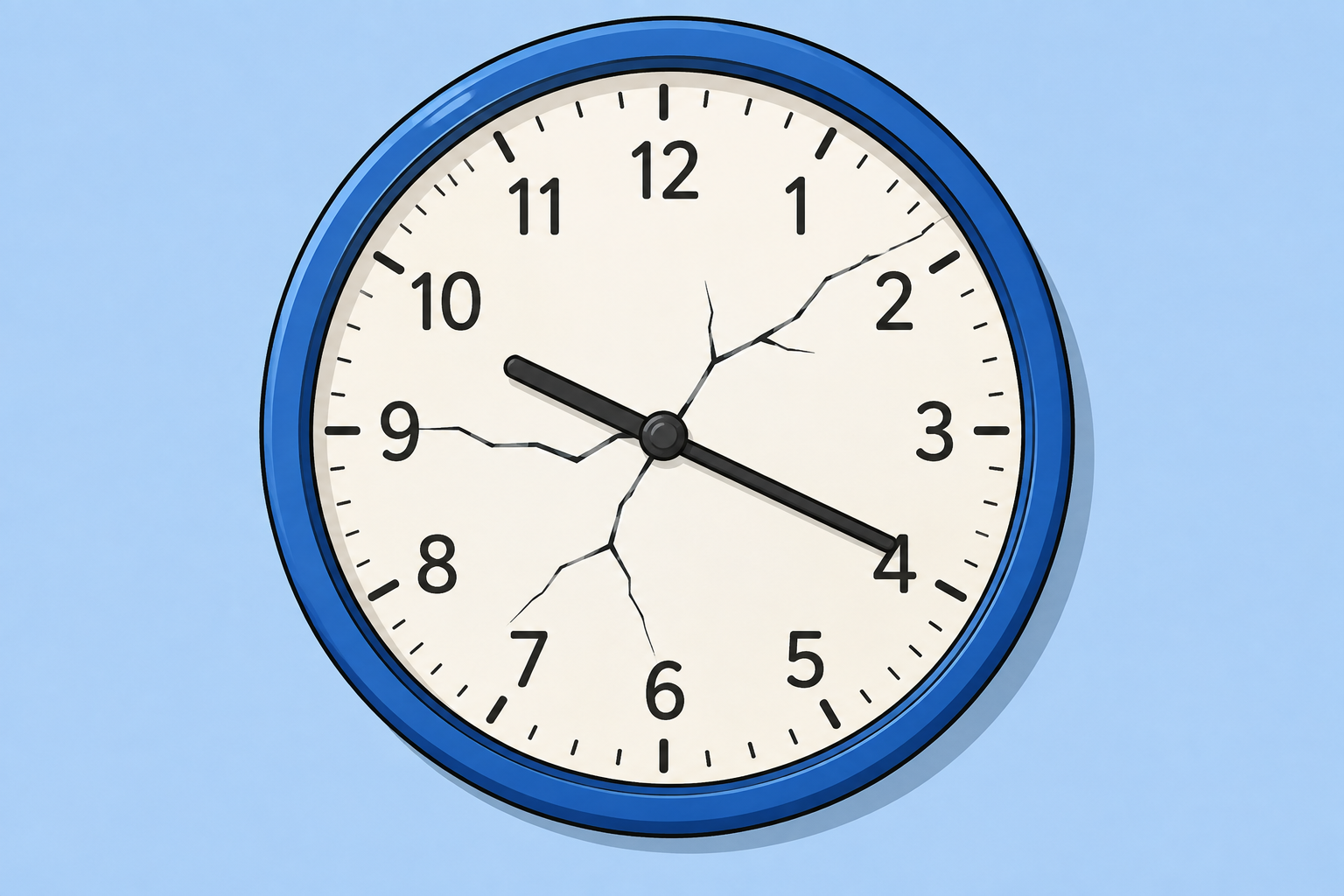
A clock is found stopped, showing 3:15. You know the clock stopped exactly 50 hours before the current real time.
Rules
- The clock stopped and stayed fixed
- It stopped exactly 50 hours ago
- Clocks repeat every 12 hours
Your task — Find the current real time.
Difficulty — Easy
Hint 1 — 50 hours is more than 2 days.
Hint 2 — Break it into full 12-hour cycles.
Hint 3 — Add only the leftover hours.
Main idea — Since a 12-hour clock face repeats every 12 hours, only the remainder after dividing the elapsed time by 12 actually changes what the clock would show.
Solution
- Divide 50 hours by 12, giving 4 full cycles, 48 hours, with a remainder of 2 hours.
- The stopped clock showed 3:15, so adding just the 2 leftover hours gives 5:15.
- The current real time is 5:15, on whichever day is 50 real hours after the clock stopped.
Reasoning
Full 12-hour cycles bring the clock's hands back to exactly the same position, so they contribute nothing to the final displayed time, only to how many days have passed.
Reducing 50 hours to its remainder after dividing by 12 isolates the only part that actually shifts the hands, making the arithmetic far simpler than tracking all 50 hours directly.
5. Two Clocks Showing Different Times
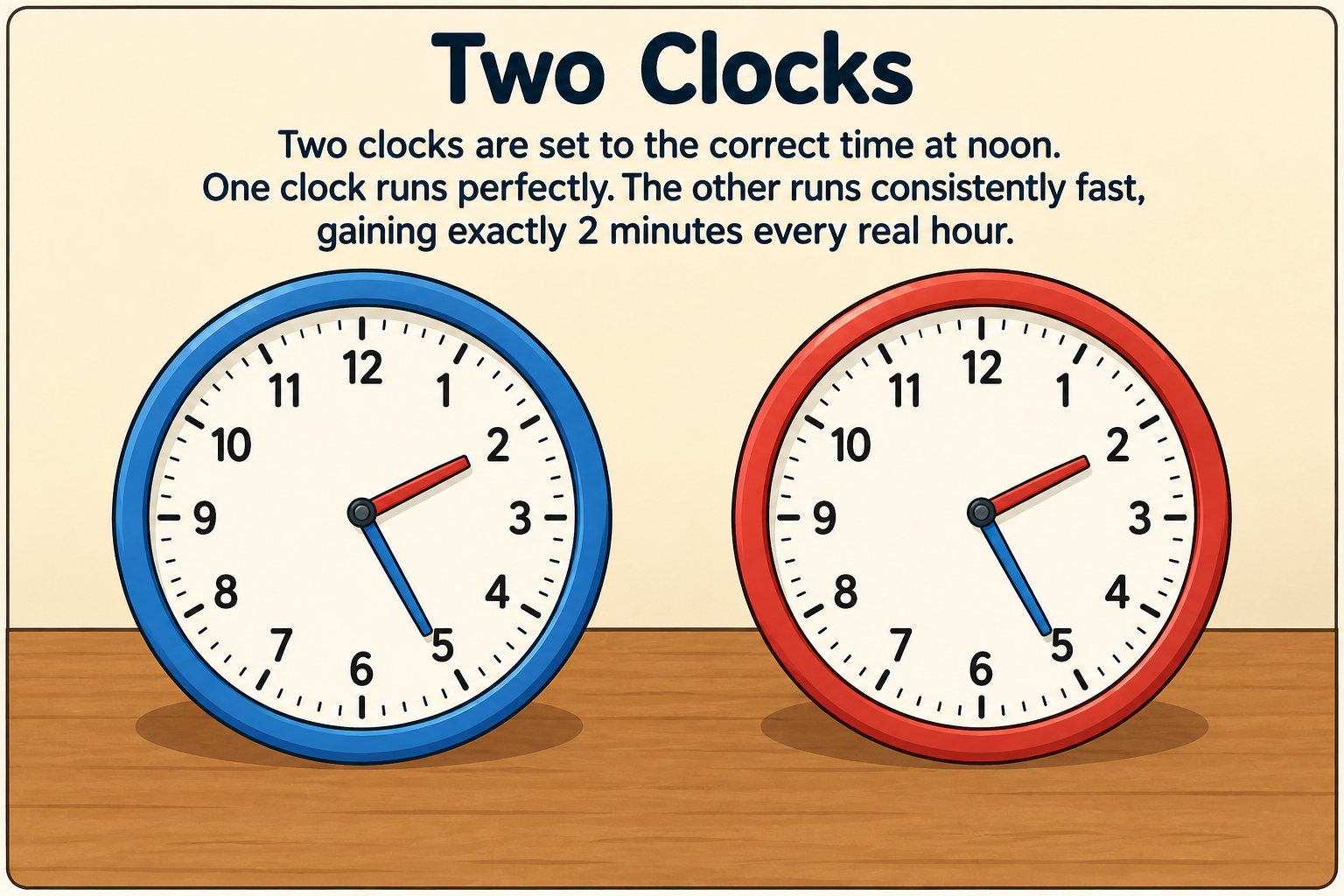
Two clocks are set to the correct time at noon. One clock runs perfectly. The other runs consistently fast, gaining exactly 2 minutes every real hour.
Rules
- Both clocks start correct at noon
- One clock gains 2 minutes every hour
- Both are otherwise normal 12-hour clocks
Your task — Find how many real hours must pass before the fast clock shows a time exactly 1 hour ahead of the correct time.
Difficulty — Medium
Hint 1 — It gains 2 minutes per real hour.
Hint 2 — You need a 60-minute gap.
Hint 3 — Divide the gap by the gain rate.
Main idea — Since the gap between the two clocks grows at a fixed rate of 2 minutes per real hour, finding when it first reaches 60 minutes is simply a division problem.
Solution
- The fast clock gains 2 minutes of error for every real hour that passes.
- To reach a full 60-minute gap, divide 60 by 2, giving 30.
- After 30 real hours, the fast clock will show a time exactly 1 hour ahead of the correct time.
Reasoning
Because the fast clock's error accumulates at a constant, predictable rate, the total gap after any number of hours is just that rate multiplied by elapsed time, making the reverse calculation a simple division.
This same reasoning of constant-rate accumulation applies to any two clocks running at different but steady speeds.
6. Day of the Week
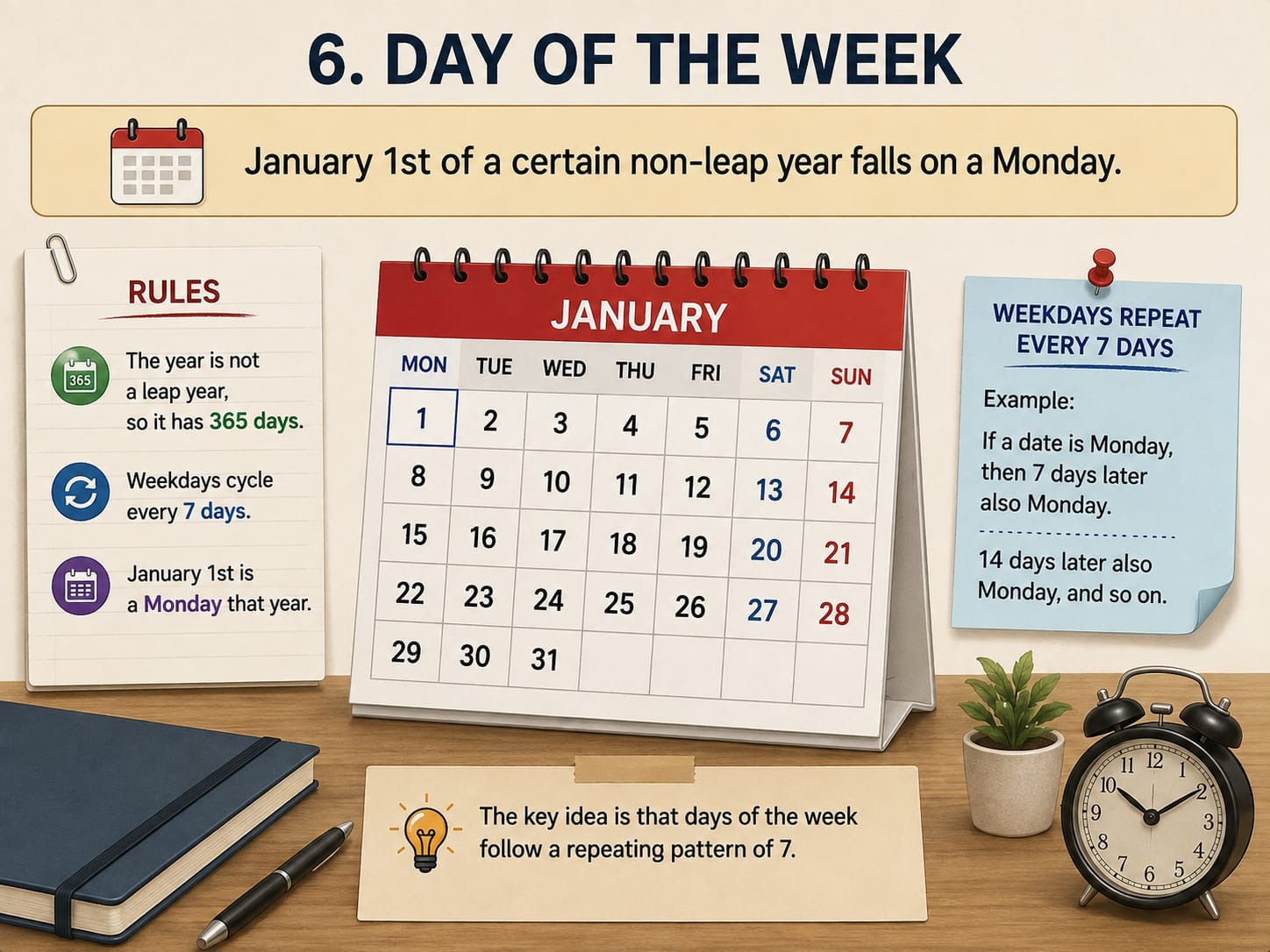
January 1st of a certain non-leap year falls on a Monday.
Rules
- The year is not a leap year, so it has 365 days
- Weekdays cycle every 7 days
- January 1st is a Monday that year
Your task — Find what day of the week December 31st of that same year falls on.
Difficulty — Medium
Hint 1 — 365 days, cycle of 7.
Hint 2 — Find the remainder after dividing.
Hint 3 — Shift Monday forward by that remainder.
Main idea — Since weekdays repeat every 7 days, only the remainder of the total day count after dividing by 7 actually shifts the weekday, no matter how many days have passed.
Solution
- From January 1st to December 31st is 364 days later, since January 1st itself is day 1 of the 365-day year.
- Dividing 364 by 7 gives exactly 52 with no remainder.
- Since the remainder is 0, December 31st falls on exactly the same day of the week as January 1st: Monday.
Reasoning
A remainder of 0 after dividing by 7 means the elapsed time is an exact whole number of weeks, so the weekday cycles all the way around and lands back on its starting point.
This is why a standard, non-leap 365-day year always begins and ends on the same day of the week, a direct consequence of 364 being a multiple of 7.
7. The Meeting Trains Puzzle
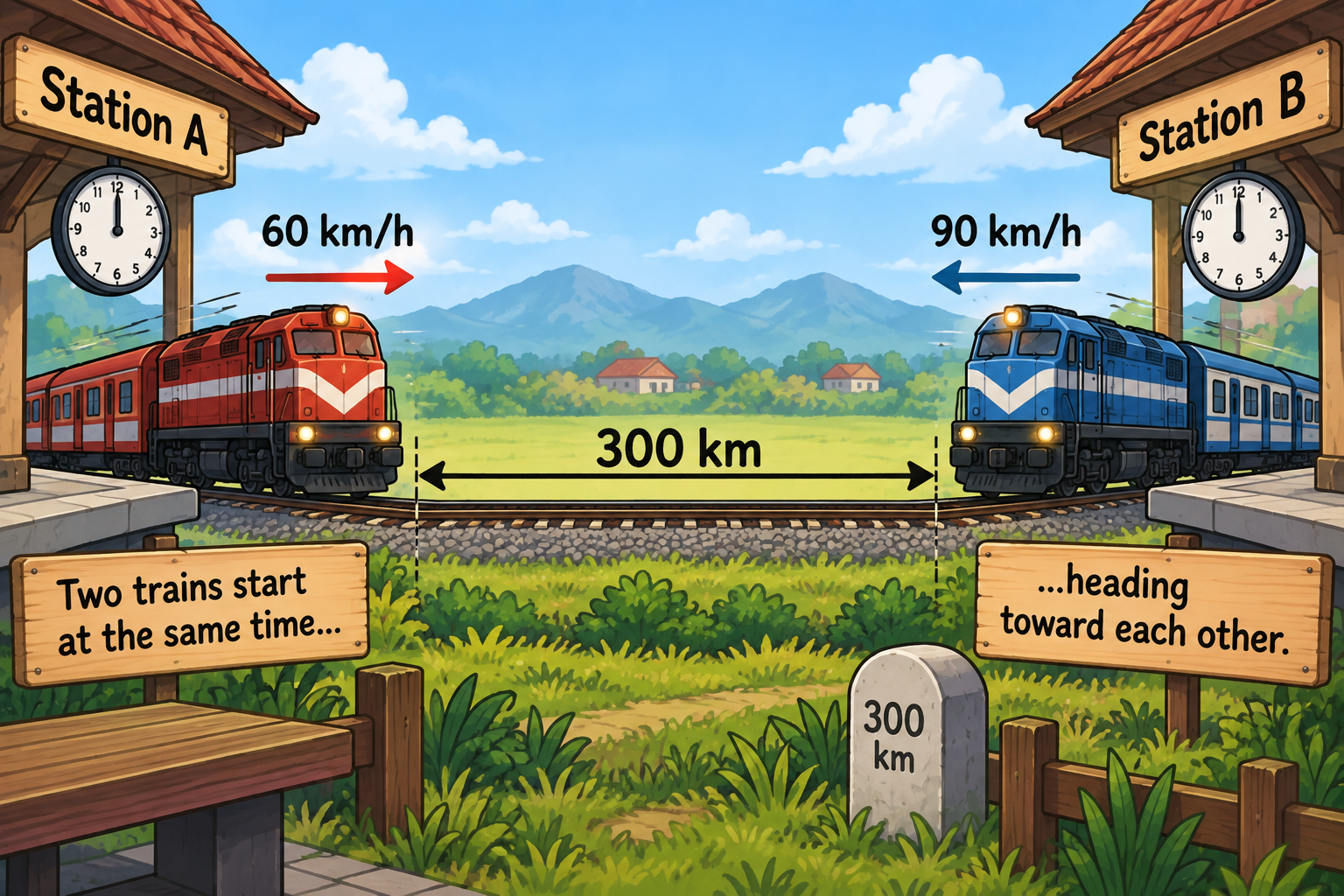
Two trains start at the same time from two stations 300 kilometers apart, heading toward each other. One train travels at 60 kilometers per hour, and the other at 90 kilometers per hour.
Rules
- Trains start together, heading toward each other
- Speeds are 60 and 90 kilometers per hour
- The stations are 300 kilometers apart
Your task — Find how long after departure the two trains meet.
Difficulty — Easy
Hint 1 — Combine their speeds.
Hint 2 — Distance divided by combined speed.
Hint 3 — That gives the meeting time directly.
Main idea — Since the trains are closing the distance between them together, their combined speed determines how quickly the gap disappears, without tracking each train separately.
Solution
- Add the two speeds together: 60 plus 90, which is 150 kilometers per hour of combined closing speed.
- Divide the total distance by this combined speed: 300 divided by 150, which is 2.
- The two trains meet exactly 2 hours after departure.
Reasoning
When two objects move toward each other, the gap between them shrinks at the sum of their individual speeds, since both are closing the same distance simultaneously.
Dividing the starting distance by this combined rate gives the exact time until the gap reaches zero, without needing either train's position along the way.
8. The Hourglass Timing Puzzle
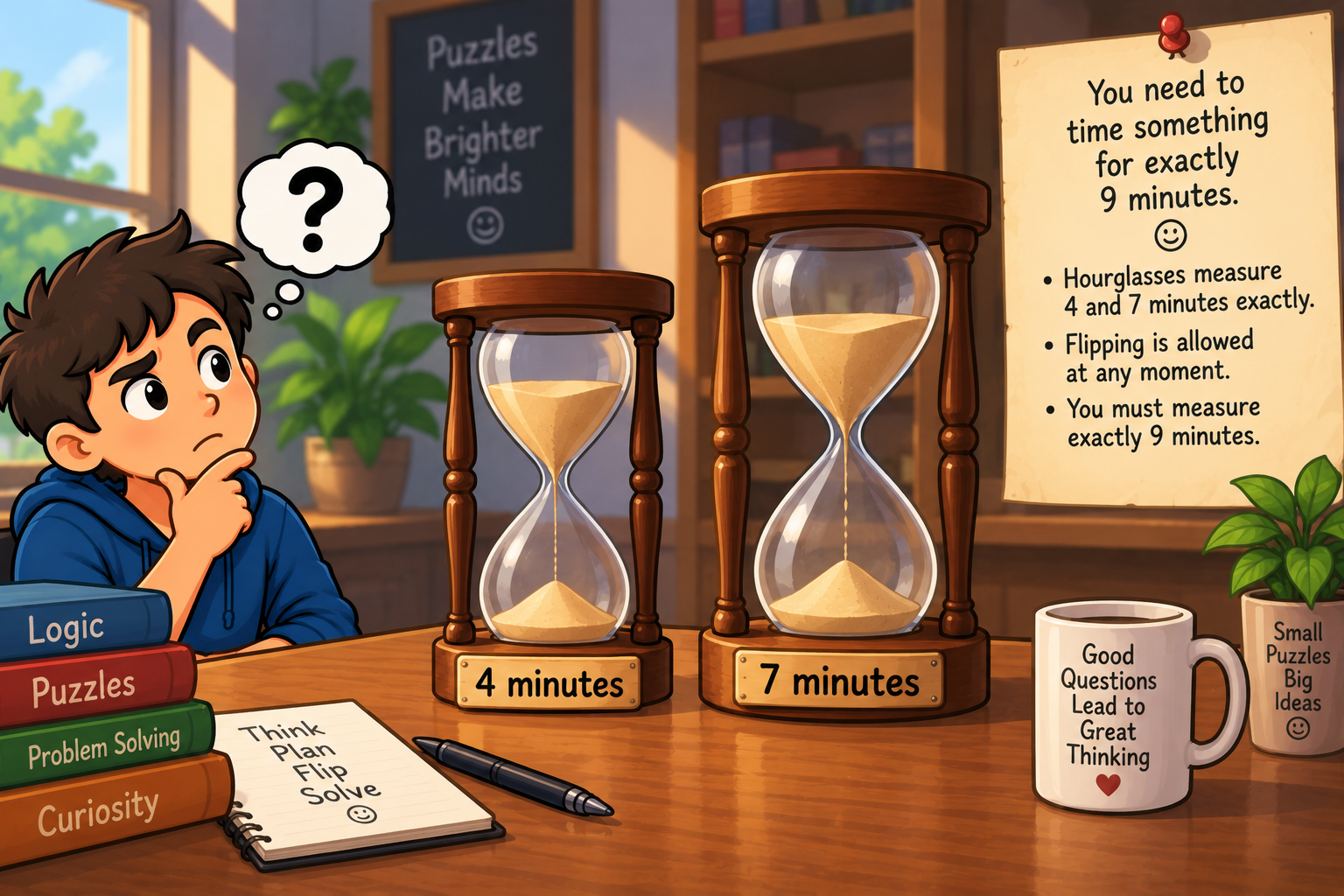
You have two hourglasses, one that measures exactly 4 minutes and another that measures exactly 7 minutes. You need to time something for exactly 9 minutes.
Rules
- Hourglasses measure 4 and 7 minutes exactly
- Flipping is allowed at any moment
- You must measure exactly 9 minutes
Your task — Find a sequence of flips using both hourglasses that measures exactly 9 minutes.
Difficulty — Hard
Hint 1 — Start both together.
Hint 2 — Flip glasses the moment they empty.
Hint 3 — A mid-run flip saves only leftover sand.
Main idea — Flipping an hourglass partway through a run doesn't reset it to a full measure, it only preserves whatever sand is left, which lets you carve out small, precise leftover intervals.
Solution
- Start both hourglasses together at minute 0.
- When the 4-minute hourglass empties at minute 4, flip it immediately to start a second run.
- When the 7-minute hourglass empties at minute 7, let the 4-minute hourglass's second run continue undisturbed.
- When the 4-minute hourglass's second run ends at minute 8, flip the 7-minute hourglass, which has been running its second cycle for exactly 1 minute; only that 1 minute of sand needs to fall again, finishing exactly at minute 9.
Reasoning
Flipping the 7-minute hourglass at minute 8, one minute into its second run, catches only the small amount of sand that had already fallen in that one minute, and turning it over sends just that 1 minute back through, ending exactly at minute 9.
The earlier steps exist purely to create that precise 1-minute marker at minute 8, since 8 minus 7 is exactly 1, showing how combining two run lengths through careful flip timing produces intervals neither hourglass measures alone.